LONDON: Prime Minister Boris Johnson cleared the way Thursday for a long-awaited parliamentary report into alleged Russian interference in British politics to be published “as soon as possible.”
A government spokesman said parliament’s intelligence and security committee (ISC) will be re-formed next week, and will then be free to publish its findings into concerns about disinformation and meddling in the 2016 Brexit vote.
The committee finished the 50-page report in March last year and the report was cleared by the intelligence agencies in October.
But Johnson failed to authorize its publication before the committee was disbanded ahead of the December general election, and it was then delayed until the committee was restored.
The nominations for the new committee members are expected to be published later Thursday and put to a vote by lawmakers next Monday and Tuesday. The new members will then elect their own chairman.
Committee members have to be approved by the PM.
Johnson’s spokesman said publication of the Russia report “will be a matter for the new committee but we would encourage them to publish it as soon as possible.”
The ISC launched the investigation in November 2017, in response to concerns about attempts by Russia to influence the 2016 US presidential election and fears of meddling in Britain’s referendum vote the same year to leave the European Union.
Then prime minister Theresa May had accused Russia of “planting fake stories” to “sow discord in the West and undermine our institutions.”
The 2018 poisoning of former Russian double agent Sergei Skripal and his daughter Yulia in the English town of Salisbury, which London and its Western allies blamed on Moscow, only added to the ISC’s concerns.
Former ISC chairman Dominic Grieve had accused Johnson of deliberately delaying the report until after the election — something Downing Street denies.
Politicians in the main opposition Labour party have alleged the report could contain evidence of links between Johnson’s Conservative party and Russian billionaires.


![]()


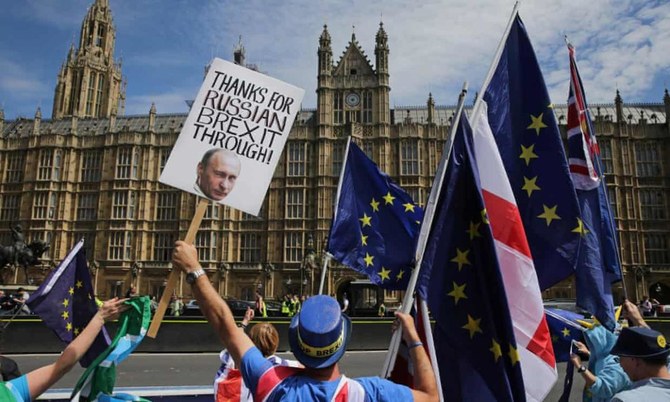
UK PM Boris Johnson clears way for Brexit ‘Russian meddling’ report
Short Url
https://arab.news/2b7q7
UK PM Boris Johnson clears way for Brexit ‘Russian meddling’ report
- The committee finished the 50-page report in March last year
- Report was cleared by intelligence agencies in October


US NATO envoy says allies must ‘pull weight’ after Czech defense cut
PRAGUE, March 12 : The United States’ ambassador to NATO said on Thursday that all allies must “pull their weight,” after Czech lawmakers approved a 2026 budget that cuts defense outlays.
Czech Prime Minister Andrej Babis’ government, in power since December, pushed a revamped budget through the lower house on Wednesday evening which cut the defense ministry’s allocation versus a previous proposal to 154.8 billion crowns ($7.31 billion), or 1.73 percent of gross domestic product.
That is below a NATO target of 2 percent of GDP already expected before alliance members pledged last year in the Hague to raise defense spending to 3.5 percent of GDP plus 1.5 percent on other defense-relevant investments over the next decade.
The Czech Finance Ministry says total defense spending in the budget will reach 2.07 percent of GDP, but the country’s budget watchdog has warned that includes money earmarked elsewhere, like for the transport ministry for road projects, that may not be recognized by NATO.
“All Allies must pull their weight and honor The Hague Defense Commitment,” US Ambassador to NATO Matthew Whitaker said on X on Thursday with a picture of a news headline on the Czech budget approval.
“These numbers are not arbitrary. They are about meeting the moment — and the moment requires 5 percent as the standard. No excuses, no opt-outs.”
European NATO countries are under pressure to raise defense spending amid the Ukraine-Russia war and at US President Donald Trump’s urging.
Babis, whose populist ANO party won elections last year, said in February the country was “certainly not” on the path to raising core defense spending to the 3.5 percent target, saying there was a different focus, like on health care.
The budget watchdog on Thursday reiterated “strong doubts” that some spending deemed defense in this year’s budget would meet NATO’s definition.
President Petr Pavel, a former NATO official, has also said defense cuts risked a loss of trust from allies — but has signalled he would not veto the budget.
US Ambassador to Prague Nicholas Merrick said last week the Czech Republic may slip to the bottom of NATO’s defense-spending ranks.
Czech Prime Minister Andrej Babis’ government, in power since December, pushed a revamped budget through the lower house on Wednesday evening which cut the defense ministry’s allocation versus a previous proposal to 154.8 billion crowns ($7.31 billion), or 1.73 percent of gross domestic product.
That is below a NATO target of 2 percent of GDP already expected before alliance members pledged last year in the Hague to raise defense spending to 3.5 percent of GDP plus 1.5 percent on other defense-relevant investments over the next decade.
The Czech Finance Ministry says total defense spending in the budget will reach 2.07 percent of GDP, but the country’s budget watchdog has warned that includes money earmarked elsewhere, like for the transport ministry for road projects, that may not be recognized by NATO.
“All Allies must pull their weight and honor The Hague Defense Commitment,” US Ambassador to NATO Matthew Whitaker said on X on Thursday with a picture of a news headline on the Czech budget approval.
“These numbers are not arbitrary. They are about meeting the moment — and the moment requires 5 percent as the standard. No excuses, no opt-outs.”
European NATO countries are under pressure to raise defense spending amid the Ukraine-Russia war and at US President Donald Trump’s urging.
Babis, whose populist ANO party won elections last year, said in February the country was “certainly not” on the path to raising core defense spending to the 3.5 percent target, saying there was a different focus, like on health care.
The budget watchdog on Thursday reiterated “strong doubts” that some spending deemed defense in this year’s budget would meet NATO’s definition.
President Petr Pavel, a former NATO official, has also said defense cuts risked a loss of trust from allies — but has signalled he would not veto the budget.
US Ambassador to Prague Nicholas Merrick said last week the Czech Republic may slip to the bottom of NATO’s defense-spending ranks.
Latest updates


© 2026 SAUDI RESEARCH & PUBLISHING COMPANY, All Rights Reserved And subject to Terms of Use Agreement.