A closed chapter: Afghan refugees face an uphill task getting education in Karachi

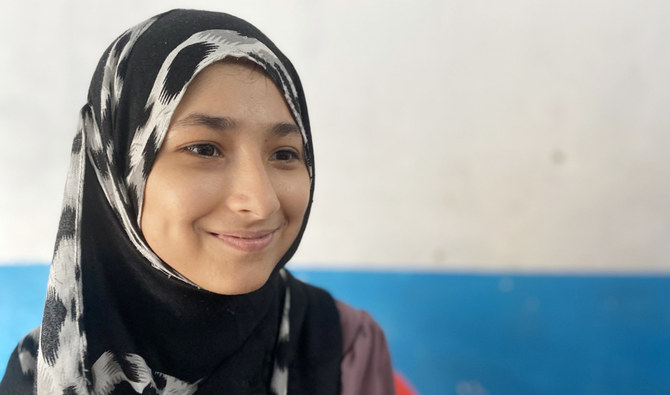
Asma Rahimi, a 14-year-old Afghan refugee, during the interview with Arab News on Wednesday. (AN photo)
Short Url
Updated 03 August 2020
Follow

A closed chapter: Afghan refugees face an uphill task getting education in Karachi

  • Education is a provincial matter, and admission rules differ across Pakistan

KARACHI: When an Afghan refugee boy was one of the top matriculation exam scorers in Mardan, in Khyber Pakhtunkhwa province, last month, Asma Rahimi says she was happy for him, but that the feeling was bittersweet.
It’s because she, too, is a child of Afghan refugees and knows well that she will not be able to complete secondary education in Karachi, where she lives.
“I won’t be able to study further,” the eighth grader told Arab News. “This will be my last year.” Education is a provincial matter, and admission rules differ across Pakistan.
While in Khyber Pakhtunkhwa and Balochistan, which host most of the 1.4 million registered Afghan refugees, children face no legal obstacles in continuing education, in Karachi they have no chance of completing secondary school.
Rahimi’s family moved to Pakistan three decades ago, fleeing armed conflict in Afghanistan’s Kunduz province, which is now dominated by the Taliban. 
Her sister studies at Syed Jamaluddin Afghani School, a school for refugees in Karachi’s Al-Asif area, which is registered with the Afghan Ministry of Education and offers tuition up to grade 12. Its certification, however, is not recognized by Pakistan.
“If anyone wants to study further, he or she will have to go to Afghanistan,” Syed Mustafa, the principal of the school, said. 
Faced with this situation, Mustafa said, many parents have no other option but to send their kids to religious seminaries for any kind of education.
Rahimi, however, wants to go to university and become a psychologist. Instead of joining the refugee school, she enrolled in Alama Iqbal Public School in Karachi, only to realize that despite a lack of official restrictions, a ban is effectively in place that prevents her from studying beyond grade eight.
In 2012, the Board of Secondary Education in Karachi (BSEK), which is the authority responsible for the registration of private and government schools in the city, made it mandatory for ninth grade students to possess a Child Registration Certificate, commonly referred to as Form-B, which serves as an identity document for those who are below the age of 18. Refugee children cannot obtain it.

FASTFACT

They are unable to obtain the critical document for admission to secondary school.

According to Prof. Saeeduddin, the chairman of the BSEK, the decision was made at the request of the provincial government. He said that without it, immigrants would be able to get Pakistani nationality based on educational credentials. 
“If an immigrant does his exams, he could then say that since he has done his exams from Karachi, he should be granted nationality,” Saeeduddin said. 
However, Muhammad Riazuddin, the secretary at the Universities and Boards Department Sindh, said that in the province no regulation barred refugees from studying.
He said Sindh is an inclusive province and “strongly believes in children’s right to education, which is enshrined not only in the UN charters but also in the constitution of Pakistan.”
“The National Alien Registration Authority (NARA) cards give legal immigrants the right to have electricity, gas and water connections, as well as to obtain an education,” he said, adding that the same applies for Afghan refugees who have Proof of Registration (PoR) cards.
While there are no provincial restrictions, those in place in Karachi effectively prevent Afghan children in Sindh from studying because most of the province’s 60,000 Afghan refugee population lives in the city. 
“We are not allowed to get an education. I cannot study here,” Zahra Arif, a seventh-grader at Syed Jamaluddin Afghani School, said. 
“I want to become an engineer. I will make houses for the poor,” she said, adding that she was born in Pakistan and has never visited her native country.
Unlike her, Rahimi has been to Afghanistan and spent three months there. “Our uncle asked us to stay, but there was no school or college, and everyone was illiterate, so my father took us back as he wants us to study, to change our society,” she said.  “I want to study; I want to become something in life.” 


Ramadan tests Pakistan’s daily wage workers but faith endures

Updated 13 sec ago
Follow

Ramadan tests Pakistan’s daily wage workers but faith endures

  • Reduced work hours during fasting month cut already fragile incomes
  • Charities, local businesses step in as laborers try to support families back home

ISLAMABAD: Abdul Waqif grips a worn-out shovel and digs into the earth beneath the harsh midday sun, his body bent with age but still moving steadily.

Moments later, the 70-year-old hoists a heavy bag of cement onto his shoulders and carries it toward an under-construction house, all while fasting.

For Waqif and thousands of daily wage laborers across Pakistan, Ramadan is not just a month of spiritual devotion. It is also a month of shrinking incomes.

Waqif migrated from Mohmand tribal district in northwestern Pakistan to Islamabad two decades ago in search of work.

Like many laborers from rural and former tribal areas, he left behind limited local opportunities to earn a living in larger cities such as Islamabad, Lahore and Karachi.

In Pakistan, daily wage workers, particularly in construction and manual labor, are among the most economically vulnerable.

They are paid only for days worked, receive no job security or benefits, and often rely on informal arrangements. Any slowdown in economic activity directly affects their ability to feed their families.

Economic activity typically slows during Ramadan, when Muslims fast from dawn to sunset. Employers often reduce work hours or postpone physically demanding projects to ease the burden on fasting workers. While intended as a gesture of consideration, it means fewer working hours and fewer earnings.

For laborers such as Waqif, who earns between 1,000-1,200 rupees ($3.59-$4.31) a day, even a slight reduction in work can be devastating.

His suhoor, the pre-dawn meal before fasting begins, usually consists of a few chapatis from a nearby hotel. The hunger and thirst that follow him through the day are constant companions as he lifts bricks and mixes cement in the heat. But so is his faith.

“Allah gives me courage. I am hungry and thirsty, but I keep working,” Waqif said while wiping the sweat from his brow.

Back in Mohmand district, his wife, four daughters and two sons depend on the money he sends home. Every rupee matters.

“I support them with this work,” Waqif said. “I eat three meals a day here and I also have to save money for my children and send it to them.”

The reduction in work during Ramadan weighs heavily on him. “I don’t find much work in Ramadan, and I’m worried for my family,” Waqif said.

Finding food for suhoor is sometimes a challenge. On some mornings, someone offers him a piece of flatbread. Other times, he buys what little he can afford from a nearby eatery.

Muhammad Sajid, owner of Al-Hadi restaurant in Islamabad’s G-15 sector, says he tries to ease that burden by offering meals to laborers at half price.

“We don’t let anyone go hungry,” Sajid told Arab News. “We offer sehri and iftar as much as anyone can afford.”

The restaurant serves tea, yogurt, several types of curries and parathas.

Charity groups also expand operations during Ramadan, when community support traditionally increases. The Junaid Welfare Foundation runs a roadside dastarkhwan, or communal meal spread, serving hundreds daily.

Haq Rawan Shareefi, a manager at the foundation, said about 500 people are provided iftar meals each day. The cost of one person’s iftar is 200 rupees.

“That means, on iftar and sehri, our expenses range from 150,000 rupees to 200,000 rupees,” Shareefi said.

For Waqif, breaking his fast at sunset brings temporary relief from the physical strain of the day. But the financial uncertainty remains.

“I ask Allah for this,” he said. “May Allah give me strength to earn an honest living for my children.”