Italy puts pressure on Tunisia to control wave of migrants

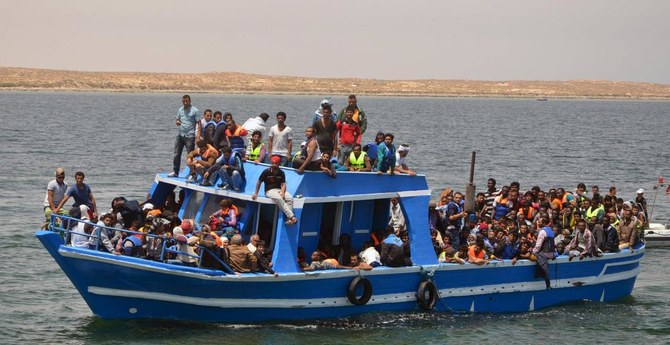
Illegal migrants are seen on a boat after being rescued by the Tunisian navy off the coast near Ben Guerdane, Tunisia. (Reuters/File Photo)
Short Url
Updated 01 August 2020
Follow

Italy puts pressure on Tunisia to control wave of migrants

  • Large numbers are creating problems for Italy's health system 

ROME: Italy is putting political pressure on Tunisia after a recent wave of migrants arrived on its southern shores and islands.

Italian authorities are struggling to manage migrant numbers on the island of Lampedusa, which is 100 miles from the Tunisian coast, transferring hundreds of migrants on ferries to the mainland daily.

They said the huge numbers arriving in packed dinghies and small boats across the channel of Sicily also carried a risk of COVID-19.

“We have at least 1,000 people every day staying there,” the mayor of Lampedusa Salvatore Martello told Arab News. “Those poor people live in terrible conditions, especially with the heatwave we had in the past few days.”

While in the past the main departure point from north Africa was Libya, most immigrants now reach Italy from Tunisia.

Italy’s Interior Minister Luciana Lamorgese, speaking to the Corriere della Sera newspaper, said the country now had “an uncontrolled flow” from Tunisia that was creating serious problems for the health system. It affected local communities living near hosting centers from where Tunisian migrants in particular tried to escape before the end of the mandatory quarantine period in place to contain the spread of coronavirus.

As of July 24, 5,237 out of the 11,191 migrants who landed in Italy in 2020 came from Tunisia, according to official data. They included nearly 4,000 Tunisian citizens.

“The difficult political situation in Tunisia has been encouraging people to flee from that country to reach Europe,” Marta Grande, chairman of the Foreign Committee of the Italian Chamber of Deputies, told Arab News. “Instability can boost emigration from that country and weaken controls by local authorities. It is a fact and we have to cope with that.”

Italian Foreign Minister Luigi Di Maio decided to postpone discussions on allocating funds of 6.5 million euros ($7.6 million) to Tunisia if it did not show a “real commitment” to preventing uncontrolled migratory flows.

"We are all perfectly conscious of the importance of cooperation for development toward some countries in order to prevent uncontrolled migratory flows, but in this phase we are asking Tunisia, a country which is considered as a ‘safe port’ for migrants, for clarification regarding an increase of arrivals to Italy,” Di Maio said in a press conference proposing an agreement on migrants to the Tunisian government. “It's good to have a 360-degree approach on the issue, it must be mainly focused on prevention of illegal emigration from that country. We must make sure that illegal migrants do not leave that country. Tunisia must increase patrols, especially in the area of ​​Sfax, from where most of the boats leave. Italy cannot afford a new wave of migrants. We cannot lower the guard.”

Regional authorities in Sicily blame migrants for the recent increase of COVID-19 infection cases on the island and a ferry is going to be deployed off the coast of Lampedusa in the next few days to hold migrants in quarantine before they reach the mainland.


Warmer seas, heavier rains drove Asia floods: scientists

Updated 3 sec ago
Follow

Warmer seas, heavier rains drove Asia floods: scientists

  • Warmer seas and heavier rains linked to climate change, along with Indonesia and Sri Lanka’s unique geographies and vulnerabilities, combined to produce deadly flooding that killed hundreds, scientist
BANGKOK:Warmer seas and heavier rains linked to climate change, along with Indonesia and Sri Lanka’s unique geographies and vulnerabilities, combined to produce deadly flooding that killed hundreds, scientists said Thursday.
Two tropical storms dumped massive amounts of rain on the countries last month, prompting landslides and flooding that killed more than 600 people in Sri Lanka and nearly 1,000 in Indonesia.
A rapid analysis of the two weather systems carried out by an international group of scientists found a confluence of factors drove the disaster.
They include heavier rainfall and warmer seas linked to climate change, as well as weather patterns such as La Nina and the Indian Ocean Dipole.
The research could not quantify the precise influence of climate change because models do not fully capture some of the seasonal and regional weather patterns, the scientists said.
Still, they found climate change has made heavy rain events in both regions more intense in recent decades, and that sea surface temperatures are also higher due to climate change.
Warmer oceans can strengthen weather systems and increase the amount of moisture in them.
“Climate change is at least one contributing driver of the observed increase in extreme rainfall,” said Mariam Zachariah, one of the study’s authors and a research associate at Imperial College London.
The analysis, known as an attribution study, uses peer-reviewed methodologies to assess how a warmer climate may impact different weather events.
The scientists found extreme rainfall events in the Malacca Strait region between Malaysia and Indonesia had “increased by an estimated 9-50 percent as a result of rising global temperatures,” said Zachariah.
“Over Sri Lanka, the trends are even stronger, with heavy rainfall events now about 28-160 percent more intense due to the warming we have already experienced,” she told reporters.
While the datasets “showed a wide range,” Zachariah added, “they all point in the same direction, that extreme rainfall events are becoming more intense in both study regions.”
The scientists said other factors were also at play, including deforestation and natural geography that channeled heavy rain into populated flood plains.
The two tropical storms coincided with the monsoon rains across much of Asia, which often brings some flooding.
But the scale of the disaster in the two countries is virtually unprecedented.
“Monsoon rains are normal in this part of the world,” said Sarah Kew, climate researcher at the Royal Netherlands Meteorological Institute, and study lead author.
“What is not normal is the growing intensity of these storms and how they are affecting millions of people and claiming hundreds of lives.”