

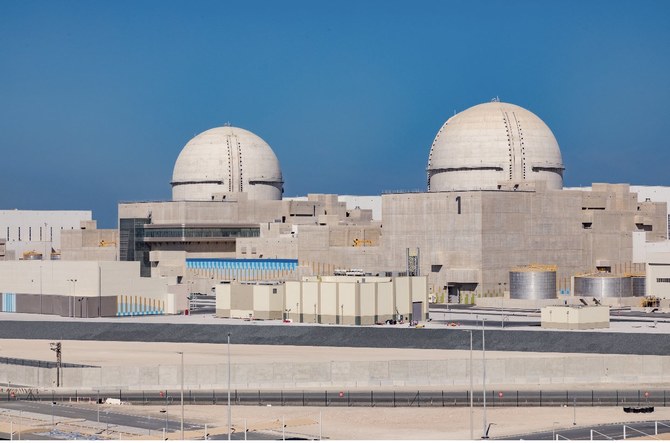
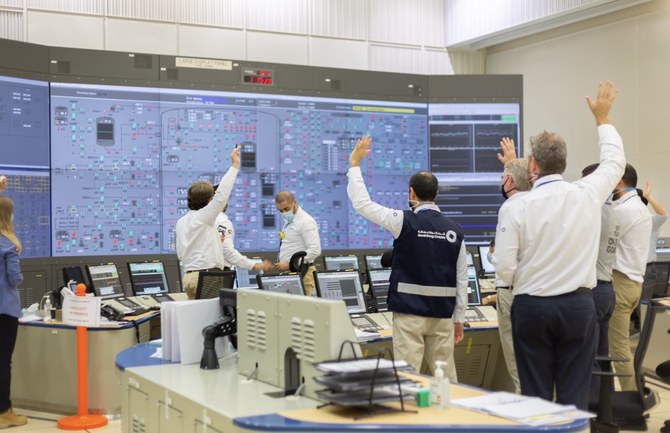

DUBAI: The UAE has successfully conducted start up operations at Barakah, the first nuclear plant in the Arab world.
Unit 1 of the Barakah Nuclear Energy Plant has been successfully started up by Nawah Energy Company, a subsidiary of Emirates Nuclear Energy Corporation, state news agency WAM said.
“The teams successfully loaded nuclear fuel and carried out comprehensive tests … I congratulate my brother Mohamed bin Zayed for this achievement,” Dubai Ruler Sheikh Mohammed bin Rashid Al-Maktoum earlier posted on Twitter.
نعلن اليوم عن نجاح دولة الإمارات في تشغيل أول مفاعل سلمي للطاقة النووية في العالم العربي، وذلك في محطات براكة للطاقة النووية بأبوظبي .. نجحت فرق العمل في تحميل حزم الوقود النووي واجراء اختبارات شاملة وإتمام عملية التشغيل بنجاح . أبارك لأخي محمد بن زايد هذا الانجاز .. pic.twitter.com/e8VHz4o6BY
— HH Sheikh Mohammed (@HHShkMohd) August 1, 2020
Firing up one of Baraka’s units “is the most historic milestone to date in the delivery of the UAE Peaceful Nuclear Energy Program, as part of the process towards generating clean electricity for the Nation for at least the next 60 years,” WAM reported.
The start-up of Unit 1 marks the first time that the reactor safely produces heat, which is used to create steam, turning a turbine to generate electricity, it added.
Unit 1 will be ready to connect to the UAE’s electricity grid, delivering the first megawatts of clean electricity to the homes and businesses, once numerous safety tests have been conducted.
“Today is a truly historic moment for the UAE. It is the culmination of more than a decade of vision, strategic planning and robust program management,” Mohamed Ibrahim Al-Hammadi, the CEO of ENEC, said.
“We are now another step closer to achieving our goal of supplying up to a quarter of our Nation’s electricity needs and powering its future growth with safe, reliable, and emissions-free electricity.”
The UAE is the first country in the Arab World, and the 33rd nation globally, to develop a nuclear energy plant to generate safe, clean, and reliable baseload electricity.
The Barakah plant is significantly contributing to the UAE’s efforts to move towards the electrification of its energy sector, and the decarbonization of electricity production.
When fully operational, the plant will produce 5.6 gigawatts of electricity while preventing the release of more than 21 million tons of carbon emissions every year, equivalent to the removal of 3.2 million cars from the UAE’s roads annually.
Egypt’s President Abdel Fattah El-Sisi congratulated Abu Dhabi’s Crown Prince Sheikh Mohamed bin Zayed Al-Nahyan on the successful launch of the Barakah Nuclear Energy Plant, WAM reported.
Meanwhile, Bahrain’s Ambassador to the UAE Sheikh Khalid bin Abdullah bin Ali bin Hamad Al-Khalifa has also congratulated the country’s leadership on the operation of Unit 1 of the Barakah Nuclear Energy Plant.
The ambassador said the launch is a significant step made by Emirati hands toward the production of clean energy, which reflects the vision of the country's leadership.
The Secretary-General of the Gulf Cooperation Council Dr. Naif bin Falah Al-Hajraf commended the start of the Arab World’s first peaceful nuclear energy plant. He also congratulated the UAE’s President Sheikh Khalifa bin Zayed bin Sultan Al-Nahyan for the successful launch, state news agency SPA reported.
“The UAE has long sought to build human capabilities and huge scientific, research, technical and administrative cadres. And over the years, it achieved tremendous accomplishments in several fields, and hereby announced the success of the operation of the first peaceful nuclear energy reactor in the Arab world in Abu Dhabi,” he said.
The Director General of the Federal Authority for Nuclear Regulation, FANR, Christer Viktorsson has also commended the successful startup of the Barakah Nuclear Energy Plant, saying that while the world is under the impact of coronavirus, the delivery of this milestone is an important success to the UAE, WAM reported.


