MANILA: Philippine President Rodrigo Duterte on Friday extended coronavirus restrictions in the capital Manila until mid-August and said the Southeast Asian country would be given priority by China if supplies of a vaccine became available.
The Philippines this month recorded Southeast Asia’s biggest daily jump in coronavirus deaths and biggest single-day increase in confirmed infections.
The capital region, provinces south of it, and cities in central Philippines were placed under general community quarantine, limiting movement of elderly and children, and the capacity of business establishments.
“My plea is to endure some more. Many have been infected,” Duterte said in a televised address.
Duterte promised free vaccines if they became available by late this year, prioritizing first the poor and then the middle class, police and military personnel. The Philippines will be given precedence by China in vaccine distribution, he said.
Several pharmaceutical companies from China, the United States and the United Kingdom are conducting late-stage trials on vaccines.
The Philippines planned to buy 40 million doses worth $400 million for 20 million people, around a fifth of the country’s 107 million population, said Finance Secretary Carlos Dominguez.
“Once the vaccine is available I am sure can fully open,” Dominguez said.
The Philippines has Southeast Asia’s second-highest number of coronavirus infections after Indonesia, with cases jumping nearly five-fold to 89,374 and deaths more than doubling to 1,983 since a tough lockdown was eased in June.

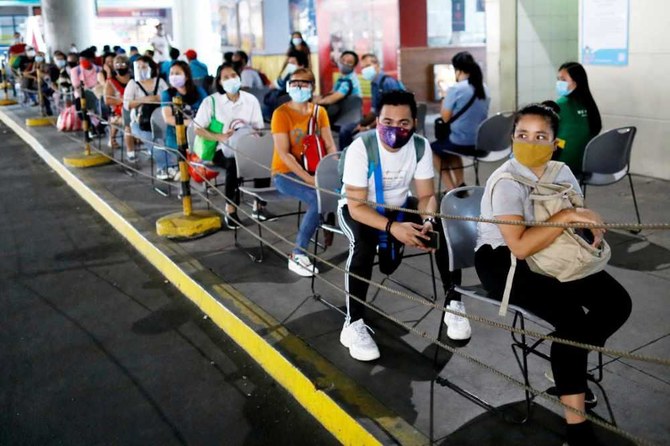
Philippines extends coronavirus restrictions in Manila as cases surge
https://arab.news/9qx37
Philippines extends coronavirus restrictions in Manila as cases surge
Cuba says a 5th person died after people on a Florida-flagged speedboat opened fire on soldiers
- Authorities in Cuba said that on Feb. 26 Cuban soldiers confronted a speedboat carrying 10 people as the vessel approached the island and opened fire on the troops
- The shooting threatened to increase tensions between US President Donald Trump and Cuban authorities
HAVANA: Cuba said a fifth person has died as a consequence of a fatal shootout last month involving a Florida-flagged speedboat that allegedly opened fire on soldiers in waters off the island nation’s north coast.
The island’s interior ministry said late Thursday in a statement that Roberto Álvarez Ávila died on March 4 as a result of his injuries. It added that the remaining injured detainees “continue to receive specialized medical care according to their health status.”
Authorities in Cuba said that on Feb. 26 Cuban soldiers confronted a speedboat carrying 10 people as the vessel approached the island and opened fire on the troops. They said the passengers were armed Cubans living in the US who were trying to infiltrate the island and “unleash terrorism”. Cuba said its soldiers killed four people and wounded six others.
“The statements made by the detainees themselves, together with a series of investigative procedures, reinforce the evidence against them,” the Cuban interior ministry said in its statement, adding that “new elements are being obtained that establish the involvement of other individuals based in the US”
Earlier this week, Cuba said it had filed terrorism charges against six suspects that were on the speedboat. The government unveiled items said to have been found on the boat, including a dozen high-powered weapons, more than 12,800 pieces of ammunition and 11 pistols.
Cuban authorities have provided few details about the shooting, but said the boat was roughly 1.6 kilometers (1 mile) northeast of Cayo Falcones, off the country’s north coast. They also provided the boat’s registration number, but The Associated Press was unable to readily verify the details because boat registrations are not public in the state of Florida.
The shooting threatened to increase tensions between US President Donald Trump and Cuban authorities. The island’s economy was until recently largely kept economically afloat by Venezuela’s oil, which is now in doubt after a US military operation deposed then-Venezuelan President Nicolás Maduro.


