

Proper disposal of animal remains during Eid vital for flight safety — Pakistani officials

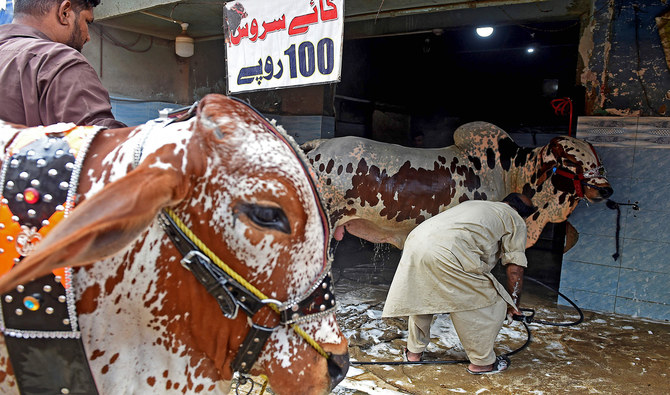
In this picture taken on July 27, 2020, Sheikh Sagheer, right, washes a cow for a customer at his car service station ahead of the Muslim festival Eid al-Adha or the 'Festival of Sacrifice', in the Pakistan's port city of Karachi. (AFP)
Short Url
Updated 30 July 2020
Follow

Proper disposal of animal remains during Eid vital for flight safety — Pakistani officials

  • Authorities say fear of bird strikes increases during Eid al-Adha since cities are usually not cleaned after the festivity
  • The Pakistan Air Force and Civil Aviation Authority have launched separate awareness campaigns to address the issue

LAHORE: The Pakistan Air Force on Thursday issued a public service message to emphasize the importance of safe disposal of animal offal and remains ahead of Eid al-Adha, saying the carcasses and remains of sacrificial animals could be hazardous for its aircrafts and aircrew since they attracted large number of birds. 

The issue was also raised by the country’s aviation industry officials who pointed out that most airports in Pakistan were surrounded by densely populated neighborhoods, adding that it posed a serious threat to flight operations during Eid al-Adha when people sacrificed animals and casually threw away their remains. 

“Lahore, Peshawar and Karachi airports are extremely vulnerable in this sense,” said Abdul Sattar Khokhar, senior joint-secretary at the Civil Aviation Division, on Thursday. “Eid al-Adha increases the danger further since many vicinities in our cities are not properly cleaned even after the festivity.” 

According to aviation experts, bird strikes are regular occurrences around the world, though the number of such incidents can be greater in countries like Pakistan. 

“Heavily populated areas around airports can be a big threat to airliners,” Abdullah Hafeez, a Pakistan International Airlines spokesperson, told Arab News. “According to the available data, 71 aircrafts were hit by birds last year. In the first seven months of 2020, there have been 22 such incidents. In fact, 10 bird strikes were recorded only in the month of July.” 

“Such incidents can cost us a lot,” he continued. “Even if a bird strikes does not cause damage, the aircraft still undergoes a complete examination that sometimes results in flight delays and mount operational expenses. It is the responsibility of the Civil Aviation Authority to take preventive measures to control such incidents.” 

According to ornithologists, pieces of flesh and fats attract big birds. 

“Vultures and crows like to eat flesh and fats. During the Eid, such stuff is usually available more than the routine days. Another reason why we see so many birds around airports is light since they also eat flying insects,” Anam Malik, a Zoology professor, told Arab News. 

Meanwhile, the Civil Aviation Authority maintained it was taking corrective measures to prevent bird-strike incidents. 

"The CAA has started a countrywide campaign to curb such occurrences. The purpose of the campaign is to educate people that they should not spread filth near airports since that can be extremely dangerous,” Khokhar told Arab News. 

He also added that the authorities had hired shooters near the airports in Lahore and Karachi to hunt these birds.

They also fire crackers while an aircraft takes off or lands to prevent an accident.


Pakistan’s Mahnoor Omer named among TIME’s ‘Women of the Year’ for 2026

Updated 01 March 2026
Follow

Pakistan’s Mahnoor Omer named among TIME’s ‘Women of the Year’ for 2026

  • Omer moved a Pakistani court against the so-called ‘period tax’ in Sept. 2025 which has since sparked a national debate
  • Taxes on sanitary pads in Pakistan can add up to 40 percent to retail price, UNICEF says only around 12 percent women use such products

ISLAMABAD: Pakistani women’s rights activist Mahnoor Omer, who fought against taxes on menstrual products, has been named among the TIME magazine’s ‘Women of the Year’ for 2026.

Omer’s efforts have been recognized alongside 16 activists, artists, athletes and businesswomen in the TIME’s Women of the Year 2026 list, including Olympic gold medalist Sydney McLaughlin-Levrone and Oscar-nominated filmmaker Chloe Zhao.

Dissatisfied with the efforts to educate Pakistani girls about sexual violence, Omer founded the Noor Foundation at the age of 14 and held her own workshops with village girls about everything from climate change to menstruation, according to the TIME magazine.

Two years later, a conversation with a domestic worker about the price of pads made her realize that not everyone could afford these essentials. She moved a court against the so-called “period tax” in Sept. 2025 and the case has sparked a national debate on the subject, considered a taboo by many in Pakistan, since its first hearing late last year.

“A decade and one law degree after her interest in activism was sparked, Omer, now 25, is putting her passion and expertise to work in the name of gender equity,” TIME wrote about Omer on its website.

Taxes imposed on sanitary products in Pakistan can add up to 40 percent to the retail price. UNICEF estimates just 12 percent of women in the country use commercially produced pads or tampons. The alternative, using cloth, risks health impacts including rashes and infections, and can make it impossible for girls to attend school while menstruating.

Omer’s suit, which awaits the government response, has sparked a national discussion. She says she spoke about menstruation to her father and male cousins, who thanked her for standing up for their daughters.
The 25-year-old, who is currently enrolled in a master’s degree in gender, peace, and security at the London School of Economics, sees this case as just the first of many.

“I’m not free until every woman is free,” she was quoted as saying by TIME. “I want to leave no stones unturned in terms of what I can do with the next few decades, as a lawyer for the women in my country and gender minorities in general.”