


PARIS: On August 2, 1990, the army of Saddam Hussein swarmed into neighboring Gulf emirate Kuwait, annexing the small oil-rich territory.
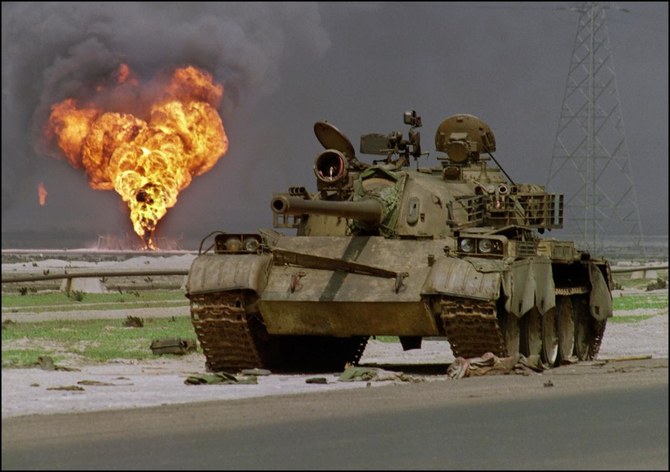
Seven months later, Iraq was chased out by a US-led international coalition, leaving behind a devastated and pillaged Kuwait, and 750 oil wells ablaze.
Here is a recap of the conflict and its aftermath:
On July 18, 1990, tensions spiral after Iraq accuses Kuwait of stealing petrol from the Rumaila oil field and encroaching on its territory.
Saddam demands $2.4 billion from the emirate.
Kuwait counters, saying Iraq is trying to drill oil wells on its territory.
It is one of several disputes, the most complex involving their border — a bone of contention since Kuwait’s independence in 1961.
Iraq also accuses the emirate of flooding the oil market, driving down crude prices.
Attempts by the Arab League and Saudi Arabia to mediate an end to the crisis fail and talks are suspended on August 1.
The next day, Iraq invades.
“Iraqi troops began at 2 a.m. local time to violate our northern borders, to enter Kuwait territory and to occupy positions within Kuwait,” Radio Kuwait announces in its first news bulletin.
It is followed by patriotic music and calls on Kuwaitis “to defend their land, their sand and their dunes.”
Violent clashes with heavy weaponry break out in Kuwait City between Kuwaiti units and the Iraqi army.
Faced with 100,000 Iraqi troops and 300 tanks, the 16,000-strong Kuwaiti army is overwhelmed.
The capital falls that morning and Kuwait’s head of state Sheikh Jaber Al-Ahmad Al-Sabah flees to Saudi Arabia.
His brother Fahd is killed as Iraqi troops seize the palace.
In Baghdad official radio announces the end of the “traitor regime” it accuses of being an accomplice in an “American Zionist plot,” aimed at undermining the recovery of the Iraqi economy.
The international community condemns the invasion and oil prices soared on world markets.
At an emergency meeting, the UN Security Council demands the immediate and unconditional withdrawal of all Iraqi forces from Kuwait.
Washington freezes Iraqi assets in the US and its subsidiaries abroad, along with Kuwaiti assets, to prevent them benefiting Baghdad.
The Soviet Union, Iraq’s main arms supplier, halts its deliveries.
On August 6, the UN Security Council slaps a trade, financial and military embargo on Iraq.
Two days later, the US president George H.W. Bush announces he is sending troops to Saudi Arabia.
Iraq closes its borders to foreigners. Thousands of western, Arab and Asian civilians are held against their will in Iraq or Kuwait, with some 500 people used for months as human shields at strategic sites.
On August 8, Baghdad announces Kuwait’s “total and irreversible” incorporation into Iraq.
Later in the month, Iraq annexes the emirate as its 19th province.
“Kuwait is part of Iraq,” Saddam declares.
On November 29, the UN Security Council authorizes the use of “all necessary means” to force Iraq out of Kuwait if it has not withdrawn its troops voluntarily by January 15, 1991.
Baghdad rejects the ultimatum.
On January 17, after diplomatic initiatives fail, Operation Desert Storm is launched with intensive bombardments of Iraq and Kuwait.
On February 24, Bush announces a ground offensive.
The allied troops free the emirate in days.
Bush announces on February 27 the liberation of Kuwait and the cessation of hostilities the next day, at 0400 GMT.
Iraq accepts all UN resolutions.
The crisis divides Arab states.
Egyptian and Syrian armies take part in the coalition, but it is denounced by other Arab countries.
More than a decade later, in 2003, Kuwait serves as a bridgehead for the US-led invasion of Iraq, which leads to the overthrow of Saddam.


