

Lebanon reinstates lockdown measures after virus rebound

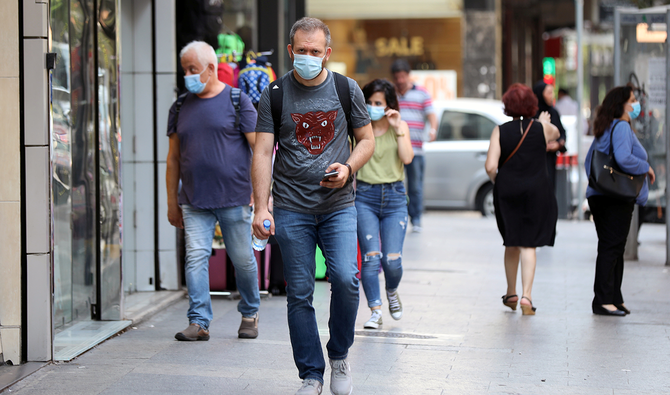
People walk as they wear face masks to prevent the spread of the coronavirus disease (COVID-19) in Beirut, Lebanon July 28, 2020. (Reuters)
Short Url
Updated 29 July 2020
Follow

Lebanon reinstates lockdown measures after virus rebound

  • Lebanon has recorded a total of 3,879 cases of COVID-19, including 51 deaths

BEIRUT: The Lebanese government agreed on Tuesday to reinforce coronavirus lockdown measures after a spike in new cases threatened to overwhelm the crisis-hit country’s health care system.

Lebanon, a country of some 6 million people, has recorded a total of 3,879 cases of COVID-19, including 51 deaths.

Activists on social media shared a video of a Lebanese man in his car arguing with security forces after being fined for failing to wear a face mask.

Authorities decided to shut down the country again following an alarming increase in the number of COVID-19 cases. Ministers on Tuesday were tested for the virus before taking part in ministerial session at the Presidential Palace.

President Michel Aoun called for “stricter application” of the lockdown order to limit the “negative repercussions on citizens and residents,” criticizing “people’s disregard for the preventive measures.”

Minister of Health Hamad Hassan said: “People are not abiding by the preventive measures, and people traveling to Lebanon are not respecting the isolation period.”

From Thursday, the country will shut down for five days with another five-day lockdown next week.

Bars, pubs, night clubs, malls, pools, gyms, churches, mosques and game centers will be closed, and all sports competitions, events and religious gatherings will be canceled. People over 65 will be told to stay at home and avoid social activity.

Security forces have arrested two Syrians who allegedly forged PCR tests showing a negative result for sale to Syrians wishing travel to their homeland.

Meanwhile, Iran reported 235 new deaths, a record toll for a single day in the Middle East’s hardest-hit country.

“We have lost 235 of our compatriots due to COVID-19 in the past 24 hours,” taking the overall toll to 16,147, said a health official.


Yemen humanitarian crisis to worsen in 2026 amid funding cuts, says UN

Updated 5 sec ago
Follow

Yemen humanitarian crisis to worsen in 2026 amid funding cuts, says UN

  • Yemen has been the ‍focus of one of the world’s largest humanitarian operations in a decade of civil war that disrupted food supplies
GENEVA: The UN warned on Monday that the humanitarian situation in Yemen is worsening and that gains made to tackle malnutrition ​and health would go into reverse due to funding cuts.
“The context is very concerning... We are expecting things to be much worse in 2026,” Julien Harneis, UN Resident and Humanitarian Coordinator for Yemen, told reporters in Geneva.
Some 21 million people will need humanitarian assistance this year, an increase from ‌19.5 million the ‌previous year, according to the ‌UN ⁠The ​situation ‌has been aggravated by economic collapse and disruption of essential services including health and education, and political uncertainty, Harneis said.
Funding Yemen traditionally received from Western countries was now being cut back, Herneis said, pointing to hopes for more help from Gulf countries.
The US slashed its ⁠aid spending this year, and leading Western donors also pared back help ‌as they pivoted to raise defense ‍spending, triggering a funding ‍crunch for the UN
Yemen has been the ‍focus of one of the world’s largest humanitarian operations in a decade of civil war that disrupted food supplies. The country has also been a source of heightened tensions ​in recent months between Saudi Arabia and the United Arab Emirates.
“Children are dying and it’s ⁠going to get worse,” Harneis said. Food insecurity is projected to worsen across the country, with higher rates of malnutrition anticipated, he stated.
“For 10 years, the UN and humanitarian organizations were able to improve mortality and improve morbidity...this year, that’s not going to be the case.”
He said Yemen’s humanitarian crisis threatened the region with diseases like measles and polio that could cross borders.
In 2025 680 million dollars was afforded to ‌the UN in Yemen, about 28 percent of the intended target, Harneis said.