Lebanon to impose two-week coronavirus lockdown

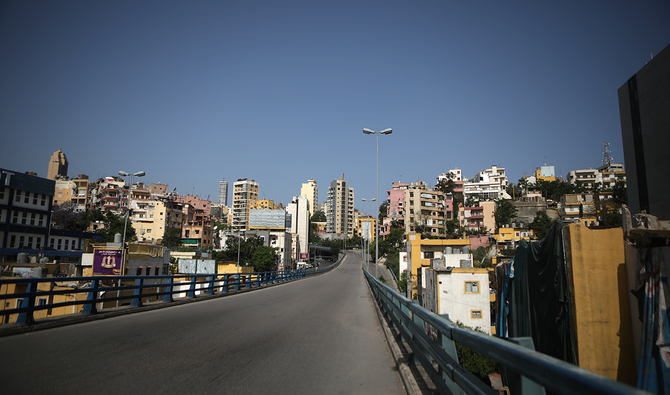
A deserted bridge on the eastern outskirts of the Lebanese capital Beirut, during a lockdown imposed by the authorities due to the novel coronavirus pandemic. (AFP/File)
Short Url
Updated 28 July 2020
Follow

Lebanon to impose two-week coronavirus lockdown

  • Shutdown includes Eid Al-Adha holiday

BEIRUT: Lebanon is imposing a two-week coronavirus lockdown starting July 30, the country’s health minister said, as he slammed the “lack of community discipline and disregard” for all preventive measures and warned that the outbreak was taking a “dangerous turn.”

The number of confirmed cases on Monday reached 135 and Saturday’s cases were the highest since February at 175.

“The number is very large and indicates the seriousness of this stage,” said Health Minister Hamad Hassan, following a meeting of a COVID-19 ministerial committee headed by Prime Minister Hassan Diab.

He added that what was happening was another indication of the “rapid spread” of the virus within one week. “The infected person is now spreading the infection to 3 people.” 

The total lockdown of the country is from July 30 to August 3 and from August 6 until August 10, including the days of Eid Al-Adha. It is a measure intended to relieve pressure on hospitals that have started to get overcrowded. However, the final decision will be taken by the Council of Ministers that will meet Tuesday.

Hassan warned that the community outbreak of the disease was beginning to take a “dangerous turn” and he regretted “the lack of community discipline and disregard for all preventive measures imposed on people.”

Fears of COVID-19 have overtaken the country’s many financial and economic concerns, with politicians, parliament officials, ministry and court staff taking polymerase chain reaction (PCR) tests on Monday and entire towns shutting down.

Although the ministerial committee did not recommend closing Beirut International Airport, it decided that nobody would be allowed into Lebanon from the start of August without a negative PCR test from the departure country.

"Passengers will have to stay in quarantine for two days at their own expense in special centers, pending the results of the second PCR test at the airport,” Hassan said. “Those who have the logistical capacity for quarantine will not have to go to these centers.” 

Hassan requested hospitals to postpone receiving cold medical cases to later appointments because there were 222 cases within the health sector among doctors, nurses and employees. He called on hospitals to “completely prevent visits to patients or make them minimal.”

Lawyers in the Bar Association had to take PCR tests after one of their number was found to have the disease. Employees and judges at the Palace of Justice in Beirut were tested and it was decided to suspend trial sessions for four days.

Fear of contracting the virus has also reached politicians. The minister of defense, Zeina Aker, announced that her daughter had been infected with the virus. Parliament closed on Monday to carry out PCR tests for MPs who had mixed with George Aqis, including Speaker Nabih Berri. Aqis’ first test was positive but the second was negative.

The need for hundreds of Syrian workers to take PCR tests before entering Syrian territory has led to overcrowding in Lebanese government hospitals, with long lines of people waiting to be seen at authorized laboratories for testing.

“There was great pressure on the 50 laboratories,” Hassan said. “The number of tests increased to between seven and eight thousand daily, which caused a delay in announcing the results and affected the control of positive cases.”

Seventeen members of the Lebanese Red Cross contracted the virus from an infected volunteer who had moved one of his relatives to hospital. The relative suffered from burns at home and it was found out that he had COVID-19.


Syrian foreign minister: National interest and the welfare of the people top priority

Updated 13 sec ago
Follow

Syrian foreign minister: National interest and the welfare of the people top priority

  • Hassan Al-Shaibani highlights reconstruction efforts, internal reforms during Munich discussion

MUNICH: The Syrian Arab Republic Foreign Minister Asaad Hassan Al-Shaibani spoke on the sidelines of the Munich Security Conference about the country’s ongoing recovery, internal reforms, and the impact of Israeli military actions.

“We are satisfied with the achievements we have made, but we continue striving to deliver the best for our people,” Al-Shaibani said.

“We will not tire or give up and will work day and night to build the Syria we aspire to, together with our citizens.”

In the Syrian Arab News Agency report the minister stressed that the Syrian state had not shirked its responsibility for what happened in Sweida and other areas, noting that “the national interest and the welfare of the people have always been our top priority.”

He emphasized that the diversity in Syria is a source of strength.

We live in a country exhausted by war and by the mismanagement inherited from the deposed regime.

Foreign Minister, Asaad Hassan Al-Shaibani

“We share national interests, including the unity and territorial integrity of the country, and we operate within the framework of the law,” he added.

Al-Shaibani highlighted progress in rebuilding state institutions and restoring trust between the government and the public.

“We live in a country exhausted by war and by the mismanagement inherited from the deposed regime,” he said. “Syrian society remains fragmented, both inside the country and abroad, and continues to face humanitarian and infrastructure challenges.”

He emphasized that efforts to unify the country include consolidating state control over weapons, a principle established after the revolution’s victory.

The minister also highlighted the role of Syrian citizens in the recovery process.

“What we rely on is our people, who possess determination and ambition,” he said, adding that “lifting sanctions is the key to reconstruction.”

He noted that there are still displacement camps in the country and that many refugees continue to live abroad.

Turning to external issues, he expressed concern over Israeli military activity.

“Since Dec. 8, 2024, Syria has faced more than 1,000 airstrikes, the occupation of new areas in southern Syria, and over 500 ground incursions,” he said, adding that the Syrian state has pursued a realistic approach toward Israel, prioritizing reconstruction and national recovery.

He noted, however, that the policy might not have been acceptable to Israel, which “continues to seek regional conflicts.”

Al-Shaibani emphasized that negotiations should result in Israel withdrawing from the areas it occupied after Dec. 8, respecting Syrian sovereignty and airspace.

Syria’s deputy interior minister met with Germany’s interior minister on the sidelines of the Munich Security Conference.

They discussed security developments and prospects for cooperation, according to a statement from the interior ministry.

Maj. Gen. Abdulkader Al-Tahhan held talks with German Interior Minister Alexander Dobrindt during the annual conference.

The Syrian Interior Ministry said the meeting included a review of current developments in Syria and their impact on security and humanitarian issues.

It added that both sides stressed the importance of coordination and information-sharing in support of regional and international stability.

The statement said the officials also discussed possible cooperation between the two interior ministries, including training, capacity-building and the exchange of expertise.