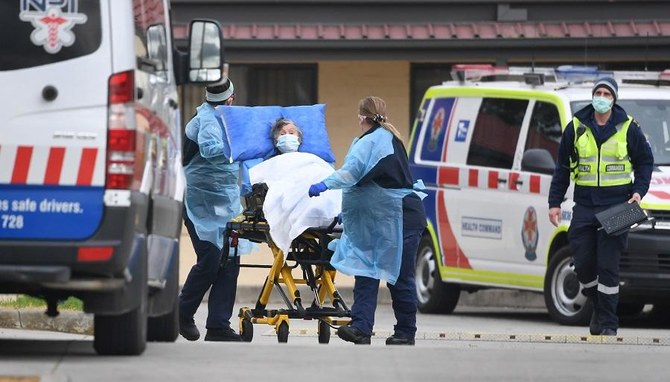
SYDNEY: Australia’s Victoria state on Monday reported the country’s highest daily increase in coronavirus infections, prompting the authorities to warn a six-week lockdown may last longer if people continue to go to work while feeling unwell.
The second-most populous state reported 532 new cases of the virus which causes COVID-19, taking the national total to 549, the most new cases in a day since the pandemic arrived.
Victoria currently has more than 4,500 active cases after weeks of triple digits daily rises.
It reported six more deaths, taking the state toll to 77, almost half the total national death toll. Five of the deaths were in aged care facilities, which have been hit hardest in the state.
Australia has avoided the high COVID-19 casualty rates of other countries, but a wave of community transmission in Victoria has prompted a lockdown in Melbourne, the only Australian city to make it mandatory to wear a facemask in public.
“If you’ve got a sniffle, a scratchy throat, a headache, fever, then you can’t go to work,” said Victorian Premier Daniel Andrews in a televised news conference.
“This is what is driving these numbers up, and the lockdown will not end until people stop going to work with symptoms and instead go and get tested because they have symptoms.”
Melbourne, home to a fifth of Australia’s 25 million population, is halfway though a six-week ban on movement other than for work, buying food, giving or receiving health care, or daily exercise. Andrews added that he may announce additional measures later this week.
Prime Minister Scott Morrison said the high number of new cases in Victoria showed how transmission of the illness among younger people, who were considered lower risk, could spread to aged care facilities through family members.
“In Victoria there is still a long way to go,” Morrison told reporters.
“We are still seeing case numbers at elevated levels and ... when you get community-based transmission, it does take some time to get that down.” Victoria has had a total of 8,173 cases.
Neighbouring New South Wales (NSW) state, the country’s most populous, is also grappling with several virus clusters that have sprung up at a hotel, a Thai restaurant and a club. NSW reported 17 new cases on Monday. NSW has had 3,496 cases in total, about 1,100 active.
Australia has recorded a total 14,935 cases and 161 deaths and authorities on Monday warned more lives would be lost as infections continued to rise.
“The tragedy of COVID-19 is that we know, with the number of new infections that we have seen today, that there will be many further deaths in the days ahead,” Deputy Chief Medical Officer Michael Kidd told reporters.
More than 16.13 million people have been reported to be infected by the novel coronavirus globally and 644,836 have died, according to a Reuters tally.

Australia posts daily virus record, more deaths expected
https://arab.news/9qzyb
Australia posts daily virus record, more deaths expected
- Victoria currently has more than 4,500 active cases after weeks of triple digits daily rises
- Australia has recorded a total 14,935 cases and 161 deaths
Youth voters take center stage in Bangladesh election after student-led regime change
- About 45% of Bangladeshis eligible to vote in Thursday’s election are aged 18-33
- Election follows 18 months of reforms after the end of Sheikh Hasina’s 15-year rule
DHAKA: When he goes to the polls on Thursday, Atikur Rahman Toha will vote for the first time, believing that this election can bring democratic change to Bangladesh.
A philosophy student at Dhaka University, Toha was already eligible to vote in the 2024 poll but, like many others, he opted out.
“I didn’t feel motivated to even go to vote,” he said. “That was a truly one-sided election. The election system was fully corrupted. That’s why I felt demotivated. But this time I am truly excited to exercise my voting rights for the first time.”
The January 2024 vote was widely criticized by both domestic and international observers and marred by a crackdown on the opposition and allegations of voter fraud.
But the victory of the Awami League of ex-Prime Minister Sheikh Hasina was short-lived, as a few months later the government was ousted by a student-led uprising, which ended the 15-year rule of Bangladesh’s longest-serving leader.
The interim administration, led by Nobel laureate Muhammad Yunus, took control in August 2024 and prepared a series of reforms to restructure the country’s political and institutional framework and organize the upcoming vote.
About 127.7 million Bangladeshis are eligible to cast their ballots, according to Election Commission data, with nearly a third of them, or 40.4 million, aged 18-29. Another 16.9 million are 30-33, making it a youth–dominated poll, with the voters hopeful the outcome will help continue the momentum of the 2024 student-led uprising.
“We haven’t yet fully transitioned into a democratic process. And there is no fully stable situation in the country,” Toha said. “After the election we truly hope that the situation will change.”
For Rawnak Jahan Rakamoni, also a Dhaka University student, who is graduating in information science, voting this time meant that her voice would count.
“We are feeling that we are heard, we will be heard, our opinion will matter,” she said.
“I think it is a very important moment for our country, because after many years of controversial elections, people are finally getting a chance to exercise their voting rights and people are hoping that this election will be more meaningful and credible. This should be a fair election.”
But despite the much wider representation than before, the upcoming vote will not be entirely inclusive in the absence of the Awami League, which still retains a significant foothold.
The Election Commission last year barred Hasina’s party from contesting the next national elections, after the government banned Awami League’s activities citing national security threats and a war crimes investigation against the party’s top leadership.
The UN Human Rights Office has estimated that between July 15 and Aug. 5, 2024 the former government and its security and intelligence apparatus, together with “violent elements” linked to the Awami League, “engaged systematically in serious human rights violations and abuses in a coordinated effort to suppress the protest movement.”
It estimated that at least 1,400 people were killed during the protests, with the majority shot dead from military rifles.
Rezwan Ahmed Rifat, a law student, wanted the new government to “ensure justice for the victims of the July (uprising), enforced disappearances, and other forms of torture” carried out by the previous regime.
The two main parties out of the 51 contesting Thursday’s vote are the Bangladesh Nationalist Party and Jamaat-e-Islami. Jamaat, which in 2013 was banned from political participation by Hasina’s government, heads an 11-party alliance, including the National Citizen Party formed by student leaders from the 2024 movement.
“I see this election as a turning point of our country’s democratic journey … It’s not just a normal election,” said Falguni Ahmed, a psychology student who will head to the polls convinced that no matter who wins, it will result in the “democratic accountability” of the next government.
Ahmed added: “People are not voting only for their leaders; they are also voting for the restoration of democratic credibility. That’s why this election is very different.”


