
CAIRO: Egyptian President Abdel Fattah El-Sisi on Saturday received a phone call from South Africa President Cyril Ramaphosa in which they exchanged views regarding the latest developments in Libya.
A statement from the Egyptian president’s office stressed that the two sides reviewed ways of reaching a political settlement within the framework of the Berlin Summit and the Cairo Declaration in an effort to combat terrorism, extremist armed militias and external interference that threatens regional security and stability.
The Cairo Declaration was a recent joint political initiative announced by El-Sisi, the commander of the Libyan National Army, Khalifa Haftar, and the speaker of the Libyan Parliament, Aguila Saleh, to resolve the cuntry’s crisis.
The initiative, which was welcomed by various foreign and Arab countries, mandates an intra-Libyan resolution as a basis for resolving the country’s conflict.
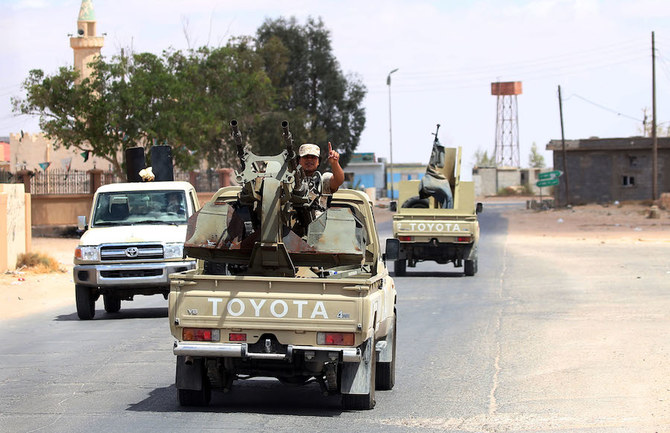
Forces loyal to Libya’s Government of National Accord (GNA), who are supported by Turkey, are reportedly planning to launch an attack on Libya’s port city of Sirte and also in Al-Jufra, which El-Sisi recently described as “red lines” in relation to Egypt’s security.
In another development, footage shared on social media showed the moment French intellectual Bernard-Henri Levy arrived in the Libyan city of Misrata in an official motorcade.
The visit sparked an angry reaction and widespread controversy in Libyan political circles on all sides. The Presidential Council of the GNA denied having knowledge of Levy’s visit to the areas under its control.
“The council has no relationship or knowledge of the visit and did not coordinate it with him,” Fayez Al-Sarraj, head of the council, said.
The statement indicated that the council took measures to investigate the visit and who was behind it, and that it had issued strict instructions to all agencies, departments and ports to prevent any future violations.
A video clip showed the moment Levy’s motorcade escaped from Tarhuna after he was arrested and expelled from it, and headed to the city of Al-Khums.
Some Arab politicians and activists call Levy, the “Godfather of the Arab Spring,” and accuse him of engineering the French military intervention in Libya and of contributing to the overthrow of former Libyan leader Muammar Qaddafi.
“The Zionist Bernard Levy, the godfather of the Hebrew spring, arrived in Misrata where a high-level delegation from the militia government (the government of reconciliation) met him, and where visits will be organized for him to Al-Khums, Tarhuna and Tripoli, and where a number of senior officials in the militia government meet. Levy has a dangerous role,” Egyptian MP Mustafa Bakry said via his official Twitter account.
Levy had appeared in Libya in 2011 alongside rebel leaders against Gaddafi. He consulted with then French President Nicolas Sarkozy before the military intervention in Libya, and was even credited with helping persuade Sarkozy to play a major role in overthrowing the former Libyan regime.
Political analyst on Libyan affairs Abdel-Basset Hamel said that Levy’s visit to Tarhuna and Misrata “is a scandal by all accounts,” noting that Levy arrived at Tarhuna at the invitation of the minister of interior of the Al-Sarraj government to provide him with support.
Hamel added that Levy had close ties to the Turkish Foreign Ministry, and that Al-Sarraj presented Libya “on a plate of gold to Turkey,” saying that (Turkish President Recep Tayyip) Erdogan was “trying to restore the glories of the Ottoman Empire through the Libyan gate. The new Ottomans have returned to Tripoli and are exploiting the Syrian mercenaries looking for dollars.”
Hamel said there were currently thousands of militiamen and mercenaries of various nationalities in Libya, including Egyptians.