

El-Sisi, Ramaphosa discuss Libyan developments

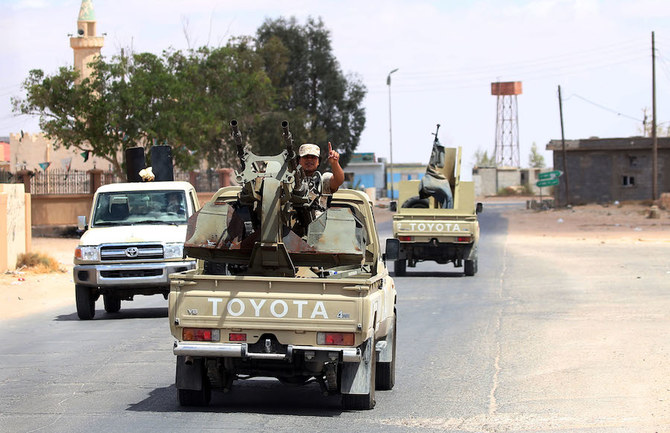
Fighters loyal to the UN-recognised Libyan Government of National Accord (GNA) secure the area of Abu Qurain, half-way between the capital Tripoli and Libya's second city Benghazi, against forces loyal to Khalifa Haftar, who is based in eastern Benghazi, on July 20, 2020. (AFP)
Short Url
Updated 26 July 2020
Follow

El-Sisi, Ramaphosa discuss Libyan developments

  • The two sides reviewed ways of reaching a political settlement within the framework of the Berlin Summit and the Cairo Declaration in an effort to combat terrorism, extremist armed militias and external interference
  • The initiative, which was welcomed by various foreign and Arab countries, mandates an intra-Libyan resolution as a basis for resolving the country’s conflict

CAIRO: Egyptian President Abdel Fattah El-Sisi on Saturday received a phone call from South Africa President Cyril Ramaphosa in which they exchanged views regarding the latest developments in Libya.

A statement from the Egyptian president’s office stressed that the two sides reviewed ways of reaching a political settlement within the framework of the Berlin Summit and the Cairo Declaration in an effort to combat terrorism, extremist armed militias and external interference that threatens regional security and stability.

The Cairo Declaration was a recent joint political initiative announced by El-Sisi, the commander of the Libyan National Army, Khalifa Haftar, and the speaker of the Libyan Parliament, Aguila Saleh, to resolve the cuntry’s crisis.

The initiative, which was welcomed by various foreign and Arab countries, mandates an intra-Libyan resolution as a basis for resolving the country’s conflict.

Forces loyal to Libya’s Government of National Accord (GNA), who are supported by Turkey, are reportedly planning to launch an attack on Libya’s port city of Sirte and also in Al-Jufra, which El-Sisi recently described as “red lines” in relation to Egypt’s security.

In another development, footage shared on social media showed the moment French intellectual Bernard-Henri Levy arrived in the Libyan city of Misrata in an official motorcade.

The visit sparked an angry reaction and widespread controversy in Libyan political circles on all sides. The Presidential Council of the GNA denied having knowledge of Levy’s visit to the areas under its control.

“The council has no relationship or knowledge of the visit and did not coordinate it with him,” Fayez Al-Sarraj, head of the council, said.

The statement indicated that the council took measures to investigate the visit and who was behind it, and that it had issued strict instructions to all agencies, departments and ports to prevent any future violations.

A video clip showed the moment Levy’s motorcade escaped from Tarhuna after he was arrested and expelled from it, and headed to the city of Al-Khums.

Some Arab politicians and activists call Levy, the “Godfather of the Arab Spring,” and accuse him of engineering the French military intervention in Libya and of contributing to the overthrow of former Libyan leader Muammar Qaddafi.

“The Zionist Bernard Levy, the godfather of the Hebrew spring, arrived in Misrata where a high-level delegation from the militia government (the government of reconciliation) met him, and where visits will be organized for him to Al-Khums, Tarhuna and Tripoli, and where a number of senior officials in the militia government meet. Levy has a dangerous role,” Egyptian MP Mustafa Bakry said via his official Twitter account.

Levy had appeared in Libya in 2011 alongside rebel leaders against Gaddafi. He consulted with then French President Nicolas Sarkozy before the military intervention in Libya, and was even credited with helping persuade Sarkozy to play a major role in overthrowing the former Libyan regime.

Political analyst on Libyan affairs Abdel-Basset Hamel said that Levy’s visit to Tarhuna and Misrata “is a scandal by all accounts,” noting that Levy arrived at Tarhuna at the invitation of the minister of interior of the Al-Sarraj government to provide him with support.

Hamel added that Levy had close ties to the Turkish Foreign Ministry, and that Al-Sarraj presented Libya “on a plate of gold to Turkey,” saying that (Turkish President Recep Tayyip) Erdogan was “trying to restore the glories of the Ottoman Empire through the Libyan gate. The new Ottomans have returned to Tripoli and are exploiting the Syrian mercenaries looking for dollars.”

Hamel said there were currently thousands of militiamen and mercenaries of various nationalities in Libya, including Egyptians.


Syrian military tells civilians to evacuate contested area east of Aleppo amid rising tensions

Updated 3 sec ago
Follow

Syrian military tells civilians to evacuate contested area east of Aleppo amid rising tensions

  • Syria’s military has announced it will open a “humanitarian corridor” for civilians to evacuate from an area in Aleppo province
  • This follows several days of intense clashes between government forces and the Kurdish-led Syrian Democratic Forces
DAMASCUS: Syria’s military said it would open a corridor Thursday for civilians to evacuate an area of Aleppo province that has seen a military buildup following intense clashes between government and Kurdish-led forces in Aleppo city.
The army’s announcement late Wednesday — which said civilians would be able to evacuate through the “humanitarian corridor” from 9 a.m. to 5 p.m. Thursday — appeared to signal plans for an offensive in the towns of Deir Hafer and Maskana and surrounding areas, about 60 kilometers (40 miles) east of Aleppo city.
The military called on the Kurdish-led Syrian Democratic Forces and other armed groups to withdraw to the other side of the the Euphrates River, to the east of the contested zone.
Syrian government troops have already sent troop reinforcements to the area after accusing the SDF of building up its own forces there, which the SDF denied. There have been limited exchanges of fire between the two sides, and the SDF has said that Turkish drones carried out strikes there.
The government has accused the SDF of launching drone strikes in Aleppo city, including one that hit the Aleppo governorate building on Saturday shortly after two Cabinet ministers and a local official held a news conference there.
The tensions in the Deir Hafer area come after several days of intense clashes last week in Aleppo city that ended with the evacuation of Kurdish fighters and government forces taking control of three contested neighborhoods. The fighting killed at least 23 people, wounded dozens more, and displaced tens of thousands.
The fighting broke out as negotiations have stalled between Damascus and the SDF, which controls large swaths of northeast Syria, over an agreement to integrate their forces and for the central government to take control of institutions including border crossings and oil fields in the northeast.
Some of the factions that make up the new Syrian army, which was formed after the fall of former President Bashar Assad in a rebel offensive in December 2024, were previously Turkiye-backed insurgent groups that have a long history of clashing with Kurdish forces.
The SDF for years has been the main US partner in Syria in fighting against the Daesh group, but Turkiye considers the SDF a terrorist organization because of its association with the Kurdistan Workers’ Party, or PKK, which has waged a long-running insurgency in Turkiye. A peace process is now underway.
Despite the long-running US support for the SDF, the Trump administration has also developed close ties with the government of interim Syrian President Ahmad Al-Sharaa and has pushed the Kurds to implement the integration deal. Washington has so far avoided publicly taking sides in the clashes in Aleppo.
The SDF in a statement warned of “dangerous repercussions on civilians, infrastructure, and vital facilities” in case of a further escalation and said Damascus bears “full responsibility for this escalation and all ensuing humanitarian and security repercussions in the region.”
Adm. Brad Cooper, commander of US Central Command, said in a statement Tuesday that the US is “closely monitoring” the situation and called for “all parties to exercise maximum restraint, avoid actions that could further escalate tensions, and prioritize the protection of civilians and critical infrastructure.” He called on the parties to “return to the negotiating table in good faith.”
Al-Sharaa blasts the SDF
In a televised interview aired Wednesday, Al-Sharaa praised the “courage of the Kurds” and said he would guarantee their rights and wants them to be part of the Syrian army, but he lashed out at the SDF.
He accused the group of not abiding by an agreement reached last year under which their forces were supposed to withdraw from neighborhoods they controlled in Aleppo city and of forcibly preventing civilians from leaving when the army opened a corridor for them to evacuate amid the recent clashes.
Al-Sharaa claimed that the SDF refused attempts by France and the US to mediate a ceasefire and withdrawal of Kurdish forces during the clashes due to an order from the PKK.
The interview was initially intended to air Tuesday on Shams TV, a broadcaster based in Irbil — the seat of northern Iraq’s semi-autonomous Kurdish region — but was canceled for what the station initially said were technical reasons.
Later the station’s manager said that the interview had been spiked out of fear of further inflaming tensions because of the hard line Al-Sharaa took against the SDF.
Syria’s state TV station instead aired clips from the interview on Wednesday. There was no immediate response from the SDF to Al-Sharaa’s comments.