

UN says thousands of anti-Pakistan militants in Afghanistan

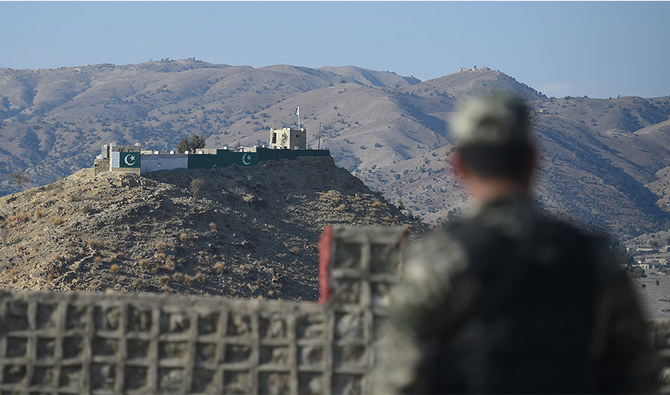
A Pakistani army soldier stands guard at a border terminal in Ghulam Khan in North Waziristan on the Pakistani-Afghan border on Jan. 27, 2019. (AFP/File)
Short Url
Updated 26 July 2020
Follow

UN says thousands of anti-Pakistan militants in Afghanistan

  • Total number of Pakistani militants in Afghanistan is estimated at between 6,000 and 6,500
  • They are linked to Tehreek-e-Taliban Pakistan (TTP), Jamaat-al Ahrar or Lashkar-e-Islam

ISLAMABAD: A UN report says more than 6,000 Pakistani insurgents, most belonging to the outlawed Tehreek-e-Taliban Pakistan (TTP) group attacking Pakistani military and civilian targets, are hiding in Afghanistan.

The report released this week said the organization has linked up with the Afghan-based Daesh (Islamic State) affiliate and some of its members have even joined the group, which has its headquarters in eastern Afghanistan.

The Afghan government did not respond to The Associated Press requests Sunday for comment.

The report said the Daesh in Afghanistan, known as IS in Khorasan province, has been hit hard by the Afghan Security Forces, as well as US and NATO forces and even on occasion by the Taliban. The report was prepared by the UN analytical and sanctions monitoring team, which tracks terrorist groups around the world.

The report estimated the membership of the Islamic State affiliate in Afghanistan at 2,200 and while its leadership has been depleted it still counts among its leaders a Syrian national Abu Said Mohammad Al-Khorasani.

The report also said the monitoring team had received information that two senior Islamic State commanders, Abu Qutaibah and Abu Hajjar Al-Iraqi, had recently arrived in Afghanistan from the Middle East.

“Although in territorial retreat, (the Islamic State) remains capable of carrying out high-profile attacks in various parts of the country, including Kabul. It also aims to attract Taliban fighters who oppose the agreement with the United States,” said the report referring to a US peace deal signed with the Taliban in February.

That deal that was struck to allow the US to end its 19 year involvement in Afghanistan also calls on the Taliban to guarantee its territory will not be used by terrorist groups. The deal is also expected to guarantee Taliban all-out participation in the fight against the Islamic State.

The second and perhaps the most critical part of that agreement calls for talks between the Taliban and Kabul’s political leadership.

Late on Saturday the US State Department issued a statement saying its peace envoy Zalmay Khalilzad was again shuttling through the region seeking to jump start those negotiations which have been repeatedly postponed as both sides squabble over a prisoner release program.

The US-backed deal calls for the Afghan government to release 5,000 Taliban prisoners and the Taliban to free 1,000 government and military personnel as a so-called good will gesture ahead of talks. Until now the government is refusing to release nearly 600 Taliban prisoners it calls high-profile criminals and have offered to free alternatives. The Taliban has refused.

“The parties are closer than ever to the start of intra-Afghan negotiations, the key next step to ending Afghanistan’s 40-year long war,” said the US State Department statement. “Although significant progress has been made on prisoner exchanges, the issue requires additional effort to fully resolve.”

The Taliban’s political spokesman earlier this week said it was ready to hold talks with Kabul’s political leaders after the Islamic holiday of Eid Al-Adha which is at the end of the month, providing the prisoner release is completed.

A big worry for Pakistan is the presence in Afghanistan of militants, particularly linked to the TTP or Jamaat-al Ahrar or Lashkar-e-Islam, as well as those with the Baloch Liberation Army (BLA), which has taken responsibility for high profile attacks this month in the southern Sindh province as well as in southwestern Balochistan Province. Several Pakistan military personnel have been killed this month in southwestern Baluchistan province in battle with insurgents.

The TTP took responsibility for one of the most horrific attacks in Pakistan in 2014 when a Pakistani army school was attacked and 140 were killed. Most were students and some were as young as five.

“The total number of Pakistani foreign terrorist fighters in Afghanistan, posing a threat to both countries, is estimated at between 6,000 and 6,500, most of them with TTP,” the report said.


Pakistan awaits mandate clarity before committing troops to Gaza stabilization force, FO says

Updated 9 sec ago
Follow

Pakistan awaits mandate clarity before committing troops to Gaza stabilization force, FO says

  • Foreign office says Islamabad cannot commit to contributing troops unless it obtains clarity on the force’s mandate
  • Says Pakistan can be part of peacekeeping force but not of any disarming or de-militarization mandates

ISLAMABAD: Foreign office spokesperson Tahir Andrabi said on Thursday that Pakistan has identified its “red lines” on contributing to the International Stabilization Force (ISF) in Gaza, adding that Islamabad would be unable to take a decision on the matter without clarity about the force’s mandate. 

Andrabi’s comments come as Prime Minister Shehbaz Sharif gears up to attend the inaugural Board of Peace meeting to be chaired by US President Donald Trump in Washington today, Thursday. 

Trump’s 20-point peace plan for Gaza calls for ‌a multi-nation force to oversee a ‌transition period for reconstruction and economic recovery in the Palestinian territory. Pakistan has previously said it is willing to contribute troops for the peace force but would not be part of any move to disarm Hamas. 

“On the international security assistance force, we understand that a decision is awaited on the contours of the mandate of the Board of Peace, on the mandate of the International Stabilization Force,” Andrabi said during a weekly briefing to reporters. 

“And till such time, we would obviously not be in a position to take any decision on this matter. We have identified our red lines quite explicitly.”

Andrabi quoted a previous statement of Deputy Prime Minister Ishaq Dar by saying: “Pakistan can be part of the peacekeeping mandate, but we would obviously not be part of any disarming, de-militarization mandates.”

He said discussion on the international force might take place in Washington today.

The foreign office spokesperson said Pakistan has joined the Board of Peace with a particular focus of aiding in the reconstruction of Gaza and for the long-term settlement of issues faced by Palestinians.

Andrabi said Israel’s recent move to register lands in the West Bank will also come up in the Board of Peace meeting today. 

“That is how Israel is violating international law, UN resolutions on wider occupied Palestinian territories, not just Gaza,” he said.

“So, I think the board of peace meeting affords an opportunity to discuss this important development.”

SAUDI MEDIATION FOR PAKISTANI DETAINEES
To a question about the release of three Pakistani detainees by Afghanistan this week on Saudi Arabia’s mediation, Andrabi welcomed the role played by the Kingdom and “other brotherly Muslim countries.”

 Afghanistan government spokesperson Zabihullah Mujahid announced on Tuesday that it had released three Pakistani soldiers captured during border clashes between the two countries in October after mediation from Saudi Arabia. Mujahid said the detainees were handed over to a visiting Saudi delegation in Kabul.

“Pakistan values the positive role of our brotherly countries, our important OIC Islamic countries, in basically messaging Taliban leadership, reminding them of their obligations under international law, to ensure that their territory is not used for terrorism in Pakistan,” the spokesperson said.

“I think such an exchange also took place between Riyadh and Kabul.”

However, he said Saudi Arabia was not part of any “structured mediation talks” between Pakistan and Afghanistan.

“I am not aware of that role and I would strongly urge you not to speculate into it,” he said. 

To a question about Pakistan’s response if India violates the Indus Waters Treaty, Andrabi said Islamabad will not compromise on its water rights.

“We will not let India weaponize water. We will not compromise on even a single drop of water that this treaty allows us to have a share of, and we will not compromise on the water rights of the people of Pakistan,” he added.