

World praises UAE on successful launch of Mars Hope probe

1 / 2
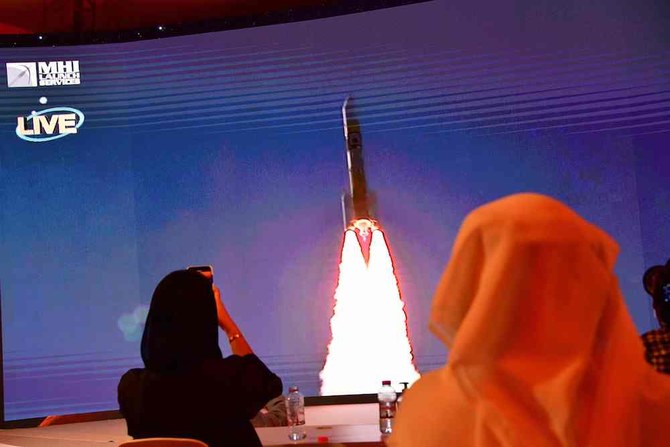
A picture taken on July 19, 2020, shows a screen broadcasting the launch of the “Hope” Mars probe at the Mohammed Bin Rashid Space Center in Dubai. The probe is one of three racing to the Red Planet, with Chinese and US rockets also taking advantage of the Earth and Mars being unusually close: a mere hop of 55 million kilometers. (AFP)
2 / 2
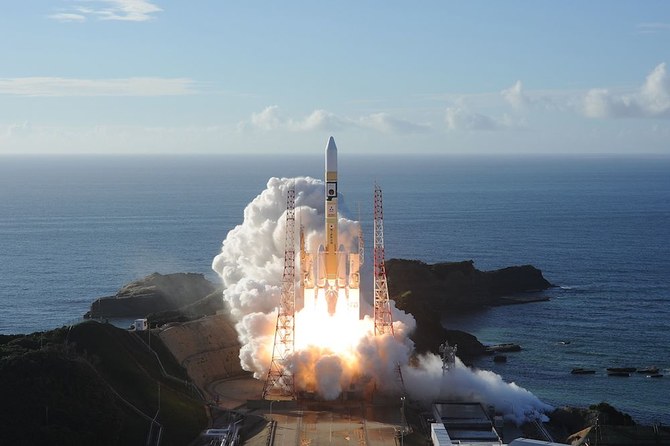
An H-2A rocket carrying the Hope Probe known as "Al-Amal" in Arabic, developed by the Mohammed Bin Rashid Space Centre (MBRSC) in the UAE to explore Mars, blasts off from Tanegashima Space Centre in southwestern Japan. (AFP/Mitsubishi Heavy Industries)
Short Url
Updated 09 February 2021
Follow

World praises UAE on successful launch of Mars Hope probe

  • Emirates Mars Mission ‘constitutes a national and Arab achievement’
  • UAE will be the ninth country to explore the Red Planet

DUBAI: The UAE has received global praise for the “historic” launch of its Mars space probe.
The Hope probe blasted off early Monday from the Tanegashima Space Center in Japan, making the Emirates the first Arab and Islamic country to attempt planetary exploration.
President Sheikh Khalifa bin Zayed led the celebrations, saying the Emirates Mars Mission “constitutes a national and Arab achievement and an advanced Emirati push in the process of building global knowledge in space.”


The probe is one of three racing to the Red Planet, with Chinese and US rockets also taking advantage of the Earth and Mars being unusually close: a mere hop of 55 million kilometers. (AFP)

He said the Hope probe idea was developed within the UAE’s “national and research institutions and was designed and manufactured with the effective participation of a young national elite of bright minds — highly qualified and trained and sincere young Emiratis.”
The mission is a joint project between the Mohammed bin Rashid Space Center and the UAE Space Agency, with the help of contributors and experts from leading universities.
The UAE will be the ninth country to explore the Red Planet, joining an exclusive club of nations.

Prior to the launch, the United Nations said the UAE’s mission is a “contribution to the entire world” and the Emirates is becoming “a main player in the space arena.”
“The UAE is always looking forward to the future; it is our wonderful partner,” said Simonetta Di Pippo, Director of the United Nations Office for Outer Space Affairs (UNOOSA).
The Arab League secretary-general said the launch is a “unique event and a milestone in UAE and Arab achievements as it embodies a message of hope, ambition and motivation for all the peoples of the region to overcome challenges.”
“This achievement is an Emirati-Arab contribution to shaping and making a promising future for humanity, and a message to future generations that nothing is impossible.” Ahmed Aboul Gheit said.
NASA congratulated the UAE on the successful launch, describing the mission as a “culmination of tremendous hard work and dedication.”
“This mission is aptly named since it’s a symbol of inspiration for the UAE, the region, and the world,” NASA Administrator Jim Bridenstine said.

“We are in awe of the speed and commitment the UAE, through both the Mohammed bin Rashid Space Center and the UAE Space Agency, has demonstrated in developing its first interplanetary spacecraft.”
The UAE plans to share all its data with the world, not just academics and scientists and the research findings will be updated regularly and made publicly available.
GCC Secretary General Nayef Al-Hajjraf also praised the UAE’s scientific achievements, expressing his pleasure at witnessing such a “unique event.”
He said “the Hope Probe comes to fulfill the hopes of millions of future generations.”
The probe will travel almost 500 million kilometers and is set to reach the orbit of Mars in February 2021, which would coincide with the 50th anniversary of the UAE’s establishment.

The data from the mission will be publicly available.
The mission is also the first of three international missions to Mars this year, including NASA’s Mars Perseverance Rover, China’s Tianwen-1, which will launch next month, and ExoMars, a collaboration between the European Space Agency and the Russian space agency Roscosmos.


Sudan’s prime minister takes his peace plan to the UN, but US urges humanitarian truce now

Updated 57 min 20 sec ago
Follow

Sudan’s prime minister takes his peace plan to the UN, but US urges humanitarian truce now

  • Sudan’s prime minister is proposing a wide-ranging peace initiative to end a nearly 1,000-day war with a rival paramilitary force
  • It seems unlikely the RSF would support the proposal, which would essentially give government forces a victory and take away their military power

UNITED NATIONS: Sudan’s prime minister on Monday proposed a wide-ranging peace initiative to end a nearly 1,000-day war with a rival paramilitary force, but the United States urged both sides to accept the Trump administration’s call for an immediate humanitarian truce.
Kamil Idris, who heads Sudan’s transitional civilian government, told the Security Council his plan calls for a ceasefire monitored by the United Nations, African Union and Arab League, and the withdrawal of paramilitary forces from all areas they occupy, their placement in supervised camps and their disarmament.
Sudan plunged into chaos in April 2023 when a power struggle between the military and the powerful paramilitary Rapid Support Forces exploded into open fighting, with widespread mass killings and rapes, and ethnically motivated violence. This has amounted to war crimes and crimes against humanity, according to the UN and international rights groups.
It seemed highly unlikely the RSF would support the prime minister’s proposal, which would essentially give government forces a victory and take away their military power.
In an indirect reference to the truce supported by the US and key mediators Saudi Arabia, Egypt and the United Arab Emirates, known as the Quad, Idris stressed to the UN Security Council that the government’s proposal is “homemade — not imposed on us.”
In early November, the Rapid Support Forces agreed to a humanitarian truce. At that time, a Sudanese military official told The Associated Press the army welcomed the Quad’s proposal but would only agree to a truce when the RSF completely withdraws from civilian areas and gives up their weapons — key provisions in the plan Idris put forward on Monday.
Idris said unless the paramilitary forces were confined to camps, a truce had “no chance for success.” He challenged the 15 members of the Security Council to back his proposal.
“This initiative can mark the moment when Sudan steps back from the edge and the international community — You! You! — stood on the right side of history,” the Sudanese prime minister said. He said the council should “be remembered not as a witness to collapse, but as a partner in recovery.”
US deputy ambassador Jeffrey Bartos, who spoke to the council before Idris, said the Trump administration has offered a humanitarian truce as a way forward and “We urge both belligerents to accept this plan without preconditions immediately.”
Bartos said the Trump administration strongly condemns the horrific violence across Darfur and the Kordofan region — and the atrocities committed by both the Sudanese Armed Forces and the Rapid Support Forces, who must be held accountable.
UAE Ambassador Mohamed Abushahab, a member of the Quad, said there is an immediate opportunity to implement the humanitarian truce and get aid to Sudanese civilians in desperate need.
“Lessons of history and present realities make it clear that unilateral efforts by either of the warring parties are not sustainable and will only prolong the war,” he warned.
Abushahab said a humanitarian truce must be followed by a permanent ceasefire “and a pathway toward civilian rule independent of the warring parties.”
UN Assistant Secretary-General for political affairs Khaled Khiari reflected escalating council concerns about the Sudan war, which has been fueled by the continuing supply of increasingly sophisticated weapons.
He criticized unnamed countries that refuse to stop supplying weapons, and both government and paramilitary forces for remaining unwilling to compromise or de-escalate.
“While they were able to stop fighting to preserve oil revenues, they have so far failed to do the same to protect their population,” Khiari said. “The backers of both sides must use their influence to help stop the slaughter, not to cause further devastation.”
The devastating war in Sudan has killed more than 40,000 people according to UN figures, but aid groups say the true number could be many times higher. The conflict has created the world’s largest humanitarian crisis, with over 14 million people displaced, disease outbreaks and famine spreading in parts of the country.