NEW YORK: A Turkish banker was properly convicted of helping Iran evade US sanctions in a case that strained relations with Turkey, a federal appeals panel said Monday.
The ruling by the 2nd US Circuit Court of Appeals in Manhattan concluded that Mehmet Hakan Atilla received a fair trial after he was arrested in 2017 during a business trip to the United States.
A three-judge panel said there was sufficient evidence to support the jury’s guilty verdict, including wiretapped conversations and hundreds of documents establishing that “Atilla was a knowing participant in the sanctions evasion scheme that involved routing hundreds of millions of dollars through the US financial system.”
Atilla’s arrest and prosecution drew an outcry from high-level Turkish officials, including President Recep Tayyip Erdogan, who called Atilla’s conviction on five charges a “scandalous verdict.”
The prosecution attracted new attention recently with the publication of a book by John Bolton, President Donald Trump’s former national security adviser.
In the book, Bolton claims that Trump assured Erdogan in 2018 that he would “take care of things” regarding a probe of a Turkish firm believed to be Turkey’s state-run Halkbank. The bank has since been criminally charged and pleaded not guilty to evading US sanctions. A March 2021 trial date has been set.
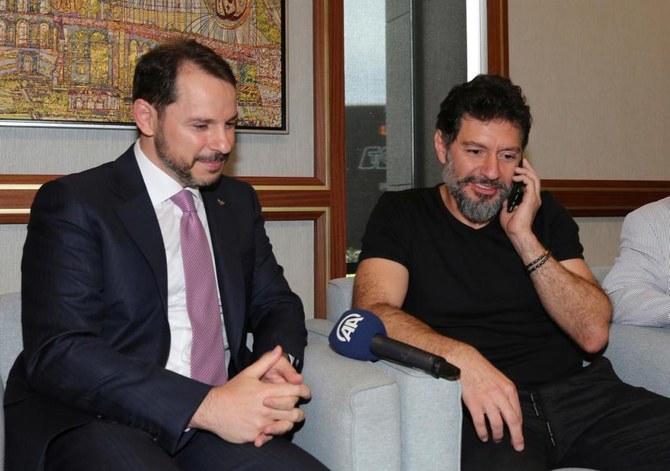
Atilla was an executive at Halkbank when he was sentenced to two and a half years in prison. The sentence was far below the life term recommended by US probation authorities and the 20 years urged by prosecutors.
He has since returned to Turkey. A message was left Monday seeking comment from his Washington-based attorney.
The trial of Atilla featured testimony by wealthy Turkish-Iranian gold trader Reza Zarrab, who pleaded guilty in a deal with prosecutors. Zarrab’s arrest a year before Atilla initially attracted considerable attention to the case because he was married to Turkish pop star and TV personality Ebru Gundes.
Zarrab testified that he paid over $50 million in bribes to Turkey’s finance minister to help the sanctions-busting scheme flourish.
For a time, former New York Mayor Rudolph Giuliani and Michael B. Mukasey, a former attorney general in President George W. Bush’s administration, attempted to negotiate a resolution to the case with Erdogan and Trump administration officials. The talks in 2017 failed to produce a deal.

US court upholds Turkish banker’s conviction in Iran case
Short Url
https://arab.news/vzuve
US court upholds Turkish banker’s conviction in Iran case
- Atilla’s arrest and prosecution drew an outcry from high-level Turkish officials, including President Recep Tayyip Erdogan
- Atilla was an executive at Halkbank when he was sentenced to two and a half years in prison – he has since returned to Turkey
Russia’s war footing may remain after Ukraine war, Latvia spy chief warns
MUNICH: Russia will not end the militarization of its economy after fighting in Ukraine ends, the head of Latvia’s intelligence agency told AFP on the sidelines of the Munich Security Conference which ends Sunday.
“The potential aggressiveness of Russia when the Ukraine war stops will depend of many factors: How the war ends, if it’s frozen or not, and if the sanctions remain,” Egils Zviedris, director of the Latvian intelligence service SAB, told AFP.
Some observers believe that Russia has so thoroughly embraced a war economy and full military mobilization that it will be difficult for it to reverse course, and that this could push Moscow to launch further offensives against European territories.
Zviedris said that lifting current sanctions “would allow Russia to develop its military capacities” more quickly.
He acknowledged that Russia has drawn up military plans to potentially attack Latvia and its Baltic neighbors, but also said that “Russia does not pose a military threat to Latvia at the moment.”
“The fact that Russia has made plans to invade the Baltics, as they have plans for many things, does not mean Russia is going to attack,” Zviedris told AFP.
However, the country is subject to other types of threats from Moscow, particularly cyberattacks, according to the agency he leads.
The SAB recently wrote in its 2025 annual report that Russia poses the main cyber threat to Latvia, because of broader strategic goals as well as Latvia’s staunch support of Ukraine.
The threat has “considerably increased” since Moscow’s full-scale invasion of Ukraine in 2022, it said.
The agency has also warned that Russia is seeking to exploit alleged grievances of Russian-speaking minorities in the Baltics — and in Latvia in particular.
Russia’s Ministry of Foreign Affairs has repeatedly claimed to be preparing cases against Latvia, Lithuania and Estonia at the UN International Court of Justice over the rights of their Russian-speaking minorities.
“The aim of litigation: to discredit Latvia on an international level and ensure long-term international pressure on Latvia to change its policy toward Russia and the Russian-speaking population,” the report said.
In 2025, approximately 23 percent of Latvia’s 1.8 million residents identified as being of Russian ethnicity, according to the national statistics office.
Following the Russian invasion of Ukraine in 2022, Latvian authorities decided to require Russian speakers residing in the country to take an exam to assess their knowledge of the Latvian language — with those failing at potential risk of deportation.
“The potential aggressiveness of Russia when the Ukraine war stops will depend of many factors: How the war ends, if it’s frozen or not, and if the sanctions remain,” Egils Zviedris, director of the Latvian intelligence service SAB, told AFP.
Some observers believe that Russia has so thoroughly embraced a war economy and full military mobilization that it will be difficult for it to reverse course, and that this could push Moscow to launch further offensives against European territories.
Zviedris said that lifting current sanctions “would allow Russia to develop its military capacities” more quickly.
He acknowledged that Russia has drawn up military plans to potentially attack Latvia and its Baltic neighbors, but also said that “Russia does not pose a military threat to Latvia at the moment.”
“The fact that Russia has made plans to invade the Baltics, as they have plans for many things, does not mean Russia is going to attack,” Zviedris told AFP.
However, the country is subject to other types of threats from Moscow, particularly cyberattacks, according to the agency he leads.
The SAB recently wrote in its 2025 annual report that Russia poses the main cyber threat to Latvia, because of broader strategic goals as well as Latvia’s staunch support of Ukraine.
The threat has “considerably increased” since Moscow’s full-scale invasion of Ukraine in 2022, it said.
The agency has also warned that Russia is seeking to exploit alleged grievances of Russian-speaking minorities in the Baltics — and in Latvia in particular.
Russia’s Ministry of Foreign Affairs has repeatedly claimed to be preparing cases against Latvia, Lithuania and Estonia at the UN International Court of Justice over the rights of their Russian-speaking minorities.
“The aim of litigation: to discredit Latvia on an international level and ensure long-term international pressure on Latvia to change its policy toward Russia and the Russian-speaking population,” the report said.
In 2025, approximately 23 percent of Latvia’s 1.8 million residents identified as being of Russian ethnicity, according to the national statistics office.
Following the Russian invasion of Ukraine in 2022, Latvian authorities decided to require Russian speakers residing in the country to take an exam to assess their knowledge of the Latvian language — with those failing at potential risk of deportation.
© 2026 SAUDI RESEARCH & PUBLISHING COMPANY, All Rights Reserved And subject to Terms of Use Agreement.