Turkish banker released from US prison

Erdogan's government has called the trial a "plot" and he has demanded the release of Zarrab and defendant, Mehmet Hakan Atilla, the deputy chief executive of Turkish lender Halkbank. (File/AFP)
Updated 20 July 2019
Follow

Turkish banker released from US prison

  • Mehmet Hakan Atilla, 47, deputy director general of Turkish lender Halkbank, was arrested in March 2017 and convicted the following year on five counts of bank fraud and conspiracy following a five-week trial in New York
  • Erdogan has repeatedly rejected the allegations, saying Turkey did not violate the US embargo on Iran and that political rivals were behind the case

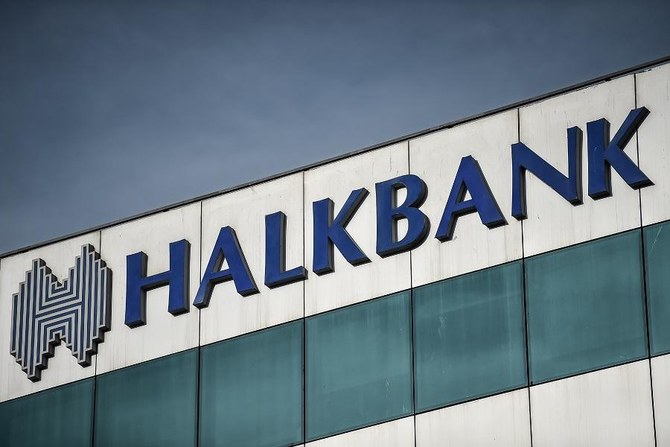
NEW YORK: A Turkish banker convicted for plotting to help Iran evade American sanctions on Iranian oil proceeds has been released from US prison, according to his lawyer and prison officials.
Mehmet Hakan Atilla, 47, deputy director general of Turkish lender Halkbank, was arrested in March 2017 and convicted the following year on five counts of bank fraud and conspiracy following a five-week trial in New York.
He was handed over to immigration police on Friday pending his deportation to Turkey, his lawyer Victor Rocco told AFP. Prison authorities confirmed his release.
Atilla claimed that he had only played a minor role in the scheme and acted as executor of instructions by the bank’s director general — an argument accepted by the court.
Prosecutors had wanted a 20-year sentence for the banker.
His conviction hinged on the testimony of Turkish-Iranian gold trader Reza Zarrab, who was arrested by US authorities in 2016 after jetting to Florida with his pop-star wife and child on a family holiday to Disney World.
Zarrab, 34, initially pleaded not guilty then flipped, becoming a US government witness after admitting being involved in the multi-billion-dollar gold-for-oil scheme to subvert US economic sanctions against Iran.
His testimony identified Atilla as a key organizer in the scheme, but also implicated former Turkish ministers and even President Recep Tayyip Erdogan.
Testifying in court last November, Zarrab said he was told that Erdogan, as prime minister in 2012, and treasury minister Ali Babacan gave “instructions” to two public banks to take part in the scheme.
Erdogan has repeatedly rejected the allegations, saying Turkey did not violate the US embargo on Iran and that political rivals were behind the case.
Zarrab’s sentence is not known, as many of the documents in his case have remained confidential.


Brazil, India eye critical minerals deal as leaders meet

Updated 1 sec ago
Follow

Brazil, India eye critical minerals deal as leaders meet

  • The two leaders are expected to sign a memorandum on critical minerals and discuss efforts to increase trade links
NEW DELHI: India’s Prime Minister Narendra Modi and Brazilian President Luiz Inacio Lula da Silva are set to meet in New Delhi on Saturday, seeking to boost cooperation on critical minerals and rare earths.
Brazil has the world’s second-largest reserves of these elements, which are used in everything from electric vehicles, solar panels and smartphones to jet engines and guided missiles.
India, seeking to cut its dependence on top exporter China, has been expanding domestic production and recycling while scouting for new suppliers.
Lula, heading a delegation of more than a dozen ministers as well as business leaders, arrived in New Delhi on Wednesday for a global summit.
Officials have said that in talks with Modi on Saturday, the two leaders are expected to sign a memorandum on critical minerals and discuss efforts to increase trade links.
The world’s most populous nation is already the 10th largest market for Brazilian exports, with bilateral trade topping $15 billion in 2025.
The two countries have set a trade target of $20 billion to be achieved by 2030.
With China holding a near-monopoly on rare earths production, some countries are seeking alternative sources.
Rishabh Jain, an expert with the Delhi-based Council on Energy, Environment and Water think tank, said India’s growing cooperation with Brazil on critical minerals complements recent supply chain engagements with the United States, France and the European Union.
While these partnerships grant India access to advanced technologies, finance and high-end processing capabilities, “Global South alliances are critical for securing diversified, on-ground resource access and shaping emerging rules of global trade,” Jain said.
‘Challenges’
Modi and Lula are also expected to discuss global economic headwinds and strains on multilateral trade systems after both of their countries were hit by US tariffs in 2025, prompting the two leaders to call for stronger cooperation.
Washington has since pledged to roll back duties on Indian goods under a trade deal announced earlier this month.
“Lula and Modi will have the opportunity to exchange views on … the challenges to multilateralism and international trade,” said Brazilian diplomat Susan Kleebank, the secretary for Asia and the Pacific.
Brazil is India’s biggest partner in Latin America.
Key Brazilian exports to India include sugar, crude oil, vegetable oils, cotton and iron ore.
Demand for iron ore has been driven by rapid infrastructure expansion and industrial growth in India, which is on track to become the world’s fourth largest economy.
Brazilian firms are also expanding in the country, with Embraer and Adani Group announcing plans last month to build aircraft in India.
Lula addressed the AI Impact summit in Delhi on Thursday, calling for a multilateral and inclusive global governance framework for artificial intelligence.
He will travel on to South Korea for meetings with President Lee Jae Myung and to attend a business forum.