

Blow to Erdogan as US boots Turkey out of F-35 strike fighter program

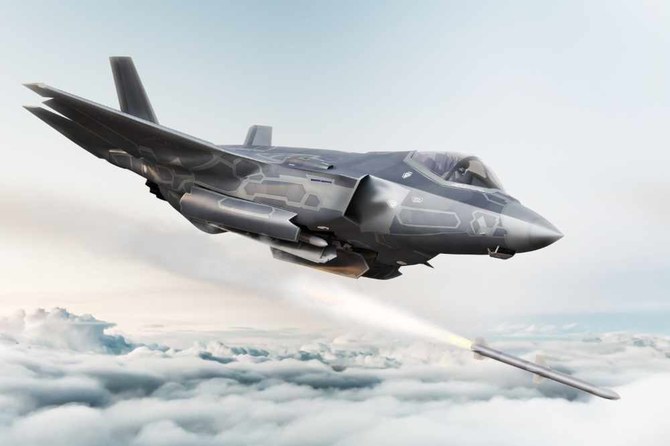
A 3D rendering of an F-35 advanced military aircraft locking on target and firing missile. (Shutterstock)
Short Url
Updated 19 July 2020
Follow

Blow to Erdogan as US boots Turkey out of F-35 strike fighter program

  • Companies in Ankara’s defense industry lose access to lucrative technology know-how
  • The move had been widely expected since Turkey took delivery last year of the Russian S-400 surface-to-air missile defense system

ANKARA: The removal of Turkey from the list of “global participants” on the US F-35 joint strike fighter program’s official website carries political significance in terms of showing the Pentagon’s determination to push its NATO ally to make a final decision about its controversial purchase of a Russian air defense system.

Turkey’s contribution to the F-35 fighter jets’ supply chain was suspended following its receipt of parts of the S-400 surface-to-air defense system last July.

But the system has not yet been made operational, although Turkey has also refused to give up the S-400 completely. It even tested its radar system in Ankara against some of its air force’s US-made F-16 fighter jets last November.

However, the activation of the S-400 missile system that was scheduled for April is still delayed. Turkey has also been banned by the US from ordering F-35s for its air force.

The only condition for Ankara to become a contributor again and feature in the F-35 list is to move the system outside the country because F-35s cannot coexist with a Russian intelligence gathering platform that might detect their stealth capabilities and harm the long-term security of the alliance by spying on the jets.

Turkey’s industrial engagement in the F-35 program brought a significant economic boost to the country, with 10 contributing companies supplying more than 900 parts worth about $12 billion.

Lockheed Martin, as the prime contractor on the F-35 program, and the US government had to find new suppliers for the parts that were previously manufactured by Turkish companies.

But Turkey was cited until recently as one of the nine principal contributors on the program’s official website along with the US, Australia, Canada, Denmark, Italy, Netherlands, Norway and the UK.

A retired senior official from Turkey’s Foreign Ministry believed the country would delay the operation of the S-400, worth $2.5 billion, for a lengthy period due to economic and regional challenges.

“Under deepening conditions of economic recession, Ankara will not risk facing potential US sanctions in case it operationalizes the controversial Russian system,” the official told Arab News. “Meanwhile, Turkish officials still have a slight hope to get credit opportunities from the US for overcoming its cash problems. It may force Ankara to think twice about not being eligible for sanctions.”

Can Kasapoglu, a defense analyst from the Center for Economics and Foreign Policy Studies, said the country’s exclusion from the F-35 program was a great loss for the Turkish defense ecosystem.

“Many aerospace firms were involved in the project with lucrative technology know-how gains and co-production opportunities,” he told Arab News. “All these achievements were perfectly in league with Turkey's defense modernization priorities.”

US senators are divided over whether they should downplay the S-400 issue, or further penalize Turkey over its Russia-inclined security reinforcement choices.

In a bid to alleviate the impasse between the two countries and get the Russian system out of Turkey, a US lawmaker proposed last week that the US buy Turkey’s S-400 through an amendment to the 2021 National Defense Authorization Act (NDAA).

This scenario, which was applied in 1997 by purchasing Moldova’s Russian-made Fulcrum fighter jets to keep them away from Iran, enables Ankara to take part in the F-35 program, but will at the same time antagonize Russia and harm the regional balance in Syria and Libya.

To alleviate Russian concerns about such a scenario, Turkey has pledged not to disclose any sensitive information it has related to the S-400 air defence system, as Defence Industries head Ismail Demir announced on Friday during a panel discussion.

However US Senate Foreign Relations Committee chairman, Jim Risch, introduced another harsher amendment that would mandate President Donald Trump’s administration to impose measures from the Countering America's Adversaries Through Sanctions Act (CAATSA) on Turkey within 30 days of the NDAA adoption because, under CAATSA, any nation procuring defense items from Russia should be subject to sanctions.

“The removal of Turkey from the list of global participants under the US’ F-35 joint strike fighter program’s official website is, as we say in Turkish, announcing what is already known, which is that Turkey is no longer part of the F-35 program,” Ozgur Unluhisarcikli, Ankara office director of the German Marshall Fund of the United States, told Arab News.

He said that the move did not, however, prevent Turkey’s readmission to the program if and when the S-400 problem was resolved.


Israel to partially reopen Gaza’s Rafah crossing

Updated 01 February 2026
Follow

Israel to partially reopen Gaza’s Rafah crossing

  • Reopening comes amid ongoing violence in the Palestinian territory
  • Gaza’s civil defense agency says dozens killed in Israeli attacks on Saturday

RAFAH, Palestinian Territories: Israel is set to partially reopen the Rafah crossing between the war-devastated Gaza Strip and Egypt on Sunday, following months of urging from humanitarian organizations, though access will be limited to the movement of people.

The reopening comes amid ongoing violence in the Palestinian territory, with Gaza’s civil defense agency reporting dozens killed in Israeli attacks on Saturday, while the Israeli military said it was retaliating against ceasefire violations.

The Rafah crossing is a vital gateway for both civilians and aid, but has remained closed since Israeli forces seized control of it in May 2024 during the war with Hamas, aside from a brief and limited reopening in early 2025.

Israel had previously said it would not reopen the crossing until the remains of Ran Gvili — the last Israeli hostage held in Gaza — were returned.

His remains were recovered days ago and he was laid to rest in Israel on Wednesday.

“The Rafah Crossing will open this coming Sunday (February 1st) in both directions, for limited movement of people only,” COGAT, an Israeli defense ministry body overseeing civil affairs in the occupied Palestinian territories, said on Friday.

Entry and exit “will be permitted in coordination with Egypt, following prior security clearance of individuals by Israel, and under the supervision of the European Union mission,” it added.

However, key details remain unclear, including how many people will be allowed to cross and whether those seeking to return to Gaza will be permitted entry.

A source at the border told AFP that Sunday would be largely devoted to preparations and logistical arrangements.

The crossing is set to open on Sunday on a trial basis to allow the passage of wounded individuals, ahead of a regular reopening scheduled for Monday, three sources at the crossing said.

However, no agreement has yet been reached on the number of Palestinians permitted to enter or exit, the sources added, noting that Egypt plans to admit “all Palestinians whom Israel authorizes to leave” the territory.

“Every day that passes drains my life and worsens my condition,” said Mohammed Shamiya, 33, who suffers from kidney disease and requires dialysis treatment abroad.

“I’m waiting every moment for the opening of the Rafah land crossing.”

Anxious wait

Safa Al-Hawajri, who has received a scholarship to study overseas, is also eagerly awaiting the reopening on Sunday.

“I’m waiting in the hope of fulfilling my ambition, which is tied to the reopening of the crossing,” said Hawajri, 18.

“I hope to be able to travel as soon as it opens.”

Located on Gaza’s southern border with Egypt, Rafah is the only crossing into and out of the territory that does not pass through Israel.

The crossing lies in an area held by Israeli forces following their withdrawal behind the so-called “Yellow Line” under the terms of a US-brokered ceasefire that came into effect on October 10.

Israeli troops still control more than half of Gaza, while the rest remains under Hamas authority.

The ceasefire has now entered its second phase and calls for reopening the crossing following the release or return of all Israeli hostages held by Palestinian militants.

Hamas had called for its full reopening in both directions after the remains of Gvili were brought back to Israel.

The reopening is expected to facilitate the entry of a 15-member Palestinian technocratic body, the National Committee for the Administration of Gaza (NCAG), established to oversee the day-to-day governance of the territory’s 2.2 million residents.

The committee is to operate under the supervision of the so-called “Board of Peace” chaired by US President Donald Trump.

The NCAG, headed by former Palestinian Authority deputy minister Ali Shaath, is expected to enter the Gaza Strip once the Rafah crossing reopens.

Violence continued ahead of the crossing’s reopening.

At least 32 people, including children, were killed on Saturday in Israeli air strikes in Gaza, reported the civil defense agency, which operates as a rescue force under the Hamas authority.

Israel’s military said the strikes were retaliation for an incident on Friday in which eight Palestinian fighters exited a tunnel in the city of Rafah, which it said violated the ceasefire.