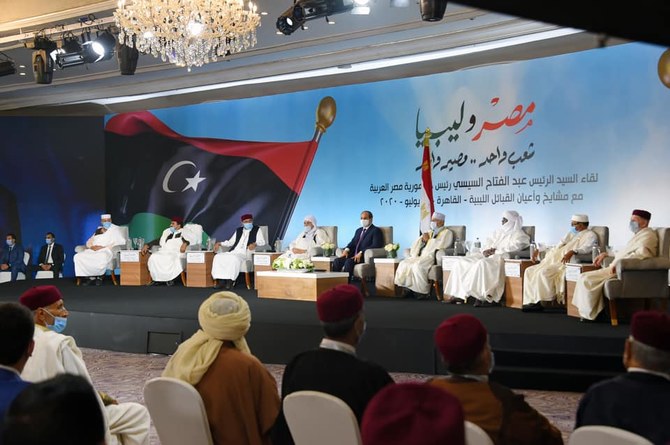

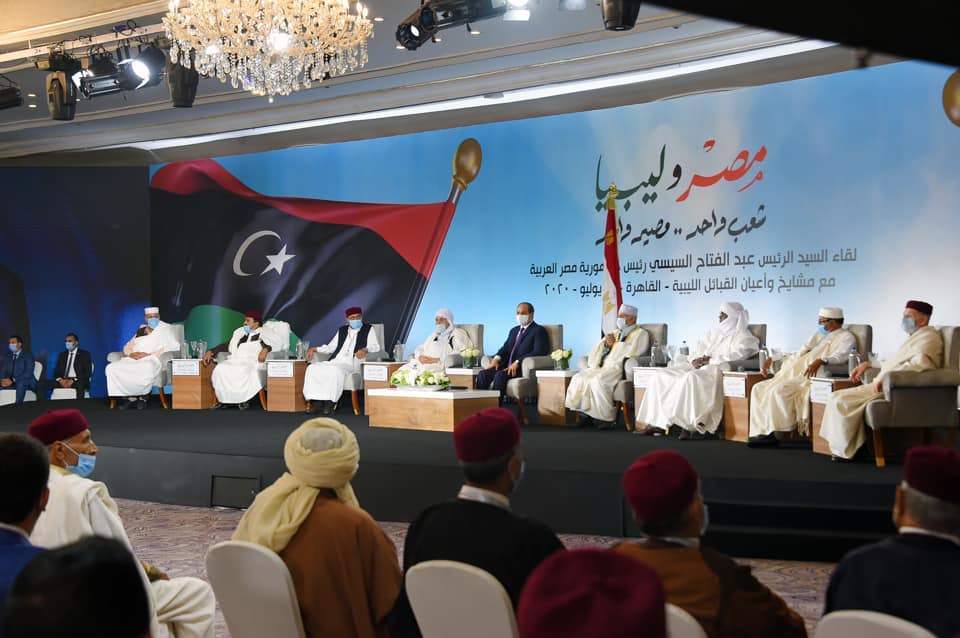
CAIRO: Libyan tribal leaders met with Egyptian President Abdel Fattah El-Sisi on Thursday after flying from Benghazi to discuss the crisis in their country.
Bassam Radi, spokesman for the Egyptian presidency, said the meeting was held under the slogan “Egypt and Libya: One Nation and One Destiny.” Radi said El-Sisi told the Libyan tribes Egypt’s goal is to “activate the free will” of the Libyan people to have a better future for their country.
Head of the Supreme Council of Sheikhs and Notables of Libya Muhammad Al-Misbahi said the tribal delegation in Egypt represented all sects of the Libyan people. He thanked the Egyptian president, who announced his support for Libya.
“We need the support of the Egyptian armed forces to expel the Turkish colonizer,” Al-Misbahi said.
Turkey recently sent thousands of Syrian mercenaries to the country to support the Government of National Accord (GNA) in its conflict with the Libyan National Army (LNA).
Al-Mabrouk Abu Ameed, head of the Supreme Council of the Warshefana tribes and official spokesman for the Conference of Libyan Tribes and Cities, said that leaders met the Egyptian president to form a plan between the two countries. The group also pushed to activate a joint Arab defense agreement and called for the support of the Libyan armed forces.
They asked for legal measures to guarantee the unity and sovereignty of Libya and the protection of its people.
Abdel-Karim Al-Orfi, official spokesman for the Supreme Council of Sheikhs and Notables of Libya, said the delegation’s visit to Egypt highlights the strong historical relationship between Libyan and Egyptian tribes, sending a message to the world that Arab nations are united.
He added that the Supreme Council has maintained a consistent position since the beginning of the Turkish invasion.
At least 7,000 sheikhs gathered in the city of Tarhuna in February to release a statement which described the Turkish strategy as an “invasion.” It was followed by several statements calling on tribes to resist Turkish activity in the country.
The statements said the relationship between the Egyptian and Libyan people “is not one that was requested but rather a relationship that comes from a clear fate that will be impacted if either countries are exposed to danger.” The council called on tribal volunteers to resist the invasion.
Ramzi Al-Rumaih, adviser to the Libyan Organization for National Security Studies, said visits to Egypt by tribal elders have happened for hundreds of years. There are more than 15 million Egyptians in Egypt who have Libyan backgrounds.
“Libyan tribal elders came to Cairo to emphasize everything that was stated in the Cairo initiative, as Egypt knows the strategic dimension of its neighboring country Libya,” Al-Rumaih said.
Egypt oversaw the Cairo Declaration, a new peace plan to restore stability in Libya following months of armed conflict between the GNA and LNA.
“The tribal elders who met the Egyptian president confirmed that the 2,000 tribes know that Egypt is a safe place,” Al-Rumaih added.
El-Sisi said in a speech last month that Sirte and Al-Jufra are strategically important in Libya, and that they represent a “red line” for the Egypt.
During the speech, the leader said Egyptian intervention in Libya had become legal.
“The Egyptian forces readiness to fight has become a necessity,” he added.
He said that Egypt is keen to reach a comprehensive settlement in Libya and wants to maintain the country’s sovereignty and territorial integrity.