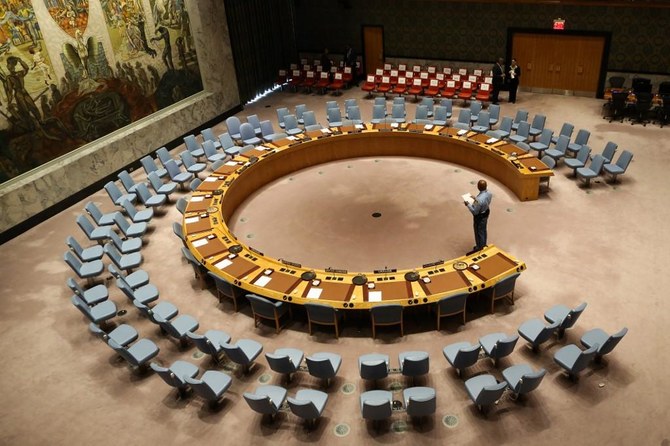
United Nations, US: Russia and China on Tuesday vetoed a UN Security Council resolution that would have extended authorization for cross-border humanitarian aid in Syria for a year, though Moscow swiftly proposed a more limited extension.
Germany and Belgium, two of the council’s non-permanent members, had drafted the resolution, which would have allowed aid to continue to pass through two points on the Turkish border without interference from Damascus.
Beyond Russia and China, the other 13 council members voted to approve the draft, the diplomats said.
During negotiations, Moscow had asked that the extension be limited to six months, rather than a year, and that it only be allowed at one border crossing, not two, they said.
“The draft resolution has not been adopted,” Germany’s UN ambassador Christoph Heusgen, the acting president of the body in July, confirmed in a letter to Council members.
Immediately after the vote, Russia proposed its own draft resolution.
Obtained by AFP, it repeats the call for a six-month extension, underlines the improvement in the delivery of humanitarian aid under the control of the Syrian regime, and excludes one of the two entry points into Syria — Bab Al-Salam — from the mechanism.
The results of a vote on that resolution will be known on Wednesday.
Authorization for cross-border humanitarian aid has existed since 2014, with periodic extensions. The latest extension expires on Friday.
Tuesday’s vote was the 15th time that Russia has used its veto since the start of the Syrian war in 2011, and the ninth for China.
They argue that the UN authorization violates Syria’s sovereignty, and that aid can increasingly be channelled through Syrian authorities.
Western nations and the UN secretariat however insist that cross-border aid is the only credible option, and that relief supplies would face multiple obstacles if they had to pass through Damascus’ control.
The veto was an “extremely negative development,” one European diplomat said on condition of anonymity.
“They want to strangle the population even more,” the diplomat said, adding that aid “cannot reach the population from one” crossing point.
“Insisting on only one crossing point is cynical and it doesn’t meet the needs of the people,” the source said.
The Bab Al-Hawa crossing point allows for shipments of humanitarian aid to the three to four million people living in the opposition-held Idlib region.
The International Rescue Committee quickly condemned the veto.
“Blocking access to food, health care supplies, vaccines, and ventilators is unacceptable anytime but in the year of COVID-19, it is even more reprehensible,” said IRC president David Miliband in a statement.
After the vote, China explained that it too was in favor of maintaining the cross-border authorization.
Its veto is due to the refusal of Germany and Belgium to take into account its request for a statement condemning the unilateral US sanctions imposed on Syria, Chinese diplomats said.
In January, Moscow, Syria’s closest ally, succeeded in having the crossing points reduced from four to two and in limiting the authorization to six months instead of a year, as had been done previously.
In a report in late June, UN Secretary-General Antonio Guterres called for a one-year extension of the use of the two crossing points.
Guterres said that since 2014, 4,774 trucks have used the Bab Al-Salam crossing and 28,574 have used Bab Al-Hawa.
According to a report published by the UN in Geneva on Tuesday, the humanitarian situation in Idlib province is disastrous.
“Syria’s economy is devastated,” said Hanny Megally, one of the authors of the report.
“The country has been in a nine-year conflict. People are suffering.”

Russia, China veto UN extension of cross-border aid in Syria
Short Url
https://arab.news/89pd5
Russia, China veto UN extension of cross-border aid in Syria
- Beyond Russia and China, the other 13 council members voted to approve the draft
- Moscow had asked that the extension be limited to six months
Jailed Turkish Kurd leader calls on government to broker deal for Syrian Kurds
- Clashes between Syrian forces and the SDF have cast doubt over a deal to integrate the group’s fighters into the army
ANKARA: Jailed Turkish Kurd leader Abdullah Ocalan said Tuesday that it was “crucial” for Turkiye’s government to broker a peace deal between the Kurdish-led Syrian Democratic Forces (SDF) and the Damascus government.
Clashes between Syrian forces and the SDF have cast doubt over a deal to integrate the group’s fighters into the army, which was due to take effect by the end of the year.
Ocalan, founder of the Kurdistan Workers’ Party (PKK) militant group, called on Turkiye to help ensure implementation of the deal announced in March between the SDF and the Syrian government, led by former jihadist Ahmed Al-Sharaa, whose forces ousted longtime ruler Bashar Assad last year.
“It is essential for Turkiye to play a role of facilitator, constructively and aimed at dialogue,” he said in a message released by Turkiye’s pro-Kurdish DEM party.
“This is crucial for both regional peace and to strengthen its own internal peace,” Ocalan, who has been jailed for 26 years, added.
“The fundamental demand made in the agreement signed on March 10 between the SDF and the government in Damascus is for a democratic political model permitting (Syria’s) peoples to govern together,” he added.
“This approach also includes the principle of democratic integration, negotiable with the central authorities. The implementation of the March 10 agreement will facilitate and accelerate that process.”
The backbone of the US-backed SDF is the YPG, a Kurdish militant group seen by Turkiye as an extension of the PKK.
Turkiye and Syria both face long-running unrest in their Kurdish-majority regions, which span their shared border.
In Turkiye, the PKK agreed this year at Ocalan’s urging to end its four-decade armed struggle.
In Syria, Sharaa has agreed to merge the Kurds’ semi-autonomous administration into the central government, but deadly clashes and a series of differences have held up implementation of the deal.
The SDF is calling for a decentralized government, which Sharaa rejects.
Turkish Foreign Minister Hakan Fidan, whose country sees Kurdish fighters across the border as a threat, urged the SDF last week not to be an “obstacle” to stability.
Syrian Kurdish leader Mazloum Abdi said Thursday that “all efforts” were being made to prevent the collapse of talks.
Clashes between Syrian forces and the SDF have cast doubt over a deal to integrate the group’s fighters into the army, which was due to take effect by the end of the year.
Ocalan, founder of the Kurdistan Workers’ Party (PKK) militant group, called on Turkiye to help ensure implementation of the deal announced in March between the SDF and the Syrian government, led by former jihadist Ahmed Al-Sharaa, whose forces ousted longtime ruler Bashar Assad last year.
“It is essential for Turkiye to play a role of facilitator, constructively and aimed at dialogue,” he said in a message released by Turkiye’s pro-Kurdish DEM party.
“This is crucial for both regional peace and to strengthen its own internal peace,” Ocalan, who has been jailed for 26 years, added.
“The fundamental demand made in the agreement signed on March 10 between the SDF and the government in Damascus is for a democratic political model permitting (Syria’s) peoples to govern together,” he added.
“This approach also includes the principle of democratic integration, negotiable with the central authorities. The implementation of the March 10 agreement will facilitate and accelerate that process.”
The backbone of the US-backed SDF is the YPG, a Kurdish militant group seen by Turkiye as an extension of the PKK.
Turkiye and Syria both face long-running unrest in their Kurdish-majority regions, which span their shared border.
In Turkiye, the PKK agreed this year at Ocalan’s urging to end its four-decade armed struggle.
In Syria, Sharaa has agreed to merge the Kurds’ semi-autonomous administration into the central government, but deadly clashes and a series of differences have held up implementation of the deal.
The SDF is calling for a decentralized government, which Sharaa rejects.
Turkish Foreign Minister Hakan Fidan, whose country sees Kurdish fighters across the border as a threat, urged the SDF last week not to be an “obstacle” to stability.
Syrian Kurdish leader Mazloum Abdi said Thursday that “all efforts” were being made to prevent the collapse of talks.
© 2025 SAUDI RESEARCH & PUBLISHING COMPANY, All Rights Reserved And subject to Terms of Use Agreement.


