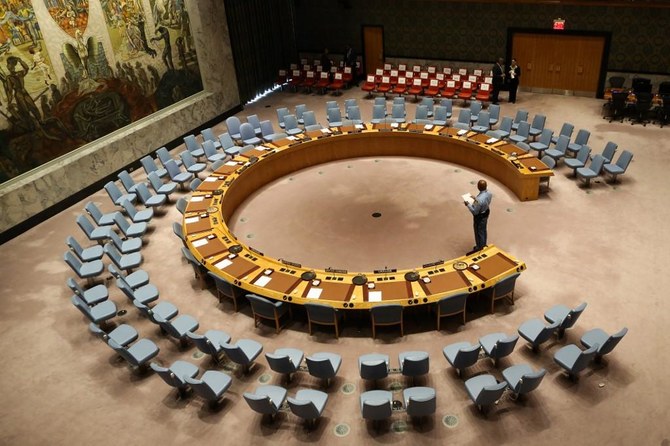
United Nations, US: Russia and China on Tuesday vetoed a UN Security Council resolution that would have extended authorization for cross-border humanitarian aid in Syria for a year, though Moscow swiftly proposed a more limited extension.
Germany and Belgium, two of the council’s non-permanent members, had drafted the resolution, which would have allowed aid to continue to pass through two points on the Turkish border without interference from Damascus.
Beyond Russia and China, the other 13 council members voted to approve the draft, the diplomats said.
During negotiations, Moscow had asked that the extension be limited to six months, rather than a year, and that it only be allowed at one border crossing, not two, they said.
“The draft resolution has not been adopted,” Germany’s UN ambassador Christoph Heusgen, the acting president of the body in July, confirmed in a letter to Council members.
Immediately after the vote, Russia proposed its own draft resolution.
Obtained by AFP, it repeats the call for a six-month extension, underlines the improvement in the delivery of humanitarian aid under the control of the Syrian regime, and excludes one of the two entry points into Syria — Bab Al-Salam — from the mechanism.
The results of a vote on that resolution will be known on Wednesday.
Authorization for cross-border humanitarian aid has existed since 2014, with periodic extensions. The latest extension expires on Friday.
Tuesday’s vote was the 15th time that Russia has used its veto since the start of the Syrian war in 2011, and the ninth for China.
They argue that the UN authorization violates Syria’s sovereignty, and that aid can increasingly be channelled through Syrian authorities.
Western nations and the UN secretariat however insist that cross-border aid is the only credible option, and that relief supplies would face multiple obstacles if they had to pass through Damascus’ control.
The veto was an “extremely negative development,” one European diplomat said on condition of anonymity.
“They want to strangle the population even more,” the diplomat said, adding that aid “cannot reach the population from one” crossing point.
“Insisting on only one crossing point is cynical and it doesn’t meet the needs of the people,” the source said.
The Bab Al-Hawa crossing point allows for shipments of humanitarian aid to the three to four million people living in the opposition-held Idlib region.
The International Rescue Committee quickly condemned the veto.
“Blocking access to food, health care supplies, vaccines, and ventilators is unacceptable anytime but in the year of COVID-19, it is even more reprehensible,” said IRC president David Miliband in a statement.
After the vote, China explained that it too was in favor of maintaining the cross-border authorization.
Its veto is due to the refusal of Germany and Belgium to take into account its request for a statement condemning the unilateral US sanctions imposed on Syria, Chinese diplomats said.
In January, Moscow, Syria’s closest ally, succeeded in having the crossing points reduced from four to two and in limiting the authorization to six months instead of a year, as had been done previously.
In a report in late June, UN Secretary-General Antonio Guterres called for a one-year extension of the use of the two crossing points.
Guterres said that since 2014, 4,774 trucks have used the Bab Al-Salam crossing and 28,574 have used Bab Al-Hawa.
According to a report published by the UN in Geneva on Tuesday, the humanitarian situation in Idlib province is disastrous.
“Syria’s economy is devastated,” said Hanny Megally, one of the authors of the report.
“The country has been in a nine-year conflict. People are suffering.”

Russia, China veto UN extension of cross-border aid in Syria
Short Url
https://arab.news/89pd5
Russia, China veto UN extension of cross-border aid in Syria
- Beyond Russia and China, the other 13 council members voted to approve the draft
- Moscow had asked that the extension be limited to six months
The Iran war has upended flights across the Middle East. Here’s what travelers should know
NEW YORK: The US and Israel’s joint war in Iran has already upended travel across the Middle East, stranding tens of thousands of people. And the future is anything but certain.
Experts stress that flights scheduled in the coming days and weeks could continue to see disruptions — causing ripple effects globally, especially as the war widens with retaliatory strikes in the Gulf states. Beyond the Middle East, airports in the Gulf serve as critical hubs connecting travelers going to Europe, Africa and Asia.
Amid airspace closures across the region, many carriers have been forced to either cancel flights or shift to longer routes. That’s straining operating costs and ticket prices, both of which could become more expensive if airlines have to pay more for fuel the longer the war drags on. In the near future, experts recommend postponing unnecessary travel if possible, checking refund or insurance policies and, most importantly, monitoring safety adviseries.
“This is not a normal delay story. This is a conflict zone airspace story,” said Hassan Shahidi, president and CEO of the Flight Safety Foundation — stressing that halted traffic and guidance from carriers, airports and governments may shift each day, if not by the hour. “Travelers should absolutely expect uncertainty.”
Here’s what travelers should know about upcoming trips.
Monitor adviseries and other safety information
Since the US and Israel launched attacks over the weekend, retaliatory strikes and other developments have unfolded rapidly. Iran says hundreds of people have been killed in the country. For travelers across the region, experts stress the importance of following safety guidance and updates from government officials.
A handful of governments have also issued travel adviseries and emergency evacuation orders. The US State Department on Monday urged all US citizens to immediately leave Iran and Israel, as well as Qatar, Bahrain, Egypt, Iraq, Jordan, Kuwait, Lebanon, Oman, the Palestinian territories, Saudi Arabia, Syria, the United Arab Emirates and Yemen using any available commercial transportation — and Secretary of State Marco Rubio pleaded for the media to publicize ways to help Americans evacuate. Meanwhile, countries like China, Italy, France and Germany moved to organize evacuation efforts for their citizens.
Experts like Shahidi say travelers should monitor these travel adviseries from governments and embassies to make sure they have the latest information. And because so many people are still stranded amid swaths of cancelations and airspace closures, he added that it’s wise to reconsider or rebook upcoming trips, if possible.
“If travel is optional, consider postponing it,” Shahidi said. “But if it’s necessary, then make sure that you get refundable or changeable fares.”
Travelers should also monitor updates from airports and airlines. Long-haul carriers Etihad Airways and Emirates, based in Abu Dhabi and Dubai, along with Doha-based Qatar Airways all temporarily suspended certain routes — citing airspace closures and safety requirements.
Read the fine print of refunds and insurance
Many airlines are taking refund requests or offering free rebooking — but such options are often limited to specific dates or routes, so it’s important for travelers to check carriers’ individual websites for more information. For future trips, buying refundable tickets now may provide more flexibility.
Beyond what individual airlines can offer, some may also be seeking travel insurance. But it’s important to read the fine print, particularly the exclusions listed under specific policies.
“Acts of war and civil unrest are typically excluded because they’re unpredictable,” said Suzanne Morrow, CEO of travel insurance agency InsureMyTrip. Consumers could still buy coverage for delays, she added, but travel insurance is “designed to make you whole,” and if an airline does everything to rebook you or offers a refund, you may not have an added claim.
Christina Tunnah, of World Nomads Travel Insurance, reiterates that the majority of her firm’s policies excludes coverage for losses resulting from acts of war, although someone might be able to get compensation in certain scenarios — such as if they purchase a “cancel for any reason” plan. Still, the traveler would have to cancel within a certain time frame.
Tunnah adds that once an event is known, it’s unlikely to be covered. So if a consumer has not already purchased traveler insurance, many insurers may have added restrictions to impacted destinations.
Brace for longer flights and higher ticket prices
Beyond cancelations, many carriers are now taking longer routes to avoid closed airspace. Shahidi noted that includes not only closures stemming from this current war but also previous conflicts worldwide.
Navigating these different conflict zones has become increasingly difficult for airlines, because longer routes can be more expensive. It’s industry standard for carriers to pay “overflight fees” when flying through other countries’ airspace — which there could be more of now. And, of course, longer flights need more fuel.
“Those costs will be passed on to the passengers,” explained Bryan Terry, managing director at Alton Aviation Consultancy. If the conflict continues, he said, travelers should “anticipate that some carriers will likely impose fuel surcharges” or increase existing fees.
Passengers have already reported seeing sky-high ticket prices. Experts say those immediate hikes more likely reflect supply and demand as thousands of flights were canceled in recent days. But the costs of those longer routes — paired with oil prices that have already spiked since the US and Israel launched their attacks — could trickle down to consumers further ahead.
The price of crude oil is a key component for jet fuel, which accounted for about 30 percent of airlines’ operating costs as of 2024, according to research from the International Air Transport Association.
Many routes within the next week are completely sold out or have exorbitant prices for last remaining seats. The market currently shows those costs, while still elevated, are lower for trips booked further out, Terry notes — but, again, if the war drags on or worsens, “those conditions could change at a moment’s notice.”
Experts stress that flights scheduled in the coming days and weeks could continue to see disruptions — causing ripple effects globally, especially as the war widens with retaliatory strikes in the Gulf states. Beyond the Middle East, airports in the Gulf serve as critical hubs connecting travelers going to Europe, Africa and Asia.
Amid airspace closures across the region, many carriers have been forced to either cancel flights or shift to longer routes. That’s straining operating costs and ticket prices, both of which could become more expensive if airlines have to pay more for fuel the longer the war drags on. In the near future, experts recommend postponing unnecessary travel if possible, checking refund or insurance policies and, most importantly, monitoring safety adviseries.
“This is not a normal delay story. This is a conflict zone airspace story,” said Hassan Shahidi, president and CEO of the Flight Safety Foundation — stressing that halted traffic and guidance from carriers, airports and governments may shift each day, if not by the hour. “Travelers should absolutely expect uncertainty.”
Here’s what travelers should know about upcoming trips.
Monitor adviseries and other safety information
Since the US and Israel launched attacks over the weekend, retaliatory strikes and other developments have unfolded rapidly. Iran says hundreds of people have been killed in the country. For travelers across the region, experts stress the importance of following safety guidance and updates from government officials.
A handful of governments have also issued travel adviseries and emergency evacuation orders. The US State Department on Monday urged all US citizens to immediately leave Iran and Israel, as well as Qatar, Bahrain, Egypt, Iraq, Jordan, Kuwait, Lebanon, Oman, the Palestinian territories, Saudi Arabia, Syria, the United Arab Emirates and Yemen using any available commercial transportation — and Secretary of State Marco Rubio pleaded for the media to publicize ways to help Americans evacuate. Meanwhile, countries like China, Italy, France and Germany moved to organize evacuation efforts for their citizens.
Experts like Shahidi say travelers should monitor these travel adviseries from governments and embassies to make sure they have the latest information. And because so many people are still stranded amid swaths of cancelations and airspace closures, he added that it’s wise to reconsider or rebook upcoming trips, if possible.
“If travel is optional, consider postponing it,” Shahidi said. “But if it’s necessary, then make sure that you get refundable or changeable fares.”
Travelers should also monitor updates from airports and airlines. Long-haul carriers Etihad Airways and Emirates, based in Abu Dhabi and Dubai, along with Doha-based Qatar Airways all temporarily suspended certain routes — citing airspace closures and safety requirements.
Read the fine print of refunds and insurance
Many airlines are taking refund requests or offering free rebooking — but such options are often limited to specific dates or routes, so it’s important for travelers to check carriers’ individual websites for more information. For future trips, buying refundable tickets now may provide more flexibility.
Beyond what individual airlines can offer, some may also be seeking travel insurance. But it’s important to read the fine print, particularly the exclusions listed under specific policies.
“Acts of war and civil unrest are typically excluded because they’re unpredictable,” said Suzanne Morrow, CEO of travel insurance agency InsureMyTrip. Consumers could still buy coverage for delays, she added, but travel insurance is “designed to make you whole,” and if an airline does everything to rebook you or offers a refund, you may not have an added claim.
Christina Tunnah, of World Nomads Travel Insurance, reiterates that the majority of her firm’s policies excludes coverage for losses resulting from acts of war, although someone might be able to get compensation in certain scenarios — such as if they purchase a “cancel for any reason” plan. Still, the traveler would have to cancel within a certain time frame.
Tunnah adds that once an event is known, it’s unlikely to be covered. So if a consumer has not already purchased traveler insurance, many insurers may have added restrictions to impacted destinations.
Brace for longer flights and higher ticket prices
Beyond cancelations, many carriers are now taking longer routes to avoid closed airspace. Shahidi noted that includes not only closures stemming from this current war but also previous conflicts worldwide.
Navigating these different conflict zones has become increasingly difficult for airlines, because longer routes can be more expensive. It’s industry standard for carriers to pay “overflight fees” when flying through other countries’ airspace — which there could be more of now. And, of course, longer flights need more fuel.
“Those costs will be passed on to the passengers,” explained Bryan Terry, managing director at Alton Aviation Consultancy. If the conflict continues, he said, travelers should “anticipate that some carriers will likely impose fuel surcharges” or increase existing fees.
Passengers have already reported seeing sky-high ticket prices. Experts say those immediate hikes more likely reflect supply and demand as thousands of flights were canceled in recent days. But the costs of those longer routes — paired with oil prices that have already spiked since the US and Israel launched their attacks — could trickle down to consumers further ahead.
The price of crude oil is a key component for jet fuel, which accounted for about 30 percent of airlines’ operating costs as of 2024, according to research from the International Air Transport Association.
Many routes within the next week are completely sold out or have exorbitant prices for last remaining seats. The market currently shows those costs, while still elevated, are lower for trips booked further out, Terry notes — but, again, if the war drags on or worsens, “those conditions could change at a moment’s notice.”
© 2026 SAUDI RESEARCH & PUBLISHING COMPANY, All Rights Reserved And subject to Terms of Use Agreement.


