

Investigation report calls deadly 2012 Pakistani factory fire ‘planned sabotage’

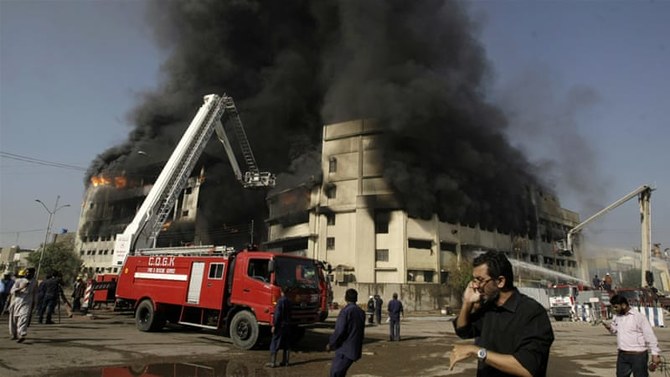
A firetruck stands outside the Baldia Town textile factory where a fire killed 259 people in Karachi, Pakistan, on September 11, 2012. (AP)
Short Url
Updated 07 July 2020
Follow

Investigation report calls deadly 2012 Pakistani factory fire ‘planned sabotage’

  • At least 259 died in a fire at a textile factory in Karachi’s industrial suburb of Baldia Town in September 2012 
  • Investigation report holds members of the MQM party responsible the fire over factory owners’ refusal to pay extortion money 

ISLAMABAD: An investigation report into a 2012 fire at a factory in Pakistan’s teeming commercial capital of Karachi called the incident “planned sabotage” over owners refusing to pay extortion money and share profits with members of a powerful political party.

Fire ravaged a cramped textile factory in Karachi’s industrial suburb of Baldia Town in September 2012, killing 259 workers trapped behind locked doors. Officials called it Pakistan’s worst industrial accident, which came just hours after another fire at a shoe factory in the eastern city of Lahore killed at least 25.

“That factory fire was a ‘planned sabotage/terrorist activity’ and ‘not an accidental fire’ carried out due to refusal to pay extortion (Bhatta) of Rs.20 (Twenty) Crores and partnership in factory profits by factory owners to office bearers namely Rehman Bhola and Hammad Siddiqui of MQM-A,” the investigation report, made public on Monday, said, referring to the Muttahida Qaumi Movement party of Altaf Hussain, Karachi’s most powerful and, until recently, untouchable political leader.

Initial investigations into the fire had determined that the death toll greatly increased because of illegal practices at the factory, reviving concerns about the regulation of Pakistan’s manufacturing sector, which is centered in Karachi.

But the investigation report by the joint investigation team has said it believed, unanimously, that the incident was not an accidental one, recommending that police file terrorism cases against Rehman Bhola, Hammad Siddiqui, Zubair Charia, Omer Hassan Qadri, Dr. Abdul Sattar, Ali Hassan Qadri, Iqbal Adeeb Khanum and four other unknown associates.

The MQM has not commented on the investigation report so far.


Bodies of Pakistani nationals who died attempting illegal migration repatriated from Iran

Updated 31 December 2025
Follow

Bodies of Pakistani nationals who died attempting illegal migration repatriated from Iran

  • Pakistan’s envoy in Tehran warns youth against human smugglers after deaths in harsh weather
  • Pakistan reported sharp fall in illegal migration to Europe this year amid nationwide crackdown

ISLAMABAD: The bodies of two Pakistani nationals, who died near the Iran-Türkiye border after attempting to travel illegally to Europe, have been repatriated to the country, said a senior diplomat on Tuesday, reiterating warnings against human smugglers amid an intensified crackdown by authorities in Islamabad on illegal migration.

Pakistan says it has stepped up action against illegal immigration and human trafficking in recent years, reporting a 47% drop in illegal migration to Europe this year and the arrest of more than 1,700 suspected human smugglers, according to official figures.

However, people continue to attempt dangerous irregular journeys in search of work and better economic opportunities abroad.

“The mortal remains of Pakistani nationals Mr. Armanullah s/o Gul Rahman and Mr. Ihtasham s/o Mukhtar Gul, both residents of Nowshera, have been repatriated to Pakistan through Taftan border earlier today,” Pakistan’s ambassador to Iran, Muhammad Mudassir Tipu, said in a post on social media platform X. “Both had fallen victim to the greed of human smugglers and lost their lives in extremely harsh weather conditions near Iran’s border with Turkiye.”

“I once again request the youth back home not to be trapped by human smugglers and instead follow the legal path to travel abroad,” he added, thanking the government of the Balochistan province in Pakistan for arranging the transportation of the bodies and offering condolences to the victims’ families.

The issue illegal immigration has drawn heightened scrutiny since 2023, when hundreds of people, including Pakistani nationals, died attempting to cross the Mediterranean Sea in an overcrowded vessel that sank off the Greek coast, prompting Islamabad to launch nationwide investigations into human smuggling and trafficking networks.

Authorities have since arrested Pakistani and foreign nationals at airports with forged travel documents, highlighting the scale of document fraud linked to illegal departures.

In September, the Federal Investigation Agency (FIA) released a list of more than 100 of Pakistan’s “most wanted” human smugglers and identified major trafficking hubs across Punjab province and the capital, Islamabad.

Earlier this month, Pakistan announced plans to roll out an artificial intelligence-based immigration screening system at Islamabad airport from January, aimed at detecting forged documents and preventing illegal travel abroad, as part of broader efforts to curb human smuggling and unauthorized migration.