Pakistan starts local production of ventilators

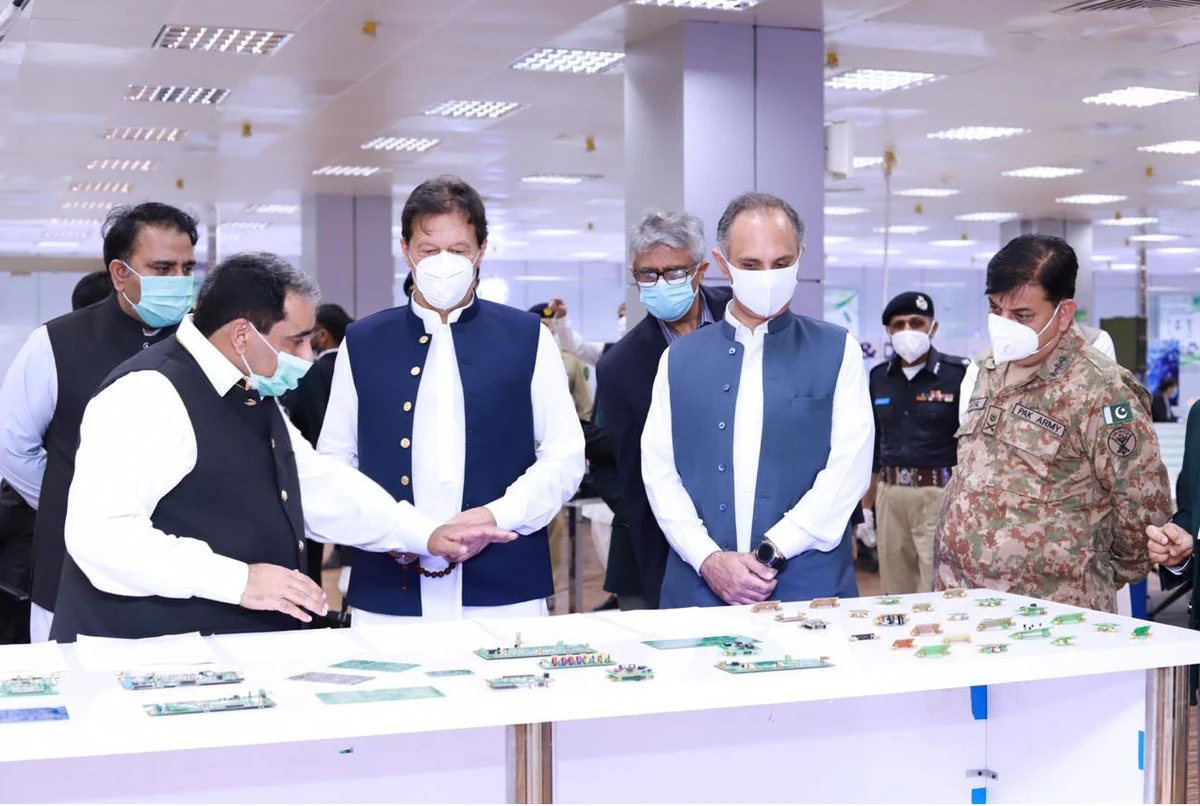
Prime Minister Imran Khan, center, inaugurates Pakistan's first facility to produce ventilators at the National Radio and Telecommunication Corporation (NRTC) in Haripur, Khyber Pakhtunkhwa, on July 6, 2020. (PID)
Short Url
Updated 07 July 2020
Follow

Pakistan starts local production of ventilators

  • First batch of SafeVent SP 100 ventilators delivered to National Disaster Management Authority
  • NRTC can manufacture between 250 and 300 units per month

ISLAMABAD: Prime Minister Imran Khan inaugurated Pakistan's first facility to produce ventilators in Haripur district, Khyber Pakhtunkhwa on Monday.
The ventilators — SafeVent SP 100 — will be produced at the National Radio and Telecommunication Corporation (NRTC), which according to a statement by the prime minister's office has a production capacity to manufacture between 250 and 300 units per month.

Calling it "a landmark achievement for Pakistan," the premier congratulated the entire team.
He said that amid the ongoing coronavirus outbreak, the government is now focused on reforming the health sector.
"Our approach in response to the pandemic and adopting smart lockdowns while keeping the economy afloat has been widely acknowledged. Our focus will now remain on comprehensive health reforms," he added.
NRTC has already produced 15 units of SafeVent SP 100. 

The company is specialized in producing communications and electro-medical equipment.

The initiative to locally produce ventilators was supported by the Ministry of Science and Technology.

Science Minister Fawad Chaudhry confirmed in a Twitter post that the first batch of domestically produced ventilators has been handed over to the National Disaster Management Authority (NDMA).

Ventilators can be lifesaving for critically ill COVID-19 patients who require artificial respiration.
Pakistan organizes second phase of Hajj training for 2026 pilgrims in Islamabad

Updated 11 January 2026
Follow

Pakistan organizes second phase of Hajj training for 2026 pilgrims in Islamabad

  • Training sessions held to inform pilgrims of various stages of Hajj, precautionary measures, obligatory acts, says state media 
  • Pilgrims told to improve their physical fitness, keep essential travel documents and vaccination cards ready ahead of Hajj 2026

ISLAMABAD: Pakistan’s Ministry of Religious Affairs organized the second phase of Hajj training for 2026 pilgrims in Islamabad today, Sunday, state media reported. 

Pakistan’s religion ministry kicked off the first phase of the mandatory Hajj trainings last Sunday in Islamabad and other cities. The ministry said the trainings were made mandatory to ensure that intending pilgrims are fully aware of Hajj rituals and administrative procedures. 

“Ministry of Religious Affairs and Interfaith Harmony organized second phase of Hajj training session for pilgrims in Islamabad today,” state broadcaster Radio Pakistan reported. 

It said the primary objective of the program was to provide awareness about the various stages of the pilgrimage, necessary precautionary measures and the obligatory acts of both Hajj and Umrah.

“Pilgrims were advised to improve their physical fitness by walking 2 to 3 kilometers daily and keep essential travel documents including original passport, CNIC, flight ticket, visa copies and vaccination cards ready,” the state media said. 

Intending pilgrims were strictly warned against carrying prohibited items such as narcotics, naswar (smokeless tobacco), cigarettes and unverified medicines.

Saudi Arabia has allocated Pakistan a quota of 179,210 pilgrims for Hajj 2026, of which around 118,000 seats have been reserved under the government scheme while the remainder will be allocated to private tour operators.

Under Pakistan’s Hajj scheme, the estimated cost of the government package ranges from Rs1,150,000 to Rs1,250,000 ($4,049.93 to $4,236), subject to final agreements with service providers.