
BEIRUT: Two suicides in Lebanon on Friday, apparently linked to the country’s spiralling economic downturn, sparked angry protests over the government’s handling of the crisis.
A 61-year-old man from the eastern region of Hermel shot himself outside a cafe on a busy Beirut shopping street shortly before noon, leaving a Lebanese flag, a note and a copy of his clean criminal record at the scene.
Shocked onlookers said that his suicide was linked to the economic crisis that has been ravaging the country.
“He killed himself because of hunger,” the man’s cousin screamed as the security forces carried away the body.
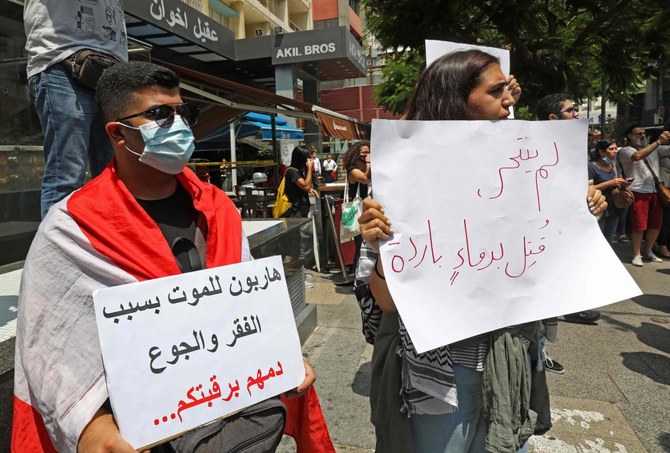
The death sparked street protests in Beirut’s Hamra neighborhood, denouncing the government for its handling of the country’s worst economic crisis since its 1975-1990 civil war.
“He did not commit suicide, he was killed in cold blood,” read one sign.
Protesters denounced “a government that does not represent them and does not care about inflation, the high dollar exchange rate and power outages.”
A second suicide, by an unemployed van driver near the southern city of Sidon, was also apparently linked to the economic collapse, according to local officials.
The 37-year-old man hanged himself in his home in the town of Jadra and his body was found early on Friday.
Officials said the man, who was married and had a daughter, was struggling financially.
The protests come amid a currency collapse, with the Lebanese pound reaching more than 9,000 to the dollar this week on the black market.
Prices have soared almost as fast as the exchange rate has plummeted, leaving companies, institutions and small businesses with little room to maneuver.
Growing anger among the population prompted Jan Kubis, UN special coordinator for Lebanon, to issue a warning to government officials.
“Do not count on the endless patience of the Lebanese. They have faced enough of the complete absence of reforms, starting with the electricity sector, of the lack of unified vision and effort to deal with the collapse and their growing misery,” he tweeted.
Hopes of an International Monetary Fund (IMF) rescue package also dimmed, with Finance Minister Ghazi Wazni saying negotiations “are on hold, awaiting Lebanon’s implementation of reforms.”
Political differences have halted reforms demanded by the international community to pull the country out of its financial crisis.
Wazni called for “a unified approach between the government and Parliament,” saying there was “no time for delay.”
Disagreements over the government’s submission to the IMF have led to calls for Prime Minister Hassan Diab’s government to quit and former leader Saad Hariri to head a new leadership.
However, Hariri said that “the password for rescue is reform.”
He told reporters on Thursday that his conditions for heading the government “have not changed, so the work style must be changed and quotas must end.”
Referring to Hezbollah, he said: “We cannot understand how a government is asking Arabian Gulf countries to provide money to Lebanon when, within this government, there are people who clap when a Houthi missile hits Riyadh or any region in Saudi Arabia. Logic says that the two things do not go together.”
Hariri added: “There is a movement (the Free Patriotic Movement) that wants to quarrel with everyone in the Cabinet, whether Amal Movement, Saad Hariri, Walid Jumblatt, or the Lebanese Forces. How will the government function?”
The former prime minister said that he “is not at odds with President Michel Aoun or anyone else” — referring to the head of the Free Patriotic Movement, Gebran Bassil.
Hariri said that supported a financial crime audit of the central bank “because we have nothing to hide.”