

UEFA insists ‘no Plan B’ for Champions League amid Lisbon virus concerns

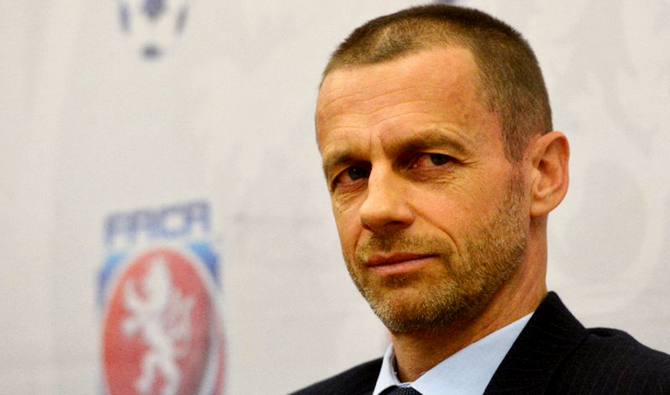
Aleksander Ceferin
Short Url
Updated 01 July 2020
Follow

UEFA insists ‘no Plan B’ for Champions League amid Lisbon virus concerns

  • Ceferin has admitted that it is unlikely any of the matches will be played in front of crowds

LAUSANNE: UEFA insists there is “no reason to prepare a Plan B” for the final eight of the Champions League in Lisbon despite Portuguese authorities reintroducing restrictions to curb the spread of coronavirus.

“We hope everything will be fine and that it will be possible to organize the tournament in Portugal. For the moment there is no reason to prepare a Plan B,” a UEFA spokesperson told AFP.

The spokesperson added that European football's governing body is in “constant contact with the Portuguese Football Federation and the local authorities.” 

UEFA announced earlier this month that the latter stages of the Champions League would be staged exceptionally as a straight knockout competition from the quarterfinals onwards with all matches in Lisbon.

Earlier this month, UEFA President Aleksander Ceferin said: “For now things look well, and we hope everything will be fine until we organize the final eight.”

He added: “We are assessing the situation, not week by week but day by day, and we will adapt when the time comes, if necessary.”

Portugal had not suffered to the same extent as other western European countries during the pandemic but last week Portuguese Prime Minister Antonio Costa announced that some coronavirus restrictions would be reimposed in and around the capital to help control fresh outbreaks.

From Wednesday, 19 neighborhoods on the northern edges of Lisbon will go back into lockdown.

Gatherings will be limited to a maximum of five people in these areas, compared to 10 people in the wider Lisbon area and 20 people across the rest of Portugal.

The final eight is due to begin with the first quarterfinal on Aug. 12, with the final scheduled for Aug.  23.

Matches will be played at Benfica's Estadio da Luz and the nearby Estadio Jose Alvalade, home of Sporting.

Atletico Madrid, Paris Saint-Germain, RB Leipzig and Atalanta all qualified for the quarterfinals before the competition was suspended in March.

The remaining last 16, second legs are: Juventus vs. Lyon; Manchester City vs. Real Madrid; Bayern Munich vs. Chelsea and Barcelona vs. Napoli.

It is hoped those matches — set for Aug. 7 and 8 — will not need to be played on neutral ground but they could also be moved to Portugal, with UEFA standing by to spread the matches around the country, in Lisbon as well as in the northern cities of Porto and Guimaraes.

Ceferin has admitted that it is unlikely any of the matches will be played in front of crowds but said UEFA would reassess the situation in July.


Russell, Antonelli lead Mercedes in one-two qualifying positions for F1’s Australian GP

Updated 07 March 2026
Follow

Russell, Antonelli lead Mercedes in one-two qualifying positions for F1’s Australian GP

  • Russell topped all three sessions in F1’s knockout qualifying format, finally casting aside questions of where Mercedes team was in the new-era pecking order

MELBOURNE: Mercedes has revealed its dominant hand during qualifying for Sunday’s Formula 1 Australian Grand Prix.
George Russell earned his ninth-career pole position Saturday ahead of his teammate Kimi Antonelli for the team’s 83rd front-row lockout and its first since the 2024 British Grand Prix.
Russell topped all three sessions in F1’s knockout qualifying format, finally casting aside questions of where Mercedes team was in the new-era pecking order. His pole time, at 1 minute, 18.518 seconds, was almost eight-tenths faster than the nearest non-Mercedes challenger, Red Bull rookie Isack Hadjar, who completed the top three.
“It was a great day, we knew there was a lot of potential in the car, but until we get to this first Saturday of the season, you never know,” Russell said. “But it really came alive this afternoon, especially when the track temperatures cooled, we know we tend to favor those conditions.”
Antonelli was relieved to have made it onto the front row alongside his teammate after a crash in final practice at the exit of turn two meant it was a race in the Mercedes garage to get him out for qualifying.
“It’s been a very stressful day. Unfortunately, I went into the wall (in FP3),” he said. “But the guys (in the garage) were the heroes today to put the car back on track.”
Hadjar was impressive by qualifying third on debut for Red Bull, his highest-ever grid position.
“The only thing I can do is take them at the start, but they’re just too fast at the moment,” Hadjar said of Mercedes. “I want to keep my position and a second podium would be cool.”
Ferrari showed it’s neck-and-neck with McLaren on pace, with just one and a half tenths seconds covering the four drivers just beyond the top-three — with Charles Leclerc qualifying fourth, McLaren’s Oscar Piastri and Lando Norris in fifth and sixth respectively, and Lewis Hamilton in seventh.
Racing Bulls showed they’ve taken a step forward over the winter, with New Zealander Liam Lawson eighth ahead of his highly-rated rookie teammate Arvid Lindblad.
The big surprise of the session came from four-time F1 world champion Max Verstappen, who triggered red flags at Melbourne’s Albert Park after he lost control of his Red Bull car in braking for turn one in the first half of Q1 and ended in the barriers.
The Dutchman, who was unhurt from the crash, though upset that his brakes locked up, will now start from the back of the grid.
F1 heads into a new era this year, with unprecedented changes across the chassis (car) and power unit, which now feature an almost 50:50 output split between the turbo 1.6-liter V6 engine and electrical energy harvested from the brakes, one that requires a new, often counterintuitive driving style from the drivers.