

UK pledges ‘Rooseveltian’ response to virus crisis

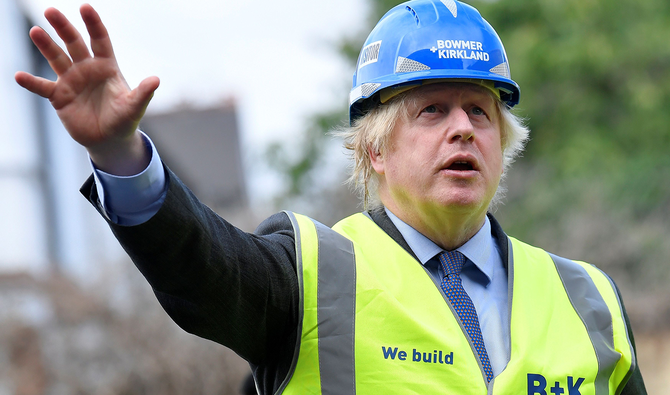
Britain’s Prime Minister Boris Johnson visits the construction site of Ealing Fields High School in London on Monday. (AFP)
Short Url
Updated 30 June 2020
Follow

UK pledges ‘Rooseveltian’ response to virus crisis

  • Britain has gone through a profound shock, says prime minister

LONDON: British Prime Minister Boris Johnson said on Monday the coronavirus crisis needed the type of massive economic response US president Franklin D. Roosevelt mobilized to deal with the Great Depression.

Johnson told The Times newspaper’s new radio station that Britain was heading for “bumpy times” as it struggles through its biggest economic contraction on record.

He intends to unveil a spending program in a speech on Tuesday his office has simply dubbed “build, build, build.”

“I think this is the moment for a Rooseveltian approach to the UK,” said Johnson. “I really think the investment will pay off.”

Roosevelt launched the New Deal program in the 1930s that created a comprehensive social care system whose legacy lives on to this day.

The first part of Johnson’s initiative earmarks £1 billion ($1.2 billion) for school repairs.

“The country has gone through a profound shock,” he said.

“We really want to build back better, to do things differently, to invest in infrastructure, transport, broadband — you name it.”

Johnson won an impressive 80-seat majority in December by positioning his Conservatives as more fiscally responsible than the main opposition Labour Party.

But the lockdowns imposed globally to fight the new disease have forced even the most prudent governments to unveil social safety nets that will put states deep into debt for years to come.

The true scale of Britain’s unemployment problem will only be revealed once the government’s furlough scheme for temporarily laid-off workers begins being rolled backed in August.

The current spending program has supported 9 million jobs and cost the government tens of billions of pounds.

The independent Resolution Foundation think tank said the government had little choice but to spend even more because “the virus will continue to hold activity below its pre-pandemic level.”

Johnson should try to generate “job creation via direct public investment in social care and retrofitting,” it said in a report.

The ruling Conservative Party’s newfound focus on spending comes with Labour trying to recover from its election drubbing that cost the job of its socialist leader Jeremy Corbyn.

New opposition chief Keir Starmer — a trained lawyer with a more pragmatic style — offered to work with Johnson while more than 1,000 people were dying of COVID-19 a day in April.

But that support appears to be wearing off as the first wave of the health emergency passes and attention shifts to the economic response.

“It’s staggering that in light of the economic crisis that is about to descend upon us that we are not having a July budget that puts jobs at the center of economic recovery,” Starmer fumed on Monday.

Restaurants along with most of the rest of the hospitality, tourism and leisure sectors in England will reopen next week for the first time since March 20.

But the easing could be delayed in the central English city of Leicester because of a reported spike in new infections.

Leicester mayor Peter Soulsby said he has received instructions from London to postpone the reopenings planned for next week.

Yet he also hinted that the ethnically diverse city of 500,000 was not looking forward to spending more time being kept away from its restaurants and pubs.

The mayor said the government’s assessment of the health problems in Leicester was “superficial.”

“Its description of Leicester is inaccurate and certainly it does not provide us with the information we need if we are to remain restricted for two weeks longer than the rest of the country,” he said.

Leicester City Council’s public health director Ivan Browne said the new infections were mostly being reported among younger people who are less susceptible to COVID-19.

“It’s very much around the younger working-age population,” Browne said.


Saudi investment pipeline active as reforms advance, says Pakistan minister

Updated 08 February 2026
Follow

Saudi investment pipeline active as reforms advance, says Pakistan minister

ALULA: Pakistan’s Finance Minister Mohammed Aurangzeb described Saudi Arabia as a “longstanding partner” and emphasized the importance of sustainable, mutually beneficial cooperation, particularly in key economic sectors.

Speaking to Arab News on the sidelines of the AlUla Conference for Emerging Market Economies, Aurangzeb said the relationship between Pakistan and Saudi Arabia remains resilient despite global geopolitical tensions.

“The Kingdom has been a longstanding partner of Pakistan for the longest time, and we are very grateful for how we have been supported through thick and thin, through rough patches and, even now that we have achieved macroeconomic stability, I think we are now well positioned for growth.”

Aurangzeb said the partnership has facilitated investment across several sectors, including minerals and mining, information technology, agriculture, and tourism. He cited an active pipeline of Saudi investments, including Wafi’s entry into Pakistan’s downstream oil and gas sector.

“The Kingdom has been very public about their appetite for the country, and the sectors are minerals and mining, IT, agriculture, tourism; and there are already investments which have come in. For example, Wafi came in (in terms of downstream oil and gas stations). There’s a very active pipeline.”

He said private sector activity is driving growth in these areas, while government-to-government cooperation is focused mainly on infrastructure development.

Acknowledging longstanding investor concerns related to bureaucracy and delays, Aurangzeb said Pakistan has made progress over the past two years through structural reforms and fiscal discipline, alongside efforts to improve the business environment.

“The last two years we have worked very hard in terms of structural reforms, in terms of what I call getting the basic hygiene right, in terms of the fiscal situation, the current economic situation (…) in terms of all those areas of getting the basic hygiene in a good place.”

Aurangzeb highlighted mining and refining as key areas of engagement, including discussions around the Reko Diq project, while stressing that talks with Saudi investors extend beyond individual ventures.

“From my perspective, it’s not just about one mine, the discussions will continue with the Saudi investors on a number of these areas.”

He also pointed to growing cooperation in the IT sector, particularly in artificial intelligence, noting that several Pakistani tech firms are already in discussions with Saudi counterparts or have established offices in the Kingdom.

Referring to recent talks with Saudi Minister of Economy and Planning Faisal Alibrahim, Aurangzeb said Pakistan’s large freelance workforce presents opportunities for deeper collaboration, provided skills development keeps pace with demand.

“I was just with (Saudi) minister of economy and planning, and he was specifically referring to the Pakistani tech talent, and he is absolutely right. We have the third-largest freelancer population in the world, and what we need to do is to ensure that we upscale, rescale, upgrade them.”

Aurangzeb also cited opportunities to benefit from Saudi Arabia’s experience in the energy sector and noted continued cooperation in defense production.

Looking ahead, he said Pakistan aims to recalibrate its relationship with Saudi Arabia toward trade and investment rather than reliance on aid.

“Our prime minister has been very clear that we want to move this entire discussion as we go forward from aid and support to trade and investment.”