Vietnam grounds Pakistani pilots over license concerns

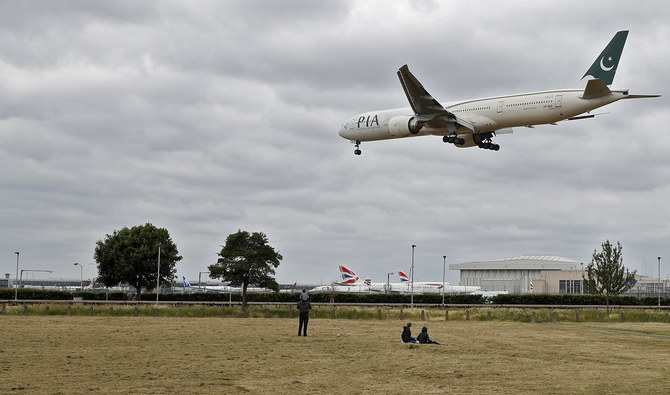
A Pakistan International Airlines Boeing 777 comes in to land at Heathrow airport in west London on June 8, 2020. (AFP)
Short Url
Updated 29 June 2020
Follow

Vietnam grounds Pakistani pilots over license concerns

  • Vietnam had licensed 27 Pakistani pilots, and 12 of them were still active
  • Pakistan said last week it will ground 262 airline pilots whose credentials may have been falsified

HANOI: Vietnam’s aviation authority said on Monday it had grounded all Pakistani pilots working for local airlines, amid concern from global regulators that some pilots may have been using “dubious” licenses.
Pakistan said last week it will ground 262 airline pilots whose credentials may have been falsified, after global airlines body IATA said that irregularities found in pilot licenses at Pakistan International Airlines represent a “serious lapse” in safety controls.
“The head of the Civil Aviation Authority of Vietnam (CAAV) has ordered a suspension for all Pakistani pilots working for Vietnamese airlines,” the CAAV said in a statement on Monday.
The suspension will be in effect until further notice from CAAV, it said, adding that the authority is coordinating with Pakistani authorities to review the pilots’ profiles.
Vietnam had licensed 27 Pakistani pilots, and 12 of them were still active, while the other 15 pilots’ contracts had expired or were inactive due to the coronavirus pandemic, according to the CAAV.
Of the 12 active pilots, 11 were working for budget airlines Vietjet Aviation and one for Jetstar Pacific, a unit of the national flag carrier Vietnam Airlines.
Vietnam Airlines and Bamboo Airways were not using any pilots from Pakistan, the CAAV said.
Vietnamese airlines currently have 1,260 pilots, with nearly half of them holding foreign citizenship, according to the CAAV.


Pakistan drops 8,000 MW power procurement, claims $17 billion savings amid IMF-driven reforms

Updated 11 sec ago
Follow

Pakistan drops 8,000 MW power procurement, claims $17 billion savings amid IMF-driven reforms

  • Government says decision taken “on merit” as it seeks to cut losses, circular debt, ease consumer pressure 
  • Power minister says losses fell from $2.1 billion to $1.4 billion, circular debt dropped by $2.8 billion

ISLAMABAD: Pakistan has abandoned plans to procure around 8,000 megawatts of expensive electricity, the power minister said on Sunday, adding that the decision was taken “purely on merit” and would save about $17 billion.

The power sector has long been a major source of Pakistan’s fiscal stress, driven by surplus generation capacity, costly contracts and mounting circular debt. Reforming electricity pricing, reducing losses and limiting new liabilities are central conditions under an ongoing $7 billion IMF program approved in 2024.

Pakistan has historically contracted more power generation than it consumes, forcing the government to make large capacity payments even for unused electricity. These obligations have contributed to rising tariffs, budgetary pressure and repeated IMF bailouts over the past two decades.

“The government has abandoned the procurement of around 8000 megawatts of expensive electricity purely on merit, which will likely to save 17 billion dollars,” Power Minister Sardar Awais Ahmed Khan Leghari said while addressing a news conference in Islamabad, according to state broadcaster Radio Pakistan.

He said the federal government was also absorbing losses incurred by power distribution companies rather than passing them on to consumers.

The minister said the government’s reform drive was already showing results, with losses reduced from Rs586 billion ($2.1 billion) to Rs393 billion ($1.4 billion), while circular debt declined by Rs780 billion ($2.8 billion) last year. Recoveries, he added, had improved by Rs183 billion ($660 million).

Leghari said electricity tariffs had been reduced by 20 percent at the national level over the past two years and expressed confidence that prices would be aligned with international levels within the next 18 months.

Power sector reform has been one of the most politically sensitive elements of Pakistan’s IMF-backed adjustment program, with higher tariffs and tighter enforcement weighing on households and industry. The government says cutting losses, improving recoveries and avoiding costly new capacity are essential to stabilizing public finances and restoring investor confidence.