

Giant Sahara dust cloud drifts over Caribbean and US, raising health concerns

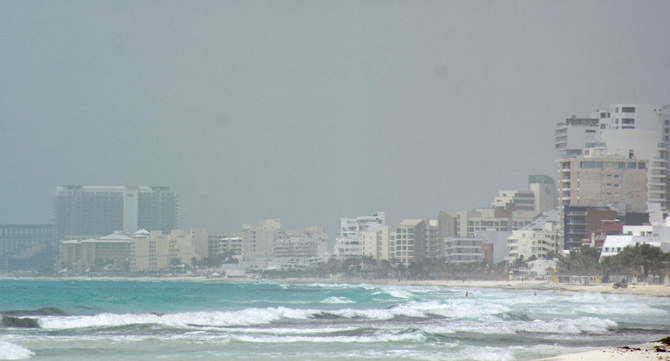
View of a cloud of Saharan dust over a beach in Cancun, Quintana Roo state, Mexico, on June 25, 2020. (AFP / ELIZABETH RUIZ)
Short Url
Updated 27 June 2020
Follow

Giant Sahara dust cloud drifts over Caribbean and US, raising health concerns

  • The dust, from North Africa, is the most dense in the past 50 years, say meteorologists
  • The 5,600-km cloud traveled 8,047 km before reaching the southern US region

NEW YORK: A massive plume of dust whipped up from the Sahara desert will hover over the US Southeast this weekend, forecasters say, shrouding the region in a brown haze and raising more health concerns in states where the coronavirus crisis is worsening.
The 3,500-mile-long (5,600 km) cloud, dubbed the “Godzilla dust cloud,” traveled 5,000 miles (8,047 km) from North Africa before reaching the region stretching from Florida west into Texas and north into North Carolina through Arkansas, the National Weather Service (NWS) said.
“It’s a really dry layer of air that contains these very fine dust particulates. It occurs every summer,” said NWS meteorologist Patrick Blood. “Some of these plumes contain more particles, and right now we expecting a very large plume of dust in the Gulf Coast.”
This year, the dust is the most dense it has been in a half a century, several meteorologists told Reuters earlier this week as it crossed over the Caribbean.
The Saharan dust plume will hang over the region until the middle of next week, deteriorating the air quality in Texas, Florida and other states where the number of COVID-19 cases has recently spiked.

“There’s emerging evidence of potential interactions between air pollution and the risk of COVID, so at this stage we are concerned,” said Gregory Wellenius, a professor of environmental health at Boston University’s School of Public Health.
Air pollution can be especially detrimental for people who are at risk for or suffer from cardiovascular and respiratory illnesses, Wellenius added. Heart and lung problems heighten the risk of severe COVID-19.
The plume will create hazy skies and lower visibility. In the past, dust plumes from Africa have dumped a thin layer of dust onto vehicles in Houston, where air quality is always a concern, Blood said.
The dry air mass that carries the dust can suppress tropical storm and hurricane formation and can enhance and illuminate sunrises and sunsets, meteorologists said.


NATO wants ‘automated’ defenses along borders with Russia: German general

Updated 7 sec ago
Follow

NATO wants ‘automated’ defenses along borders with Russia: German general

  • That zone would act as a defensive buffer before any enemy forces advanced into “a sort of hot zone,” said Lowin
  • The AI-guided system would reinforce existing NATO weapons and deployed forces, the general said

FRANKFURT: NATO is moving to boost its defenses along European borders with Russia by creating an AI-assisted “automated zone” not reliant on human ground forces, a German general said in comments published Saturday.
That zone would act as a defensive buffer before any enemy forces advanced into “a sort of hot zone” where traditional combat could happen, said General Thomas Lowin, NATO’s deputy chief of staff for operations.
He was speaking to the German Sunday newspaper Welt am Sonntag.
The automated area would have sensors to detect enemy forces and activate defenses such as drones, semi-autonomous combat vehicles, land-based robots, as well as automatic air defenses and anti-missile systems, Lowin said.
He added, however, that any decision to use lethal weapons would “always be under human responsibility.”
The sensors — located “on the ground, in space, in cyberspace and in the air” — would cover an area of several thousand kilometers (miles) and detect enemy movements or deployment of weapons, and inform “all NATO countries in real time,” he said.
The AI-guided system would reinforce existing NATO weapons and deployed forces, the general said.
The German newspaper reported that there were test programs in Poland and Romania trying out the proposed capabilities, and all of NATO should be working to make the system operational by the end of 2027.
NATO’s European members are stepping up preparedness out of concern that Russia — whose economy is on a war footing because of its conflict in Ukraine — could seek to further expand, into EU territory.
Poland is about to sign a contract for “the biggest anti-drone system in Europe,” its defense minister, Wladyslaw Kosiniak-Kamysz, told the Gazeta Wyborcza daily.
Kosiniak-Kamysz did not say how much the deal, involving “different types of weaponry,” would cost, nor which consortium would ink the contract at the end of January.
He said it was being made to respond to “an urgent operational demand.”