

Turkey releases 3 journalists accused of revealing state secrets

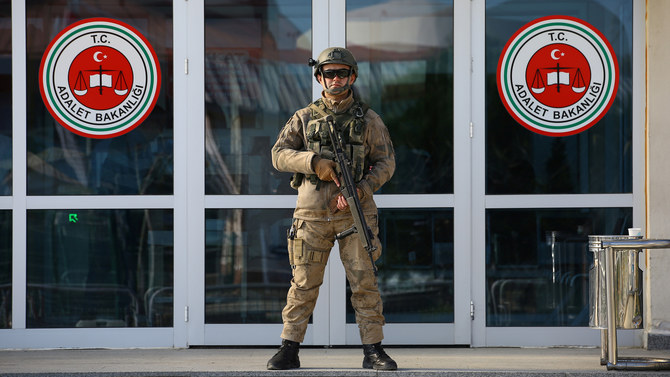
A Turkish soldier stands guard outside the Silivri Prison and Courthouse complex near Istanbul, Turkey. (Reuters)
Short Url
Updated 25 June 2020
Follow

Turkey releases 3 journalists accused of revealing state secrets

  • Baris Terkoglu, Ferhat Celik and Aydin Keser were released from prison following the court decision
  • Three others were remanded in custody while they stand trial on charges of revealing the identities of two members of Turkey’s intelligence agency

ANKARA: In a surprise move, Turkey on Wednesday released three journalists charged with revealing state secrets in their coverage of the deaths of Turkish intelligence officers in Libya.

However, three others were remanded in custody while they stand trial on charges of revealing the identities of two members of Turkey’s intelligence agency.

The high-profile case, with the defendants facing up to 19 years in jail, has been closely monitored by domestic and international press freedom groups following the arrest of the journalists four months ago.

The journalists who appeared in court on Wednesday worked for media outlets supporting the political views of the Turkish opposition, ranging from ultra-nationalists to pro-Kurdish and socialist segments.

Baris Terkoglu, Ferhat Celik and Aydin Keser were released from prison following the court decision, while the other three defendants will remain in jail until the next hearing, which is set for Sept. 9.

“This trial should not exist since the indictment fails to prove its claim of conspiracy by the journalists,” said Ozgur Ogret, Turkish representative for the Committee to Protect Journalists (CPJ).

“But since it exists, all the defendants should have been released on Wednesday to be tried without arrest,” he told Arab News.

Another source of controversy was the identity of the intelligence officer being leaked — before any media reports — by an opposition MP, Umit Ozdag, during a parliamentary speech.

Baris Pehlivan, one of the three journalists still behind bars, said during his defense that the group are victims of a “political operation” that was held through the “funeral ceremony of the martyr.”

Ogret said the arrest of the journalists was “potentially deadly” because of the pandemic.

“No journalist should be in prison for reporting at any time, but jailing journalists now is a risk to their health and possibly life,” he said.

In a report on June 10, the US-based Center for American Progress said that Turkey’s censorship “is rapidly reshaping how Turks get their news, with major implications for Turkish foreign policy, political polarization and President Recep Tayyip Erdogan’s rule.”

When Twitter recently suspended more than 7,300 Turkish accounts, arguing that these were part of a network associated with the youth wing of the government, Ankara said in a harshly worded statement that these were attempts to “redesign Turkish politics.”

The government also accused Twitter of acting as a “propaganda machine” with a political agenda.

Meanwhile, Turkey’s court of appeal on June 23 upheld a nine-year prison sentence given to Canan Kaftancioglu, the Istanbul chair of Turkey’s main opposition party, over anti-government tweets she posted seven years ago.

Renan Akyavas, Turkey program coordinator at the Vienna-based International Press Institute, said the Turkish government has been suppressing media outlets for a long time.

“Especially when it comes to the most topical and sensitive issues in Turkey’s agenda, journalists from all sides of the political spectrum have been targeted by authorities. The release of three journalists yesterday is at best only the smallest hint of ‘justice,’ given that the other three remain in prison for at least another two months,” she told Arab News.

Akyavas added that the journalists should not have been jailed for reporting on a topic in the public interest.

“A known fact already in the public domain cannot be criminalized. The right thing here would be to drop all charges against these journalists without delay,” she said.

Akyavas said that public pressure on individual cases can influence institutions and decision-makers, “even though the overall landscape on media freedom is still in a terrible state.”


International court sentences Sudanese militia leader to 20 years in prison for Darfur atrocities

Updated 8 sec ago
Follow

International court sentences Sudanese militia leader to 20 years in prison for Darfur atrocities

  • Abd-Al-Rahman stood and listened, but showed no reaction as Judge Korner passed the sentence
  • It added that it also took into account the large number of victims, that included at least 213 people who were murdered

THE HAGUE: Judges at the International Criminal Court sentenced a leader of the feared Sudanese Janjaweed militia to 20 years imprisonment Tuesday for war crimes and crimes against humanity committed in the catastrophic conflict in Darfur more than two decades ago.
At a hearing last month, prosecutors sought a life sentence for Ali Muhammad Ali Abd–Al-Rahman who was was convicted in October of 27 counts of war crimes and crimes against humanity that included ordering mass executions and bludgeoning two prisoners to death with an ax in 2003-2004.
“He committed these crimes knowingly, willfully, and with, the evidence shows, enthusiasm and vigor,” prosecutor Julian Nicholls told judges at the sentencing hearing in November.
Abd-Al-Rahman, 76, stood and listened, but showed no reaction as Presiding Judge Joanna Korner passed the sentence. He was handed sentences ranging from eight years to 20 years for each of the counts for which he was convicted before the court imposed the overarching joint sentence of 20 years.
She said that Abd-Al-Rahman “not only gave the orders that led directly to the crimes” in attacks that largely targeted members of the Fur tribe perceived as supporting a rebellion against Sudanese authorities, he “also personally perpetrated some of them using an ax he carried in order to beat prisoners.”
The court's prosecution office said that its staff would study the sentencing decision to decide whether to “take further action.” The office could appeal the sentence and renew its call for a life term.
The office said in a written statement that it sought a life sentence “owing to the extreme gravity of the crimes Mr. Abd-Al-Rahman was convicted of — murders, rapes, torture, persecution and other crimes carried out with a high level of cruelty and violence as a direct perpetrator, as a co-perpetrator and for ordering others to commit such crimes.”
It added that it also took into account the large number of victims, that included at least 213 people who were murdered, including children, and 16 women and girls who were victims of rape.
Abd–Al-Rahman, who is also known as Ali Kushayb, is the first person convicted by the ICC for atrocities in Sudan’s Darfur region, where trial judges ruled that the Janjaweed crimes were part of a government plan to stamp out a rebellion there.
The ICC has a maximum sentence of 30 years imprisonment, but judges have the discretion to raise that to life in extremely grave cases. Abd-Al-Rahman’s time in detention before and during his trial will be deducted from the sentence.
Abd-Al-Rahman’s crimes were committed more than two decades ago, but violence continues to plague Darfur as Sudan is torn apart by civil war. ICC prosecutors are seeking to gather and preserve evidence from a deadly rampage last month in a besieged city in the region.
The latest alleged atrocities in famine-hit el-Fasher “are part of a broader pattern of violence that has afflicted the entire Darfur region” and “may constitute war crimes and crimes against humanity,” the ICC statement said, noting that evidence could be used in future prosecutions.
Korner said that ICC sentences are imposed as a deterrent to prevent other crimes in the future.
“Deterrence is particularly apposite in this case given the current state of affairs in Sudan,” she said.