Sudan says near settlement with US for 1998 embassy bombings

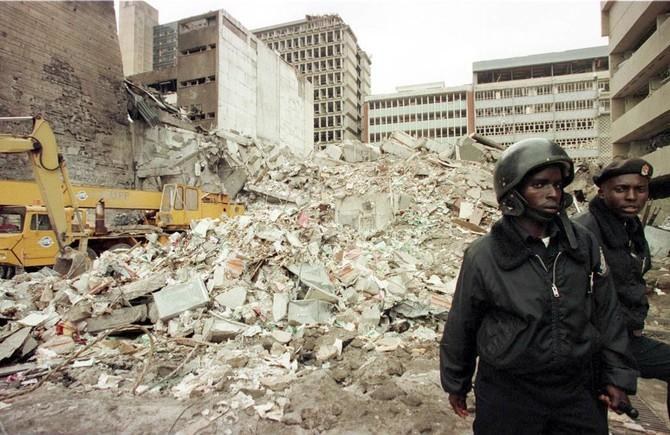
Kenyan security guards keep watch over the scene of the bomb explosion the day before near the US embassy in Nairobi on August 8, 1998. (AFP/Alexander Joe)
Short Url
Updated 23 June 2020
Follow

Sudan says near settlement with US for 1998 embassy bombings

  • Foreign Minister Asma Abdalla said Sudan was close to finalizing a deal to compensate US victims

KHARTOUM: Sudan is close to finalizing a deal with the United States to compensate the victims of 1998 embassy bombings in Kenya and Tanzania that killed 224 people, Foreign Minister Asma Abdalla said Tuesday.
“The final touches of a settlement with victims of embassy bombings in Nairobi and Dar es Salaam are being finalized,” Abdalla told AFP in an interview.
“We now have a delegation in Washington negotiating with the victims’ lawyers and officials at the US Department of State.”
The twin bombings took place in August 1998 when a massive blast hit the US embassy in downtown Nairobi, shortly followed by an explosion in Dar es Salaam.
The attacks claimed by Al-Qaeda killed a total of 224 people and injured around 5,000 — almost all of them Africans.
The US has accused Sudan of aiding militants linked to the jihadist bombings and demanded compensation for victims’ families.
Sudan has since August been led by a transitional administration following the military ouster of president Omar Al-Bashir in the wake of mass protests against his rule.
Under Bashir’s 30-year rule, the country adopted a more radical course of Islam, hosting Al-Qaeda founder Osama bin Laden between 1992 and 1996.
This strained ties with the US, which blacklisted Sudan as a state sponsor of terrorism.
The post-Bashir government has sought to boost the country’s international standing and rebuild ties with the US.
In February, Sudan had to compensate families of victims of the USS Cole bombing in 2000 in Yemen’s Aden harbor, for which Al-Qaeda also claimed responsibility.
Khartoum had always denied any involvement but agreed to the settlement to fulfil a key US condition to remove it from Washington’s terrorism blacklist.
After the deal on the embassy bombings, Sudan “will have fulfilled all the requirements” to be removed from the US blacklist of state sponsors of terrorism, Abdalla said.


Israeli-backed group kills a senior Hamas police officer in Gaza, threatens more attacks

Updated 3 sec ago
Follow

Israeli-backed group kills a senior Hamas police officer in Gaza, threatens more attacks

  • Hussam Al-Astal, leader of an anti-Hamas group based in an area under Israeli control east of Khan Younis, claimed responsibility for the killing
CAIRO: An Israeli-backed Palestinian militia said on Monday it had killed a senior Hamas police officer in the southern Gaza Strip, an incident which Hamas blamed on “Israeli collaborators.”
A statement from the Hamas-run interior ministry said gunmen opened fire from a passing car, ​killing Mahmoud Al-Astal, head of the criminal police unit in Khan Younis, in the south of the enclave. It described the attackers as “collaborators with the occupation.”
Hussam Al-Astal, leader of an anti-Hamas group based in an area under Israeli control east of Khan Younis, claimed responsibility for the killing in a video he posted on his Facebook page. The surname he shares with the dead man, Al-Astal, is common in that part of Gaza.
“To those who work with Hamas, your destiny is to be killed. Death is coming to you,” he ‌said, dressed in ‌a black military-style uniform and clutching an assault rifle.
Reuters could ‌not ⁠independently ​verify ‌the circumstances of the attack. An Israeli military official said the army was not aware of any operations in the area.
The emergence of armed anti-Hamas groups, though still small and localized, has added pressure on the Islamists and could complicate efforts to stabilize and unify a divided Gaza, shattered by two years of war.
These groups remain unpopular among the local population as they operate in areas under Israeli control, although they publicly deny they take Israeli orders. Hamas has held public executions ⁠of people it accuses of collaboration.
Under a ceasefire in place since October, Israel has withdrawn from nearly half of ‌the Gaza Strip, but its troops remain in control of ‍the other half, largely a wasteland ‍where virtually all buildings have been levelled.
Nearly all of the territory’s two million people ‍now live in Hamas-held areas, mostly in makeshift tents or damaged buildings, where the group has been reasserting its grip. Four Hamas sources said it continues to command thousands of fighters despite suffering heavy losses during the war.
Israel has been allowing rivals of Hamas to operate in areas it controls. In ​later phases, US President Donald Trump’s plan for Gaza calls for Israel to withdraw further and for Hamas to yield power to an internationally backed administration, ⁠but there has so far been no progress toward those steps.
Prime Minister Benjamin Netanyahu acknowledged Israeli backing for anti-Hamas groups in June, saying Israel had “activated” clans, but has given few details since then.
The ceasefire has ended major combat in Gaza over the past three months, but both sides have accused the other of regular violations. More than 440 Palestinians and three Israeli soldiers have been killed since the truce took effect.
Gaza health authorities said on Monday Israeli drone fire killed at least three people near the center of Khan Younis.
The Israeli military did not have an immediate comment on the drone incident.
The war erupted on October 7, 2023 when Gazan militants invaded Israel, killing about 1,200 people and taking some 250 hostages, according to ‌Israeli tallies.
Israel’s subsequent military assault on Gaza has killed more than 71,000 Palestinians, according to the enclave’s health ministry, and led to accusations of genocide and war crimes, which Israel denies.