KHARTOUM: Sudan proposed on Wednesday upgrading negotiations with Egypt and Ethiopia on a Nile mega-dam to prime ministerial level in a bid to break the deadlock.
“The disputes between the three delegations are of a legal nature especially in terms of a... mechanism for water sharing. Sudan has proposed to refer these issues to the prime ministers of the three countries,” Yasser Abbas, Sudanese irrigation and water resources minister, told reporters after the latest round of virtual talks.
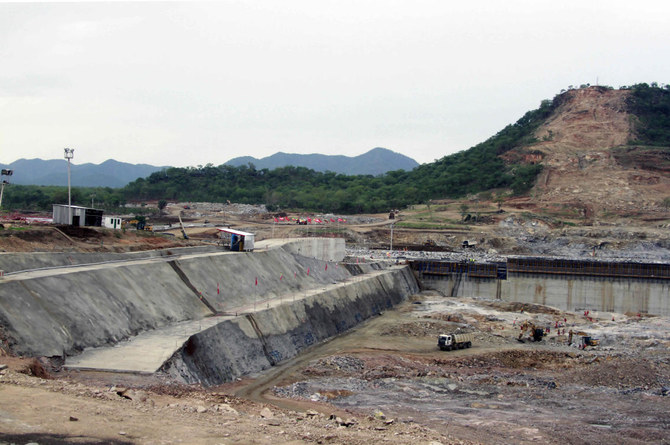
No timeline has been set for the prime ministers to meet as Addis Ababa continues to stick to the July deadline of filling the reservoir of the Grand Ethiopian Renaissance Dam to the consternation of its partners.
In a late Wednesday statement, Egypt’s irrigation and water resources minister Mohamed Abdel Aty roundly blamed Ethiopia for the negotiations slowing down to a grinding halt.
“The negotiations held recently did not achieve any progress worth mentioning because of Ethiopia’s stubborn position on technical and legal matters,” he said.
“At the end of the irrigation ministers’ meetings, Ethiopia rejected the suggestion that the issue be referred to the three Prime Ministers as a final chance to examine the floundering of the negotiations and to find solutions for the various disputes,” the statement added.
The GERD, set to be Africa’s largest hydropower project, has been a source of tension in the Nile River basin ever since Ethiopia broke ground on it nearly a decade ago.
Ethiopia sees the dam as essential for its electrification and development, while Sudan and Egypt view it as a threat to essential water supplies.
“Sudan will not accept the filling of the lake unilaterally before an agreement is reached,” Abbas added.
The recent rounds made progress on the technical front but the minister stressed that “legal differences need a political decision by the heads of government of the three countries.”
The United States, which has been observing the talks along with the European Union and South Africa, sent a pointed message on Wednesday to Ethiopia.
“257 million people in east Africa are relying on Ethiopia to show strong leadership, which means striking a fair deal,” the White House’s National Security Council posted on Twitter before the latest meeting.
Washington’s involvement in the heated talks began in November after Egyptian President Abdel Fattah El-Sisi put in a request to his ally US President Donald Trump.
The 6,600-kilometer-long (3,900-mile) Nile is a lifeline supplying water and powering electricity in the 10 countries it traverses.
Its main tributaries, the White and Blue Niles, converge in the Sudanese capital Khartoum before flowing north through Egypt to drain into the Mediterranean Sea.
“Technical issues have been resolved — time to get the GERD deal done before filling it with Nile River water!,” the National Security Council added.

Sudan wants PMs to solve Nile dam deadlock
Short Url
https://arab.news/p4zpd
Sudan wants PMs to solve Nile dam deadlock
- Egypt blamed Ethiopia for the negotiations slowing down to a grinding halt
- No timeline has been set for the prime ministers to meet as Addis Ababa continues to stick to the July deadline of filling the reservoir
Virtual museum preserves Sudan’s plundered heritage
CAIRO: Destroyed and looted in the early months of Sudan’s war, the national museum in Khartoum is now welcoming visitors virtually after months of painstaking effort to digitally recreate its collection.
At the museum itself, almost nothing remains of the 100,000 artefacts it had stored since its construction in the 1950s. Only the pieces too heavy for looters to haul off, like the massive granite statue of the Kush Pharaoh Taharqa and frescoes relocated from temples during the building of the Aswan Dam, are still present on site.
“The virtual museum is the only viable option to ensure continuity,” government antiquities official Ikhlass Abdel Latif said during a recent presentation of the project, carried out by the French Archaeological Unit for Sudanese Antiquities (SFDAS) with support from the Louvre and Britain’s Durham University.
When the museum was plundered following the outbreak of the war between the regular army and the paramilitary Rapid Support Forces (RSF) in April 2023, satellite images showed trucks loaded with relics heading toward Darfur, the western region now totally controlled by the RSF.
Since then, searches for the missing artefacts aided by Interpol have only yielded meagre results.
“The Khartoum museum was the cornerstone of Sudanese cultural preservation — the damage is astronomical,” said SFDAS researcher Faiza Drici, but “the virtual version lets us recreate the lost collections and keep a clear record.”
Drici worked for more than a year to reconstruct the lost holdings in a database, working from fragments of official lists, studies published by researchers and photos taken during excavation missions.
Then graphic designer Marcel Perrin created a computer model that mimicked the museum’s atmosphere — its architecture, its lighting and the arrangement of its displays.
Online since January 1, the virtual museum now gives visitors a facsimile of the experience of walking through the institution’s galleries — reconstructed from photographs and the original plans — and viewing more than 1,000 pieces inherited from the ancient Kingdom of Kush.
It will take until the end of 2026, however, for the project to upload its recreation of the museum’s famed “Gold Room,” which had housed solid-gold royal jewelry, figurines and ceremonial objects stolen by looters.
In addition to the virtual museum’s documentary value, the catalogue reconstructed by SFDAS is expected to bolster Interpol’s efforts to thwart the trafficking of Sudan’s stolen heritage.
At the museum itself, almost nothing remains of the 100,000 artefacts it had stored since its construction in the 1950s. Only the pieces too heavy for looters to haul off, like the massive granite statue of the Kush Pharaoh Taharqa and frescoes relocated from temples during the building of the Aswan Dam, are still present on site.
“The virtual museum is the only viable option to ensure continuity,” government antiquities official Ikhlass Abdel Latif said during a recent presentation of the project, carried out by the French Archaeological Unit for Sudanese Antiquities (SFDAS) with support from the Louvre and Britain’s Durham University.
When the museum was plundered following the outbreak of the war between the regular army and the paramilitary Rapid Support Forces (RSF) in April 2023, satellite images showed trucks loaded with relics heading toward Darfur, the western region now totally controlled by the RSF.
Since then, searches for the missing artefacts aided by Interpol have only yielded meagre results.
“The Khartoum museum was the cornerstone of Sudanese cultural preservation — the damage is astronomical,” said SFDAS researcher Faiza Drici, but “the virtual version lets us recreate the lost collections and keep a clear record.”
Drici worked for more than a year to reconstruct the lost holdings in a database, working from fragments of official lists, studies published by researchers and photos taken during excavation missions.
Then graphic designer Marcel Perrin created a computer model that mimicked the museum’s atmosphere — its architecture, its lighting and the arrangement of its displays.
Online since January 1, the virtual museum now gives visitors a facsimile of the experience of walking through the institution’s galleries — reconstructed from photographs and the original plans — and viewing more than 1,000 pieces inherited from the ancient Kingdom of Kush.
It will take until the end of 2026, however, for the project to upload its recreation of the museum’s famed “Gold Room,” which had housed solid-gold royal jewelry, figurines and ceremonial objects stolen by looters.
In addition to the virtual museum’s documentary value, the catalogue reconstructed by SFDAS is expected to bolster Interpol’s efforts to thwart the trafficking of Sudan’s stolen heritage.
© 2026 SAUDI RESEARCH & PUBLISHING COMPANY, All Rights Reserved And subject to Terms of Use Agreement.


