

Living with the dead: Indonesia’s Torajans downsize burials amid pandemic

1 / 2
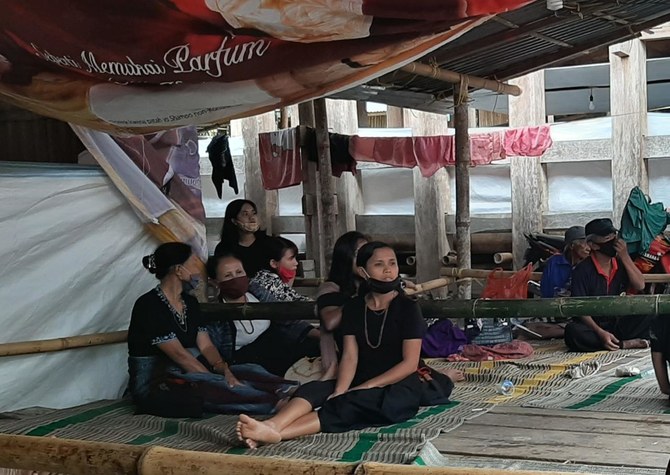
Mourners clad in black wore face masks in compliance with the health protocol. (Lisa Saba Palloan)
2 / 2
A relative mourns on the deceased's coffin. (Lisa Saba Palloan)
Short Url
Updated 21 June 2020
Follow

Living with the dead: Indonesia’s Torajans downsize burials amid pandemic

  • The Torajas inhabit two administrative areas — the North Toraja and Tana Toraja regencies — in the South Sulawesi province
  • A burial ceremony is central to the lives of the Toraja ethnic group

JAKARTA: She had been dead for two years and was ready to be buried. After restrictions to curb the spread of the coronavirus disease (COVID-19) were imposed in March, however, villagers in the La’bo village of the North Toraja regency in Sulawesi Island had no choice but to suspend the ceremony at the last minute.

On Saturday, they were finally able to hold a proper burial for the deceased village elder in a toned-down version of the elaborate, centuries-old ceremony known as Rambu Solo. The ceremony is central to the lives of the Toraja ethnic group, who are predominantly Christian but hold some animistic belief.

The Torajas inhabit two administrative areas — the North Toraja and Tana Toraja regencies — in the South Sulawesi province.

The burial ceremony is a large family affair involving the entire village and would last for up to a week in pre-COVID-19 times. It requires the sacrifice of dozens of buffaloes, following years of preparations, while the mummified corpse remains unburied in the family’s tongkonan, or a Toraja traditional house."

"We conducted the burial in compliance with health protocols by providing a hand washing station at the entrance. All mourners who came in had to wear face masks," Yohannes Limbong, a family representative, told Arab News.

The family was supposed to hold the ceremony on March 25, but it was suspended after the regency administration issued a stay-at-home order on March 23, advising citizens to hold off on any events involving large gatherings of people such as the Rambu Solo.

As of Saturday, the regency has not reported any COVID-19 deaths, but there were four confirmed cases, all of whom were travelers from virus-infected areas, including the provincial capital, Makassar, about 317 kilometers away. 

The province has had 3,635 confirmed cases so far or about 8 percent of the 45,029 national caseloads. North Toraja, which has a population of 230,000, has lifted some restrictions in recent weeks after the region was considered an area where the risk of infections is low, allowing for religious events. Participants are nevertheless required to observe health protocols.

"There were less than 100 mourners who attended the ceremony. Normally, it would be double that amount or more," Lisa Saba Palloan, a local tourist guide, told Arab News.

Romba Marannu Sombolinggi, chairwoman of the Indigenous Peoples Alliance of the Archipelago Toraya chapter, said that families who conducted the burials recently had to compromise between the obligation to perform a respectable send-off and compliance with social restrictions.

"A complete ceremony could take at least five days," she told Arab News.

"But we are obeying government regulations. There are some disappointments, but we understand the situation. We do not want people to be infected because we insist on having the long ceremony."

A few people had died who were under treatment but who had tested negative for COVID-19. They had to be buried in accordance with health protocols as soon as possible, which meant that the surviving family members could not keep the deceased embalmed in their houses as they would traditionally do.

"The families still performed the most essential rituals, including sacrificing at least a pig or a buffalo before the burial," Sombolinggi said.

"It is very much about the family’s dignity. They would otherwise experience social repercussions if they were not able to hold a presentable burial," she added.

Sombolinggi said that buffaloes are sacrificed to mark the symbolic passage to death since they would serve as the deceased’s "carriage" in the afterlife.  

Her mother, who passed away in June 2019, is still kept mummified in the family’s tongkonan in the village of Lembang Madandan, in the Tana Toraja regency.

Her corpse is laid down with her face and the body facing east to the sunrise, which symbolizes life. For Torajans, the deceased are not dead yet; they are seen, rather, as sick. Family members still talk to them, bringing food and drinks and keeping essential items nearby.

"I greet her good morning or goodbye when I visit the family tongkonan. When my father died, he was mummified for three years before we held the Rambu Solo for him," Sombolinggi said.  

The death is only considered official once the buffaloes are slaughtered in the ceremony. Family members must save up enough money to buy the animals, which can cost at least 20 million rupiahs each ($1,400).

"The extended family chips in to bear the costs together. It is a communal obligation that binds the Torajan people together," Palloan said.


US senators visit key Ukrainian port city as they push for fresh sanctions on Russia

Updated 19 February 2026
Follow

US senators visit key Ukrainian port city as they push for fresh sanctions on Russia

  • The visit and the push for Congress to take up sanctions on Russia come at a crucial moment in the conflict

WASHINGTON: A delegation of US senators was returning Wednesday from a trip to Ukraine, hoping to spur action in Congress for a series of sanctions meant to economically cripple Moscow and pressure President Vladimir Putin to make key concessions in peace talks.
It was the first time US senators have visited Odesa, Ukraine’s third-most populous city and an economically crucial Black Sea port that has been particularly targeted by Russia, since the war began nearly four years ago. Democratic Sens. Jeanne Shaheen, Chris Coons, Richard Blumenthal and Sheldon Whitehouse made the trip. Republican Sen. Thom Tillis had planned to join but was unable to for personal reasons.
“One of the things we heard wherever we stopped today was that the people of Ukraine want a peace deal, but they want a peace deal that preserves their sovereignty, that recognizes the importance of the integrity of Ukraine,” Shaheen said on a phone call with reporters.
The visit and the push for Congress to take up sanctions on Russia come at a crucial moment in the conflict. Delegations for the two sides were also meeting in Switzerland for two days of US-brokered talks, but neither side appeared ready to budge on key issues like territory and future security guarantees. The sanctions, senators hoped, could prod Putin toward settling for peace, as the US has set a June deadline for settlement.
“Literally nobody believes that Russia is acting in good faith in the negotiations with our government and with the Ukrainians,” Whitehouse said. “And so pressure becomes the key.”
Still, legislation to impose tough sanctions on Russia has been on hold in Congress for months.
Senators have put forward a range of sanction measures, including one sweeping bill that would allows the Trump administration to impose tariffs and secondary sanctions on countries that purchase Russia’s oil, gas, uranium and other exports, which are crucial to financing Russia’s military. The Senate Foreign Relations Committee has also advanced a series of more-targeted bills that would sanction China’s efforts to support Russia’s military, commandeer frozen Russian assets and go after what’s known as Moscow’s “shadow fleet” of oil tankers being used to circumvent sanctions already in place.
Republican Sen. Lindsey Graham, who has co-sponsored the Senate’s sweeping sanctions and tariff legislation, also released a statement during the Munich Security Conference this weekend saying that Senate Majority Leader John Thune had committed to bringing up the sanctions bill once it clearly has the 60 votes needed to move through the Senate.
“This legislation will be a game changer,” Graham said. “President Trump has embraced it. It is time to vote.”
Blumenthal, who co-sponsored that bill alongside Graham, also said there is bipartisan support for the legislation, which he called a “very tough sledgehammer of sanctions and tariffs,” but he also noted that “we need to work out some of the remaining details.” Democrats, and a handful of Republicans, have been opposed to President Donald Trump’s campaign to impose tariffs around the world in an effort to strike trade deals and spur more manufacturing in the US
In the House, Democrats are opposed to the tariff provisions of that bill. Instead, a bipartisan group of lawmakers, led by Republican Rep. Brian Fitzpatrick, has proposed separate legislation that makes it more difficult for Trump to waive sanctions, but does away with the tariff provisions.
A separate bill, led by the top Democrat on the House Foreign Affairs Committee, Rep. Gregory Meeks, would bolster US military support for Ukraine by $8 billion. Democrats currently need one more Republican to support an effort to force a vote on that bill.
Once they return to the US, the senators said they would detail how US businesses based in Ukraine have been attacked by Russia. The Democrats are also hoping to build pressure on Trump to send more US weapons to Ukraine. “Putin understands weapons, not words,” Blumenthal said.
Still, the lawmakers will soon return to a Washington where the Trump administration is ambivalent about its long-term commitments to securing peace in Ukraine, as well as Europe. For now, at least, they were buoyed by the conversations from their European counterparts and Republican colleagues.
“We and the Republican senators who were with us in Munich spoke with one voice about our determination to continue to support Ukraine,” Coons said.