

Not a minor problem: Children in Indonesia most vulnerable to COVID-19

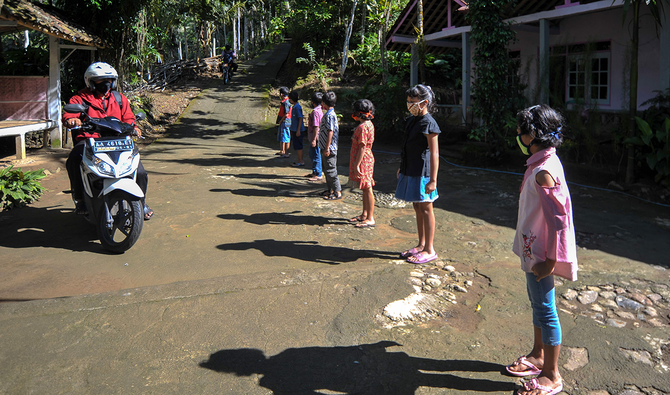
This photo taken on May 20, 2020 shows elementary school students (R) greeting their teacher Henrikus Suroto (L) as he arrives to teach them at their homes in Magelang, Central Java, after schools were closed due to the COVID-19 coronavirus outbreak. (AFP)
Short Url
Updated 15 June 2020
Follow

Not a minor problem: Children in Indonesia most vulnerable to COVID-19

  • Schools remain shut to address issue which has affected thousands

JAKARTA: Schools in Indonesia will not be opening anytime soon, with 94 percent of students across the country living in areas with a moderate to high risk of coronavirus disease (COVID-19) infections, and over 6,000 children said to have been exposed to the disease.

In a virtual press conference on Monday, Education Minister Nadiem Makarim said that the school year would start on schedule in July, but students would have to study from home, adding that only schools in the green zone, or regions where the infection cases are low, could reopen for the new academic year.

“Only six percent of our students live in the green zone — 85 regions and cities — where schools can gradually reopen. But they will need their parents’ consent to go back studying in school,” Makarim said.

The announcement came after the Indonesian Pediatric Society (IDAI) advised in late May against the reopening of schools at least until December this year after regional governments across Indonesia started to ease some restrictions and reopen the economy.

“They need to clearly explain to the parents that their children will still be exposed to the risk of infections. Assigning zones can be very dynamic — today a region may be a green zone, but it could change anytime,” IDAI Chairman Aman Pulungan told Arab News.

“We can consider reopening schools when there are no new COVID-19 cases in a month, and  no movement of people in and out of the region.”

As of Monday, there were 1,017 new infections and 64 deaths reported in the country, increasing the national total to 39,294 cases and 2,198 deaths.

About 3,000 people below the age of 18 had contracted the virus, 7.8 percent of the national tally, while around 3,400 minors were being treated, according to data from the COVID-19 national task force.

The data also showed that 550 minors had died, out of which 353 were under five years old.

“The number of children who contracted COVID-19 and who died from it continues to increase every week. We should not let even one child die,” Pulungan said, adding that an average of four percent of children who tested positive for the virus died every week, and that the figure of those who had died while undergoing treatment was even higher.

Even before the pandemic, Indonesian children were already exposed to several health issues such as malnutrition, with the World Health Organization (WHO) listing Indonesia among countries with the highest prevalence of stunted growth. In 2019, the prevalence was 27 percent, still well above the WHO standard of 20 percent.

“The comorbidities found in adults are found in children, too, but many Indonesian children also suffer from diarrhea, dengue fever, tuberculosis, and malnutrition,” Pulungan said.

Data from the Ministry of Health showed that 17.7 percent of Indonesian children below five years of age suffered from malnutrition, making their immune systems even more at risk from COVID-19.

“The government needs to beef up its efforts in preventing children from contracting the coronavirus and treating those exposed to the disease,” Susanto, chairman of the Indonesian Commission for Child Protection, told Arab News.


Sri Lanka hospital releases 22 rescued Iranian sailors

Updated 08 March 2026
Follow

Sri Lanka hospital releases 22 rescued Iranian sailors

  • Sri Lankan authorities said the survivors from the Dena were being handled according to international humanitarian law

COLOMBO: Sri Lanka discharged from hospital 22 Iranian sailors who were plucked from life rafts after their warship was sunk by a US submarine, officials said Sunday.
The sailors were treated at Karapitiya Hospital in the southern port city of Galle since Wednesday after the IRIS Dena was torpedoed just outside Sri Lanka’s territorial waters.
“Another 10 are still undergoing treatment,” a medical officer at the hospital told AFP.
He said the bodies of 84 Iranians retrieved from the Indian Ocean were also at the hospital.
Those discharged from hospital overnight had been taken to a beach resort in the same district.
Sri Lankan authorities said the survivors from the Dena were being handled according to international humanitarian law, and the government had contacted the International Committee of the Red Cross for assistance.
The island is also providing safe haven for another 219 Iranian sailors from a second ship, the IRIS Bushehr, that was allowed to berth a day after the Dena was sunk.
Sailors from the Bushehr have been moved to a Sri Lanka Navy camp at Welisara, just north of the capital Colombo, and their ship taken over by Sri Lanka’s navy.
Sri Lanka announced it was taking the Bushehr to the north-eastern port of Trincomalee, but an engine failure and other technical and administrative issues had delayed the movement, a navy spokesman said.
Sri Lanka has denied claims that it was under pressure from Washington not to allow the Iranians to return home, and said Colombo will be guided solely by international law and its own domestic legislation.
A US State Department spokesperson said the disposition of the Bushehr crew and Iranian sailors rescued at sea was up to Sri Lanka.
“The United States, of course, respects and recognizes Sri Lanka’s sovereignty in the handling of this situation,” the spokesperson told AFP in Washington.
India, meanwhile, said Saturday that it had allowed a third Iranian warship, the IRIS Lavan, to dock in one of its ports on “humane” grounds after it too reported engine problems.
The three ships were part of a multi-national fleet review held by India before the war in the Middle East started last week.
“I think it was the humane thing to do, and I think we were guided by that principle,” Indian Foreign Minister Subrahmanyam Jaishankar said on Saturday.
The Lavan docked in the south-west Indian port of Kochi on Wednesday.
“A lot of the people on board were young cadets. They have disembarked and are in a nearby facility,” Jaishankar said.