

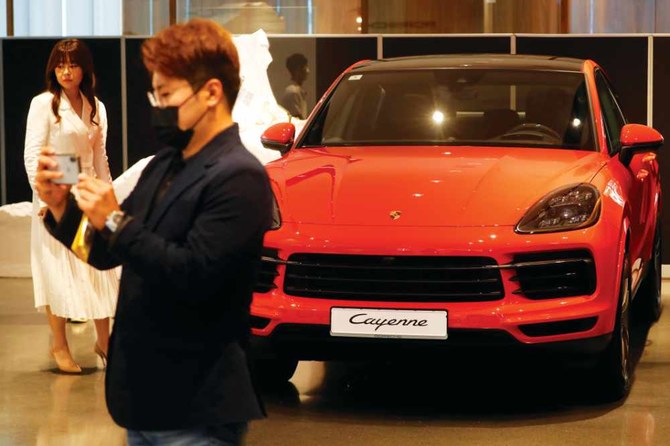
South Korea’s wealthy splash out on Porsches and BMWs

For the wealthy South Koreans buying a luxury car is an alternative to buying property. (Reuters)
Short Url
Updated 20 June 2020
Follow

South Korea’s wealthy splash out on Porsches and BMWs

  • Rising luxury car sales illustrate how the pandemic has widened the country’s wealth gap

SEOUL: Hwang Min-yong, a 37-year-old South Korean businessman, recently received his black Porsche Cayenne coupe with red leather seats after a seven-month wait and took it out for a spin on a scenic road overlooking a river near Seoul.

“Porsche has been my dream car ... I don’t really feel the effects of COVID-19, as my company is less affected,” said Hwang, who owns a small tech firm.

South Korea’s swift handling of the COVID-19 crisis has provided a backdrop for a sharp increase in demand for premium and luxury cars, dealers and officials said, as wealthy people, insulated from many of the pandemic’s worst effects, want to show off on the road. 

“This year will be one of our strongest years,” Porsche Korea CEO Holger Gerrmann told Reuters on Tuesday, as the brand’s sales rose by 46 percent to 3,433 vehicles as of January-May this year from a year earlier. That compared with 4,285 vehicles in all of 2018, and 4,204 in 2019.

In many ways, experts say, the rising sales of imported cars illustrate the widening wealth gap during the pandemic in South Korea, which already has one of the highest inequality levels among advanced countries.

Despite the COVID-19 outbreak, the monthly average income of the wealthiest 20 percent of households rose by 6 percent from January to March, while the poorest 20 percent of households saw income unchanged.

“The strong sales are testament to the rising consumption power of the top class despite the pandemic,” said Yang Jun-ho, an economics professor at Incheon National University.

He said rich people benefited from rising stock and property prices, while vulnerable workers at mom-and-pop stores lost their jobs. South Korea’s unemployment rate surged to its highest level in more than 10 years in May.

But those who can afford it see luxury cars as an alternative to buying property, dealers said. “In the early 2000s, the price of a BMW 320 was the cost of a Gangnam apartment,” said Ro Chang-whan, a longtime dealer and exporter of used cars. “House prices have gone up enormously since and buying a car is a more realistic choice.”

Sales of imported cars priced more than 100 million won ($82,511) jumped 70 percent to 15,667 vehicles from January to May this year, compared with a year earlier. Sales of small cars made in Korea fell by 10 percent from January to April, according to the latest data.

“Porsche and BMW are so popular that there are not enough of them,” said Kim Ryu-bin, a dealer of imported cars.

BMW sales rose 46 percent to 21,361 vehicles from January to May this year from a year earlier, while Lamborghini sales quadrupled to 115 vehicles during the same period, Korea Automobile Importers & Distributors Association data showed.

South Korea has surpassed the US as the top country for sales of the BMW 5 series from January to April this year, according to BMW’s South Korean unit.

“As the virus eases quicker than expected, consumers are going ahead with purchases,” said Kim Hyo-hyun, a BMW dealer in the affluent Gangnam district of Seoul.

Sales of Hyundai Motor’s premium sedan Genesis G80, priced at roughly $50,000, surpassed that of the $30,000 Sonata last month and hit a record high.

While demand is strong, supply constraints due to COVID-19 manufacturing shutdowns in Europe and the US are expected to slow sales, dealers say. Kim said his store expects to see sales fall by one fifth next month. 


Multilateralism strained, but global cooperation adapting: WEF report

Updated 10 January 2026
Follow

Multilateralism strained, but global cooperation adapting: WEF report

DUBAI: Overall levels of international cooperation have held steady in recent years, with smaller and more innovative partnerships emerging, often at regional and cross-regional levels, according to a World Economic Forum report.

The third edition of the Global Cooperation Barometer was launched on Thursday, ahead of the WEF’s annual meeting in Davos from Jan. 19 to 23.

“The takeaway of the Global Cooperation Barometer is that while multilateralism is under real strain, cooperation is not ending, it is adapting,” Ariel Kastner, head of geopolitical agenda and communications at WEF, told Arab News.

Developed alongside McKinsey & Company, the report uses 41 metrics to track global cooperation in five areas: Trade and capital; innovation and technology; climate and natural capital; health and wellness; and peace and security.

The pace of cooperation differs across sectors, with peace and security seeing the largest decline. Cooperation weakened across every tracked metric as conflicts intensified, military spending rose and multilateral mechanisms struggled to contain crises.

By contrast, climate and nature, alongside innovation and technology, recorded the strongest increases.

Rising finance flows and global supply chains supported record deployment of clean technologies, even as progress remained insufficient to meet global targets.

Despite tighter controls, cross-border data flows, IT services and digital connectivity continued to expand, underscoring the resilience of technology cooperation amid increasing restrictions.

The report found that collaboration in critical technologies is increasingly being channeled through smaller, aligned groupings rather than broad multilateral frameworks.  

This reflects a broader shift, Kastner said, highlighting the trend toward “pragmatic forms of collaboration — at the regional level or among smaller groups of countries — that advance both shared priorities and national interests.”

“In the Gulf, for example, partnerships and investments with Asia, Europe and Africa in areas such as energy, technology and infrastructure, illustrate how focused collaboration can deliver results despite broader, global headwinds,” he said.

Meanwhile, health and wellness and trade and capital remained flat.

Health outcomes have so far held up following the pandemic, but sharp declines in development assistance are placing growing strain on lower- and middle-income countries.

In trade, cooperation remained above pre-pandemic levels, with goods volumes continuing to grow, albeit at a slower pace than the global economy, while services and selected capital flows showed stronger momentum.

The report also highlights the growing role of smaller, trade-dependent economies in sustaining global cooperation through initiatives such as the Future of Investment and Trade Partnership, launched in September 2025 by the UAE, New Zealand, Singapore and Switzerland.

Looking ahead, maintaining open channels of communication will be critical, Kastner said.

“Crucially, the building block of cooperation in today’s more uncertain era is dialogue — parties can only identify areas of common ground by speaking with one another.”