

OPEC+ pushes for compliance, undecided on oil cut extension

1 / 2
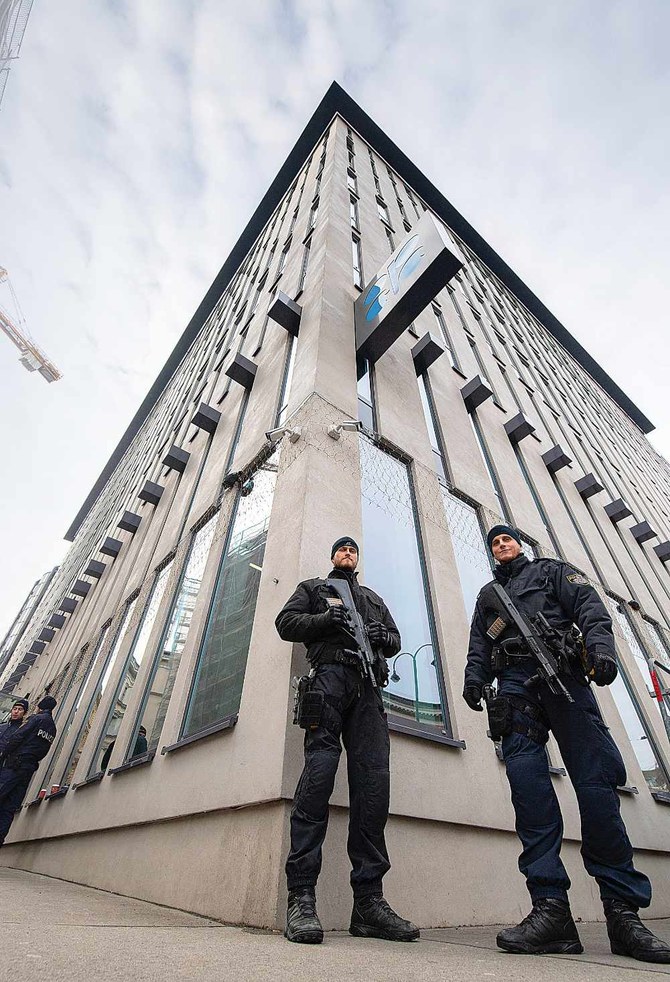
The Austria-based Organization of the Petroleum Exporting Countries (OPEC) is attempting to re-balance global crude markets. (AFP)
2 / 2
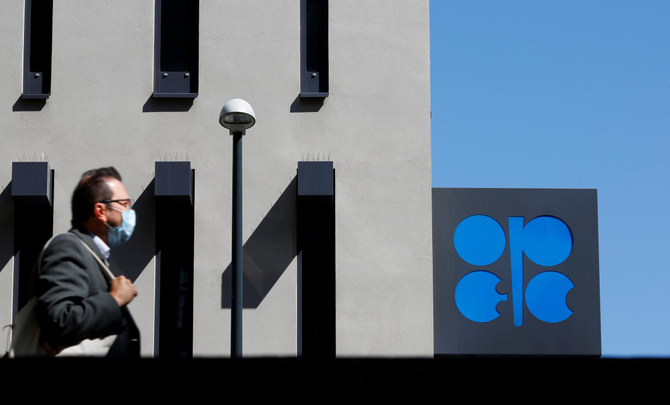
A person passes the logo of the Organization of the Petroleoum Exporting Countries (OPEC) in front of OPEC’s headquarters in Vienna, Austria, April 9, 2020. (Reuters)
Short Url
Updated 19 June 2020
Follow

OPEC+ pushes for compliance, undecided on oil cut extension

  • OPEC+ presses countries such as Iraq and Kazakhstan to comply better with oil cuts
  • Oil has recovered to above $41 a barrel from a 21-year low below $16 a barrel in April, helped by OPEC+ cuts and a recovery in demand

DUBAI:  OPEC+ — the oil alliance led by Saudi Arabia and Russia — is aiming for full compliance with agreed output cuts in an attempt to re-balance global crude markets.

The 23-strong organization’s Joint Ministerial Monitoring Committee (JMMC) met by webinar under co-chairmanship of Prince Abdulaziz Bin Salman, the Kingdom’s energy minister, and agreed that “the attainment of 100 percent conformity from all participating countries is not only fair and equitable, but vital for the ongoing and timely rebalancing efforts, and helping deliver sustainability oil market sustainability.”

The meeting disclosed that compliance levels had averaged 87 percent in May — a very high level by previous standards — and that those countries that had failed to meet their commitments would make up for the shortfall between July and September.

Failure to meet agreed compliance levels has thrown out OPEC+ calculations in the past. Saudi Arabia holds the view that a rigorous adherence to agreed output reduction commitments is the key to future oil market stability.

The issue has become all the more important in face of the downturn in global demand as a result of the economic effects of the pandemic lockdowns. If oil producers “cheat” on their output levels it will add to the surpluses on global markets.

OPEC+ has taken approximately 9.6 million barrels per day out of the market since April, and Saudi Arabia and the Gulf allies have made voluntary cuts of a further 1.2 million barrels, due to expire at the end of the month.

Those countries that failed to meet the May target have agreed to make up for those shortfalls between July and September, in addition to their existing cut commitments. Iraq and Kazakhstan have submitted formal schedules to compensate for their shortfalls. 

Some members of OPEC+ want to extend the current level of cuts beyond the end of this month, when they are scheduled to be replaced by lower targets.

Russia, which was represented at the webinar by its energy minister, Alexander Novak, is believed to be less convinced of the need to prolong the current historic cuts levels.

Separately, Saudi Aramco said yesterday that it would meet its dividend obligation of $18.75 billion this quarter from a mixture of cash and debt.

“We would like to use our free cash definitely most of the time, but other debt instruments from banks, or bonds, are also available for us as we have a strong balance sheet,” Amin Nasser, Aramco’s chief executive officer,
told journalists.


Saudi Arabia’s cultural sector is a new economic engine between Riyadh and Paris, says ambassador

Updated 6 sec ago
Follow

Saudi Arabia’s cultural sector is a new economic engine between Riyadh and Paris, says ambassador

RIYADH: Culture has become a fundamental pillar in bilateral relations between France and Saudi Arabia, according to the French Ambassador to the Kingdom, Patrick Maisonnave.

Maisonnave noted its connection to the entertainment and tourism sectors, which makes it a new engine for economic cooperation between Riyadh and Paris.

He told Al-Eqtisadiah during the opening ceremony of La Fabrique in the Jax district of Diriyah that cultural cooperation with Saudi Arabia is an important element for its attractiveness in the coming decades.

La Fabrique is a space dedicated to artistic creativity and cultural exchange, launched as part of a partnership between the Riyadh Art program and the French Institute in Riyadh. 

Running from Jan. 22 until Feb 14, the initiative will provide an open workspace that allows artists to develop and work on their ideas within a collaborative framework.

Launching La Fabrique as a space dedicated to artistic creativity

The ambassador highlighted that the transformation journey in the Kingdom under Vision 2030 has contributed to the emergence of a new generation of young artists and creators, alongside a growing desire in Saudi society to connect with culture and to embrace what is happening globally. 

He affirmed that the relationship between the two countries is “profound, even cultural par excellence,” with interest from the Saudi side in French culture, matched by increasing interest from the French public and cultural institutions unfolding in the Kingdom.

Latest estimates indicate that the culture-based economy represents about 2.3 percent of France’s gross domestic product, equivalent to more than 90 billion euros ($106.4 billion) in annual revenues, according to government data. The sector directly employs more than 600,000 people, making it one of the largest job-creating sectors in the fields of creativity, publishing, cinema, and visual arts.

Saudi Arabia benefiting from French experience in the cultural field

Maisonnave explained that France possesses established cultural institutions, while Saudi Arabia is building a strong cultural sector, which opens the door for cooperation opportunities.

This comes as an extension of the signing of 10 major cultural agreements a year ago between French and Saudi institutions, aiming to enhance cooperation and transfer French expertise and knowledge to contribute to the development of the cultural system in the Kingdom.

He added that experiences like La Fabrique provide an opportunity to meet the new generation of Saudi creators, who have expressed interest in connecting with French institutions and artists in Paris and France.

La Fabrique encompasses a space for multiple contemporary artistic practices, including performance arts, digital and interactive arts, photography, music, and cinema, while providing the public with an opportunity to witness the stages of producing artistic works and interact with the creative process.