

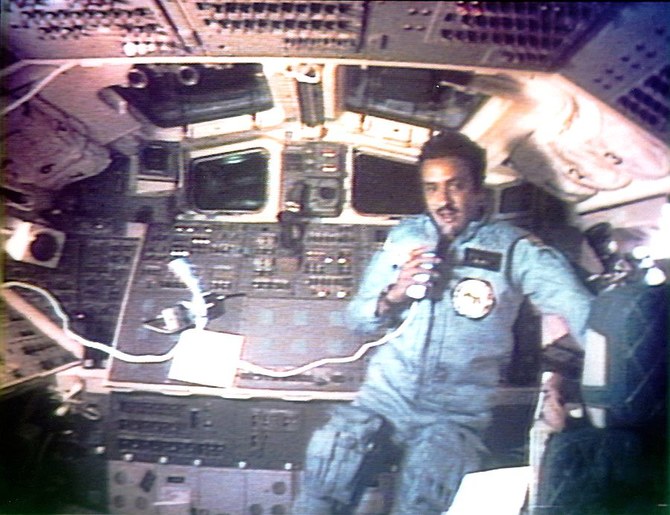

LONDON: Thirty-five years ago today, at 2:33 p.m. Riyadh time on June 17, 1985, the space shuttle Discovery blasted off from launch pad 39A at the Kennedy Space Center in Florida.
By then, four years and 17 successful missions since the launch in April 1981 of Columbia, the world’s first reusable orbital spacecraft, shuttle launches had become, if not exactly routine, then almost business as usual.
But there was nothing routine or usual about NASA Mission STS 51-G.
On board Discovery as it set off on its seven-day orbital mission were three commercial communication satellites, a trial tracking system for the proposed US Star Wars missile defense system, a series of astronomy and biomedical experiments — and a copy of the Qur’an.
Its owner was 28-year-old Prince Sultan bin Salman, who, strapped into seat seven as one of two payload specialists on the flight deck of Discovery, blasted into orbit and the history books at 28,968 kilometers per hour as the first Muslim, the first Arab and the first member of a royal family to fly into space.
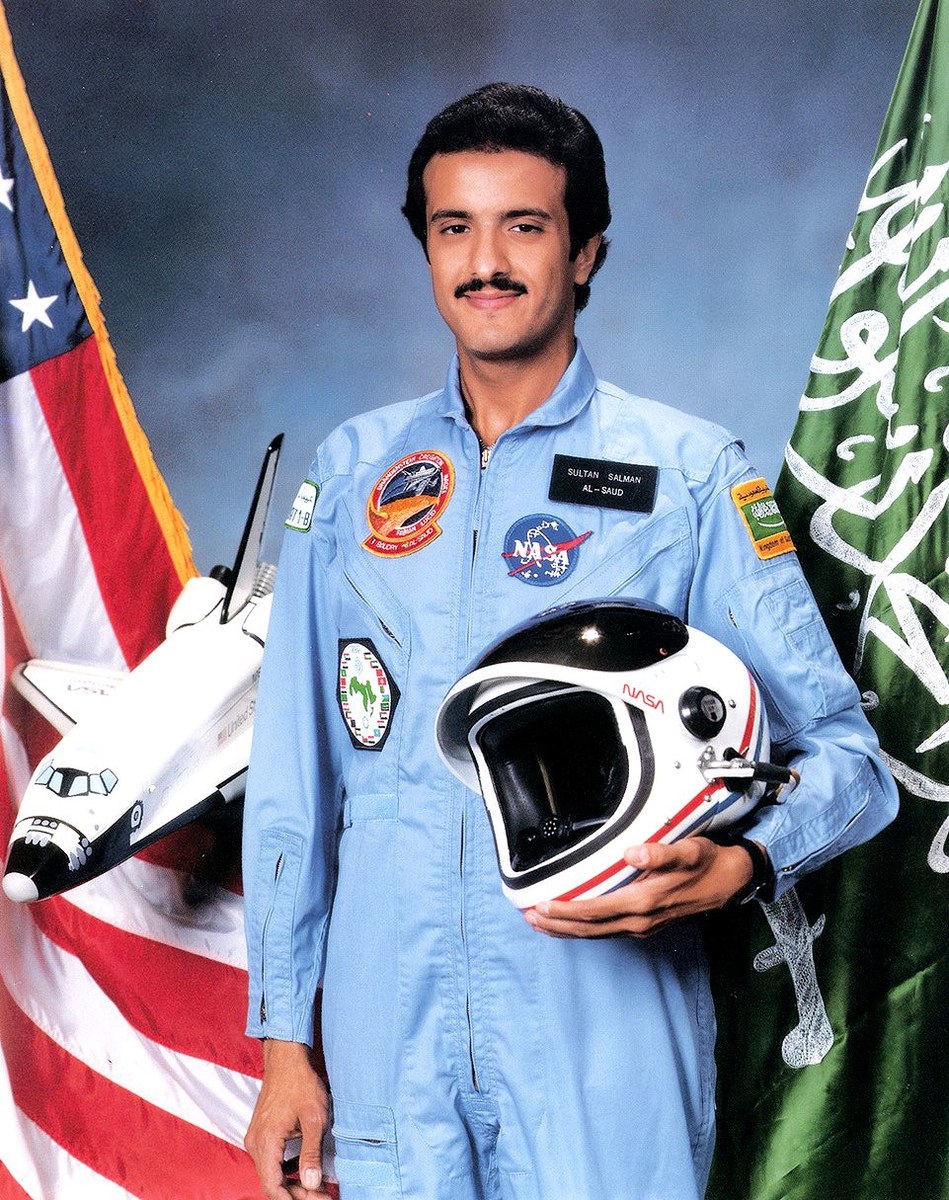
Back home, Prince Sultan was greeted as a hero, appointed a major in the Royal Saudi Air Force and, as an unofficial ambassador, met many world leaders. (Flickr/NASA)
The choice of launch pad 39A for the mission had been a hugely symbolic one for the prince, who, as a 13-year-old boy in Riyadh, had watched the grainy television footage of the Apollo 11 lunar mission, which had taken off from the same site on July 16, 1969.
As Prince Sultan recalled in an interview with Arab News for the 50th anniversary of the Moon landing last year, the sight of astronaut Neil Armstrong taking his one small step made a lasting impression.
“Humans made airplanes and made advances in industry,” he said. “But for humans to leave their own planet … that was really something else,” he said.
At the time, the young prince entertained no thoughts of reaching for the stars himself. Even after he learnt to fly aircraft, gaining his private pilot’s license in 1977 while studying in the US, he “dismissed as impossible the idea that somebody from the Arab world” would ever venture into space.
Then, suddenly, the impossible became possible.
“When you see Earth from space you then begin to focus … that this is a gift from Allah, and that there is more to it than yourself and your small community, more to it than your own limited passions.”
Prince Sultan bin Salman
In 1976, Saudi Arabia had played a key role in the Arab League’s formation of Arabsat, a satellite communications company. Its first satellite, Arabsat-1A, was deployed from an Ariane 3 rocket launched from the French space center in Guiana in February 1985.
Arabsat’s second satellite, 1B, was due to follow four months later, and this time it would be carried aloft by NASA’s Space Shuttle Discovery.
The members of the Arab League were invited to nominate a payload specialist and, after 10 weeks of intensive training, Prince Sultan made the transition from pilot to astronaut. Blasting off into the Florida sky, he was watched and applauded by more than 200 Arab guests of NASA.
Ahead were seven days, one hour, 38 minutes and 52 seconds he would never forget. After 111 complete orbits of the Earth, he was left with an abiding sense of wonder.
“When you see Earth from space, you then begin to focus … that this is a gift from Allah, and that there is more to it than yourself and your small community, more to it than your own limited passions,” he recalled.
“Your care and passion for things become more global, more universal.”
Even orbiting 387 km above Earth, traveling over 4.5 million km in seven days, there were reminders of home — a call from his father and King Fahd broadcast live on television; being awoken on day six by mission control playing “Abaad Kontom Wala Garayebein” (“Near or Far”), by the Saudi singer Mohammed Abdo; and, of course, reading the Qur’an in space.
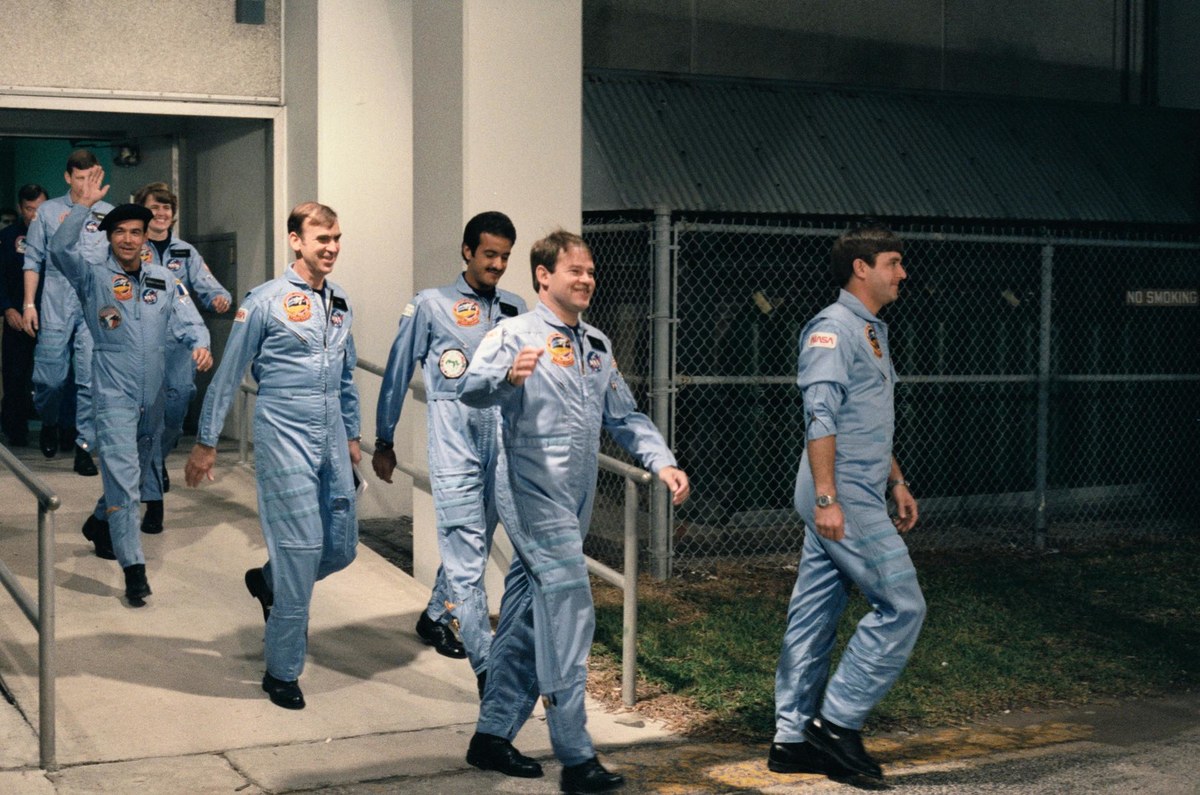
Prince Sultan and Discovery touched down on runway 23 at Edwards Air Force Base in California at 6:11 a.m. Pacific Daylight Time on June 24, 1985. (File/NASA)
“My father, when he called me on the space shuttle, said: ‘I learned today that you finished the Qur’an,’ and he was very happy about it,” the prince recalled last year.
To this day, as Arab News reported, “he holds this accomplishment dear to his heart, knowing that King Salman is proud of him for being the only person to read the Qur’an in space.”
Multiple missions accomplished, Prince Sultan and Discovery touched down on runway 23 at Edwards Air Force Base in California at 6:11 a.m. Pacific Daylight Time on June 24, 1985.
Back home, he was greeted as a hero, appointed a major in the Royal Saudi Air Force and, as an unofficial ambassador, met many world leaders — and his childhood heroes, the crew of Apollo 11.
Mission STS 51-G had been carried out flawlessly. But if any reminder were necessary that space travel could never be regarded as routine, it came on Jan. 28, 1986, just seven months after Prince Sultan’s successful voyage into space.
At the start of the shuttle program’s 25th mission, Discovery’s sister ship, the Challenger, broke apart shortly after takeoff, killing all seven crew members, including Christa McAuliffe, who had been selected to be the first teacher in space.

keywords
Prince Sultan’s next mission was earthbound, but equally dear to his heart. Fired by a belief that “our heritage and culture are not just important but are critical to our future,” in 2000 he was appointed secretary general of the Saudi Commission for Tourism and National Heritage.
There, he began work to preserve the Kingdom’s treasures, overseeing the master plan that in 2008 would see the ancient rock-carved city of Hegra designated a UNESCO World Heritage Site.
By 2018 it had been joined on the list by four other national treasures.
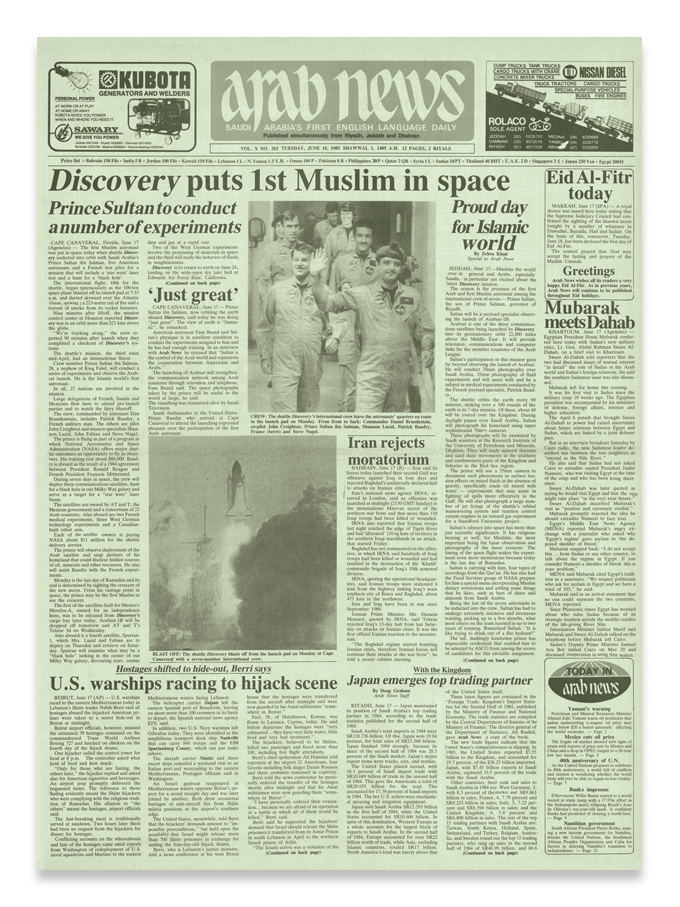
A page from the Arab News archive showing the news on June 18, 1985.
However, Prince Sultan was not yet done with space. In December 2018, he was appointed chairman of the newly formed Saudi Space Commission (SSC).
On June 17, 1985, he took his own one small step, for himself, for his faith — and for the future of his country in space.
As chairman of the SSC, with its mission “to empower the generation of tomorrow to lead in the field of space science and its applications,” he continues to inspire the youth of Saudi Arabia to follow in his footsteps.


