Mass virus testing in Beijing after new cluster triggers lockdowns

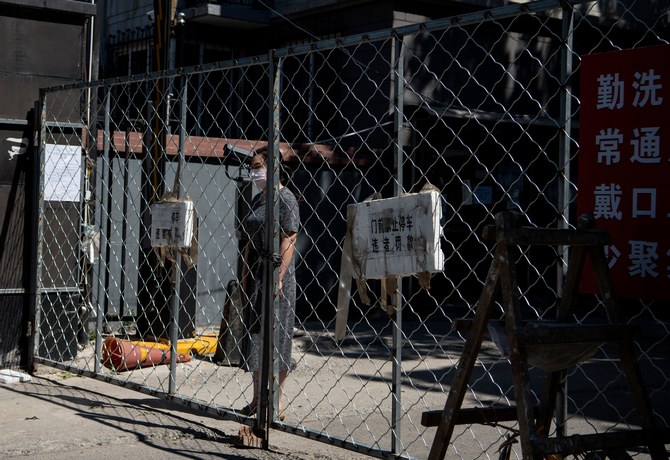
A woman stands behind a fence in the Yilanyuan residential area which is under lockdown after a new COVID-19 coronavirus outbreak near the closed Xinfadi Market in Beijing. (AFP)
Short Url
Updated 14 June 2020
Follow

Mass virus testing in Beijing after new cluster triggers lockdowns

  • The new outbreak of infections has been linked to a wholesale food market in the Chinese capital
  • Virus breakouts linked with food markets have raised questions over the hygiene of the food supply chain in China

BEIJING: Beijing carried out mass testing for the coronavirus on Sunday after a new outbreak in the city that prompted travel warnings across the country amid fears of a resurgence of the disease.
The deadly contagion had been brought largely under control in China through strict lockdowns that were imposed early this year but have since been lifted.
But a fresh cluster linked to a wholesale food market in the capital has sparked widespread alarm and raised the spectre of a return to painful restrictions.

The National Health Commission (NHC) reported 57 new infections on Sunday, of which 36 were local transmissions in Beijing, all linked to the Xinfadi market.
Another two domestic infections were in northeastern Liaoning province and were close contacts of the Beijing cases.
The 19 other infections were among Chinese nationals returning from abroad.
Liaoning was among several provinces to advise residents against traveling to Beijing due to the new outbreak — along with cities such as nearby Tianjin and several in Hebei province, which surrounds Beijing.
Some local authorities said people entering from Beijing would have to quarantine, state media reported.
In the capital, lockdowns have been imposed on a very small part of the city that includes 11 residential estates near the market which supplies most of the city’s fresh produce.
Officials said Sunday they planned to carry out virus tests on 46,000 residents in the area surrounding the market and had set up 24 testing stations.
Everyone who works at Xinfadi also has to undergo testing.
So far 10,881 people have been tested in the area with another eight cases diagnosed on Sunday. They were not included in the NHC’s tally earlier in the day that covered the previous 24 hours.
“I went to Xinfadi market so I want to confirm that I am not infected,” a 32-year-old woman surnamed Guo told AFP as she queued in scorching heat at a stadium waiting for a virus test.
“We were told that after the tests... if it is positive, we will be taken directly to the hospital.”
One of Sunday’s new cases was a 56-year-old man who works as an airport bus driver and had visited the Xinfadi market in early June before later falling ill, state-run People’s Daily reported.
The meat section of the huge, sprawling market was closed Sunday and AFP reporters saw hundreds of police officers and security personnel plus dozens of paramilitary police blocking access.
Efforts to trace those who had visited the market have begun, with companies and neighborhood communities messaging staff and residents across the city to ask about their recent movements.
A vegetable market adjacent to Xinfadi was open Sunday and trucks were arriving to deliver or collect stock.
“Afraid? Not really” a delivery driver surnamed Zhang told AFP.
“But anyway I have no choice — I am part of the lowest class of society. So I have to keep working in order to make a living.”
In nearby streets, residents were under lockdown and restaurants closed.
Some people used a wooden stepladder propped against the gated entrance to one community to pass supplies to loved ones.
A resident surnamed Chen told AFP he had made several trips with his car to the front gate of his compound to deliver food.
“As soon as I finish delivering the supplies to my family members, I will go upstairs to join them,” he said.
“After that I won’t be able to get out.”
COVID-19 first emerged late last year and one of the first clusters was from a market in the central city of Wuhan that sold wild animals for meat.
The latest outbreak in Beijing has turned the spotlight on the hygiene of the city’s food supply chain.
State-run media reported that the virus was detected on chopping boards used to handle imported salmon, and that major supermarkets had removed the fish from their stocks.
Beijing authorities ordered a city-wide food safety inspection focusing on fresh and frozen meat, poultry and fish in supermarkets, warehouses and catering services.
One trader surnamed Sun, selling tomatoes and cherries at a central food market, told AFP there were fewer customers than normal.
“People are scared,” he said.
City authorities have closed nine schools and kindergartens near Xinfadi, while sporting events and cross-provincial tour groups have been stopped.


Pakistan rules out talks with Afghanistan, says more than 330 Afghan fighters killed in operations

Updated 5 sec ago
Follow

Pakistan rules out talks with Afghanistan, says more than 330 Afghan fighters killed in operations

  • More than 330 Afghan fighters killed in operations

ISLAMABAD: Pakistan has ruled out talks with Afghanistan until there is an end to “terrorism” emanating from Afghan soil, officials said on Friday. The statement follows the killing of more than 330 Afghan fighters in cross-border skirmishes this week.

The latest clashes between the neighbors erupted after Pakistani airstrikes on Afghan territory last weekend triggered retaliatory attacks along the border on Thursday, escalating long‑simmering tensions over Pakistan’s claim that Afghanistan shelters Pakistani Taliban militants. Afghanistan denies this, saying Pakistan is deflecting blame for its own security failures.

Pakistani Information Minister Attaullah Tarar said his country had killed 331 Afghan fighters, destroyed over 100 posts and targeted 37 military locations across Afghanistan. Afghan officials have said more than 50 Pakistani soldiers have been killed and several Pakistan posts captured. Neither casualty figures nor battlefield claims by either side could be independently verified.

Meanwhile, Mosharraf Zaidi, Prime Minister Shehbaz Sharif’s spokesperson for foreign media, ruled out any talks with Afghanistan until Kabul addresses the issue, while the US expressed support for what it called Pakistan’s “right to defend itself” against attacks from Afghanistan’s Taliban rulers.

“There won’t be any talks, there is nothing to talk about ... Terrorism from Afghanistan has to end,” Zaidi told state-run Pakistan TV Digital, saying Islamabad would continue to target militant havens inside Afghanistan.

“Pakistan’s responsibility is to protect its citizens. If we know that there is a terrorist in point A and we know that there is a terrorist enabler at point A, we will find a weapon to land at point A and eliminate the threat.”

Zaidi said he did not expect Pakistan to deviate from this position: “We have clearly articulated what we are doing and what we plan on continuing to do and what it will take for us to stop doing what we are doing.”

He added: “And we will expect that both the international community and the regime in question, the Afghan Taliban, will come to their senses and will help reduce instability and disorder in this region.”

Pakistan is a major non-NATO ally of Washington, while the US considers the Afghan Taliban a “terrorist” group.

“The United States supports Pakistan’s right to defend itself against attacks from the Taliban, a Specially Designated Global Terrorist group,” Reuters quoted a State Department spokesperson as saying.

US diplomat Allison Hooker said on X she had spoken with Pakistan Foreign Secretary Amna Baloch on Friday.

The State Department spokesperson said Washington was aware of the escalation in tensions and “outbreak of fighting between Pakistan and the Afghan Taliban,” adding the US was “saddened by the loss of life.”

“The Taliban have consistently failed to uphold their counterterrorism commitments,” it said. “Terrorist groups use Afghanistan as a launching pad for their heinous attacks.”

Meanwhile, Afghan Taliban spokesperson Zabihullah Mujahid called for talks to resolve the crisis.

“We have always emphasized peaceful resolution, and now too we want the issue to be resolved through dialogue,” he said on Friday afternoon.

Asked what Pakistan desired, Tarar said: “Neutralizing the threat and ensuring that Pakistan is safe. Because for us, we’ve been good neighbors, we’ve been very friendly neighbors, we’ve been very, very generous neighbors. Our generosity, unfortunately, has often been seen as our weakness. So the objective, aim is to neutralize the threat and make Pakistan safe.”

He added it was too early to comment on a ceasefire as it was an evolving situation.