PARIS: Ancient crocodiles — long thought to have walked on all fours like their modern-day cousins — may have got around on two legs, according to new research published Thursday.
A team of researchers from China, Australia and the US analyzed footprints found at the Jinju Formation in modern day South Korea, a rich archaeological dig site that has led to the discovery of ancient species of lizards, spiders and tiny raptors dating back 120 million years.
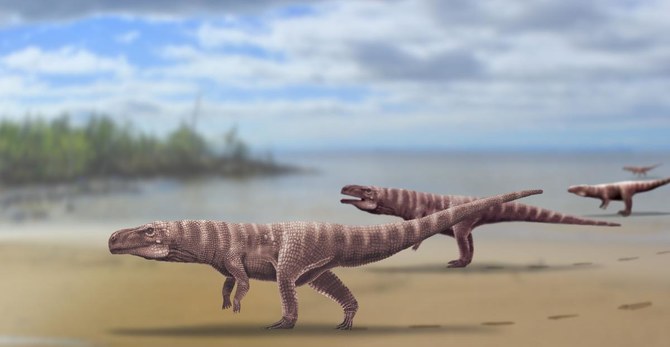
They believe the footprints may have been made by a three-meter (10-foot) long crocodile ancestor — called Batrachopus grandis — that walked around “like a crocodile balancing on a tight-rope,” according to Kyung Soo Kim from the Chinju National University of Education.
“They were moving in the same way as many dinosaurs, but the footprints were not made by dinosaurs,” Kim said.
While the researchers initially thought the tracks were those of an ancient pterosaur — a winged dinosaur that roamed Earth until 66 million years ago — they more likely belonged to a particularly large and previously undiscovered member of the crocodylomorph family.
The 24-centimeter-long (10-inch) track prints give a sense of the size of these croc relatives.
Their legs, according to Anthony Romilio, a paleontologist at the University of Queensland and one of the study’s authors, would have been about the same size as those of an adult human. But their bodies were “over three meters in length.”
This would have made them about twice as large as relatives from the same time period.
The ancient crocodiles most likely would have walked flat on their feet, digging their heels into the earth much like humans do — leaving deep, narrow impressions.
Reconstructions of the crocodiles show they had a low center of gravity.
The lack of handprints and tail-drag marks found at the dig site, as well as the animal’s narrow gait, also indicated bipedal movement, Romilio added.
The finding could shed light on how other creatures from the Cretaceous period — such as pterosaurs — would have moved about, the authors added.
They noted that footprints from other fossil sites — such as the Haman Formation, also in South Korea — may have to be re-examined in light of the new discovery.
The study was published in Nature Scientific Reports.


![]()
![]()

‘Tight-rope walking’ crocodile may have stood on two legs: study

Short Url
https://arab.news/ma5ws
‘Tight-rope walking’ crocodile may have stood on two legs: study
- Footprints found at the Jinju Formation in modern day South Korea were analyzed


Latest updates




Recommended


© 2026 SAUDI RESEARCH & PUBLISHING COMPANY, All Rights Reserved And subject to Terms of Use Agreement.