Mystical connection: The African village where crocodiles are welcome

People in Bazoule, around 30 kilometers from the capital Ouagadougou, share their pond with more than 100 of the razor-toothed creatures. (AFP)
Updated 19 June 2018
Follow

Mystical connection: The African village where crocodiles are welcome

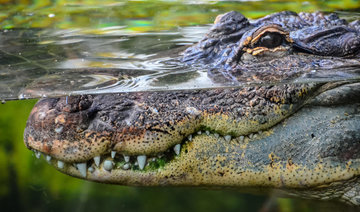
BAZOULE, Burkina Faso: Crocodiles may be one of the deadliest hunters in the animal kingdom, but in a small village in Burkina Faso it is not unusual to see someone sitting atop one of the fearsome reptiles.
People in Bazoule, around 30 kilometers from the capital Ouagadougou, share their pond with more than 100 of the razor-toothed creatures.
“We got used to the crocodiles when we were young, swimming in the water with them and all that,” said Pierre Kabore, just a few meters (yards) away from a crocodile feasting on chicken provided by the village.
“Now we can always approach them and sit on them — and if you have the courage, you can lie on them too. There’s no problem, they are sacred crocodiles. They don’t do anything to anyone.”
According to local legend, the startling relationship with the predators dates back to at least the 15th century.
The village was in the grip of an agonizing drought until the crocodiles led women to a hidden pond where the population could slake their thirst.
“The villagers organized a party to celebrate and thank the reptiles,” Kabore said.
A celebration known as Koom Lakre is still held every year during which villagers make sacrifices and ask the animals to grant their wishes of health, prosperity and a good harvest.
Far from being considered a threat, the crocodiles are deemed to have a mystical connection with Bazoule.
“Crocodiles are represented as the soul of our ancestors and if one of them dies, they are buried and even given a funeral as if they were human,” said Kabore.
“When a misfortune is about to happen in the village, they cry out. Elders are charged with interpreting the cries, and then make wishes to ward off bad luck.”
The unusual contact between man and croc has drawn disbelieving tourists to the village to see for themselves.
On their arrival, travelers can buy a chicken which is hung on a stick by a guide and used to entice the crocodiles out of the pond so that visitors can pose with the creatures.
“It was nice to watch from a distance but sitting on one was a bit freaky,” said Thomas Baspin, a young Frenchman who came to visit his grandparents in Burkina Faso.
“I’m glad I did it — but I’m also glad it’s over!” he quipped.
Tourism has become a big money-spinner for the impoverished villagers, but a three-year-old jihadist insurgency in Burkina Faso is taking its toll.
Ouagadougou has come under attack three times, most recently in March, when jihadists attacked the military headquarters and French embassy.
“We could have more than 10,000 visitors per year but at the moment, there’s no more than 4,000 or 5,000,” said Raphael Kabore, one of the guides.
Global warming is also believed to be having an impact. Rainfall levels are down each year, and the famous pond that is the crocodiles’ home is shrinking. When it disappears, will the reptiles once more guide their human friends to a new watery home?


Arts festival’s decision to exclude Palestinian author spurs boycott

Randa Abdel Fattah. (Photo/Wikipedia)
Updated 12 January 2026
Follow

Arts festival’s decision to exclude Palestinian author spurs boycott

  • A Macquarie University academic who researches Islamophobia and Palestine, Abdel-Fattah responded saying it was “a blatant and shameless act of anti-Palestinian racism and censorship,” with her lawyers issuing a letter to the festival

SYDENY: A top Australian arts festival has seen ​the withdrawal of dozens of writers in a backlash against its decision to bar an Australian Palestinian author after the Bondi Beach mass shooting, as moves to curb antisemitism spur free speech concerns.
The shooting which killed 15 people at a Jewish Hanukkah celebration at Sydney’s Bondi Beach on Dec. 14 sparked nationwide calls to tackle antisemitism. Police say the alleged gunmen were inspired by Daesh.
The Adelaide Festival board said last Thursday it would disinvite Randa ‌Abdel-Fattah from February’s ‌Writers Week in the state of South Australia because “it ‌would not ​be ‌culturally sensitive to continue to program her at this unprecedented time so soon after Bondi.”

FASTFACTS

• Abdel-Fattah responded, saying it was ‘a blatant and shameless act of anti-Palestinian racism and censorship.’

• Around 50 authors have since withdrawn from the festival in protest, leaving it in doubt, local media reported.

A Macquarie University academic who researches Islamophobia and Palestine, Abdel-Fattah responded saying it was “a blatant and shameless act of anti-Palestinian racism and censorship,” with her lawyers issuing a letter to the festival.
Around 50 authors have since withdrawn from the festival in protest, leaving it in doubt, local media reported.
Among the boycotting authors, Kathy Lette wrote on social media the decision to bar Abdel-Fattah “sends a divisive and plainly discriminatory message that platforming Australian Palestinians is ‘culturally insensitive.'”
The Adelaide Festival ‌said in a statement on Monday that three board ‍members and the chairperson had resigned. The ‍festival’s executive director, Julian Hobba, said the arts body was “navigating a complex moment.”

 a complex and ‍unprecedented moment” after the “significant community response” to the board decision.
In the days after the Bondi Beach attack, Jewish community groups and the Israeli government criticized Prime Minister Anthony Albanese for failing to act on a rise in antisemitic attacks and criticized protest marches against Israel’s war in ​Gaza held since 2023.
Albanese said last week a Royal Commission will consider the events of the shooting as well as antisemitism and ⁠social cohesion in Australia. Albanese said on Monday he would recall parliament next week to pass tougher hate speech laws.
On Monday, New South Wales state premier Chris Minns announced new rules that would allow local councils to cut off power and water to illegally operating prayer halls.
Minns said the new rules were prompted by the difficulty in closing a prayer hall in Sydney linked to a cleric found by a court to have made statements intimidating Jewish Australians.
The mayor of the western Sydney suburb of Fairfield said the rules were ill-considered and councils should not be responsible for determining hate speech.
“Freedom ‌of speech is something that should always be allowed, as long as it is done in a peaceful way,” Mayor Frank Carbone told Reuters.