


NEW YORK CITY: A group of Western and Middle Eastern nations on Wednesday announced the creation of an international task force with the aim of identifying and destroying the remnants of Syria’s chemical weapons program.
They pledged their full support for the country’s new government as it seeks to move beyond the legacy of the former president, Bashar Assad.
The initiative, led by Syria and supported by the Organisation for the Prohibition of Chemical Weapons, will focus on locating, securing and verifiably destroying any remaining chemical weapons stockpiles, infrastructure or other materials linked to the Assad-era program.
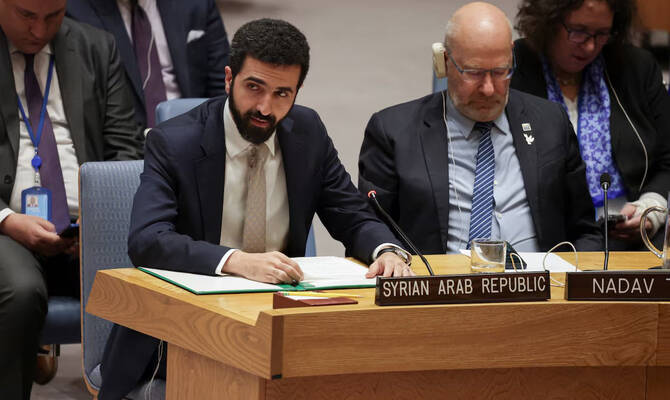
In a joint statement delivered by Syria’s permanent representative to the OPCW, Ambassador Mohammed Kattoub (himself a survivor of the chemical attack on Ghouta), Canada, France, Germany, Qatar, Syria, Turkiye, the UK and the US said they would stand “side-by-side” with Damascus through the newly formed “Breath of Freedom Task Force.”
They continued: “Today, Syria turns from a past tarnished by the former regime’s use of chemical weapons against its own people, toward a future that is worthy of Syria’s rich history and its people.”
The task force will also work to build Syria’s domestic capacity to carry out the task through the provision of training, equipment and operational support, while coordinating closely with the OPCW’s verification efforts.
Chemical weapons attacks by the Assad regime during the Syrian civil war drew widespread international condemnation and were among the conflict’s defining atrocities. The most notorious incident of this kind, the attack on Ghouta in 2013, killed hundreds of civilians, including many children, shocking the world.
Subsequent attacks, in places such as Khan Shaykhun in 2017 and Douma in 2018, reinforced concerns about the continued use of chemical weapons. Estimates from monitoring groups and international organizations suggest that more than 1,000 people were killed in major chemical warfare incidents, and thousands injured.
The attacks triggered global outrage, emergency debates at the UN, and calls for accountability. They led to international agreements that aimed to dismantle Syria’s declared chemical arsenal, though concerns persisted for years about undeclared stockpiles and their continued use by the former regime.
The Syrian ambassador to the UN, Ibrahim Olabi, told Arab News that the new international initiative marked the culmination of months of quiet coordination among participating states. He described Wednesday’s announcement as “an inauguration” rather than a starting point.
“This is the result of really hard work that took place quietly over the last months,” Olabi said, adding that the countries had contributed in different ways, such as the provision of technical expertise, access or procurement support.
“Our aim is to close this file once and for all,” Olabi said. He also stressed that survivors of chemical strikes remain central to the new government’s efforts, noting that several officials, including Syria’s representative to the OPCW, were themselves victims of such attacks.
“It does trigger our trauma when we remember what we went through,” Olabi said. “But that also places a responsibility on us to ensure this never happens again — not in Syria and not anywhere else.”
The joint statement acknowledged that the task of dismantling what remains of the chemical weapons program will be complex and time-consuming, given the secretive nature of the Assad regime’s weapons development, as well as ongoing operational hazards including landmines and other unexploded ordnance at suspected storage sites.
“Much is still unknown about its nature and extent,” the statement said of the Assad program, adding that access to facilities might be limited or dangerous.
The participating countries said their contributions would vary depending on their expertise but it all would be in support Syria’s leadership of the efforts.
The initiative also seeks broader international backing, and the signatories called on other OPCW member states to contribute resources and expertise to ensure the mission’s success. They also emphasized that it is grounded in the Chemical Weapons Convention, which bans the development, production and use of such weapons.
“Chemical weapons have no place in Syria, no place in the region, and no place in our world,” the statement said.
The OPCW will continue with its own parallel mandate to verify disarmament efforts and investigate responsibility for prior attacks.
Framing the international initiative as both symbolic and practical, the participating countries described the task force as a turning point for Syria’s international standing.
“At a time when the world desperately needs stories of unity and hope, we have chosen to write one together,” they said.
“In honor of the victims and in defense of humanity, this international norm will be upheld in Syria once more, and Syria will breathe freely again.”


