

New Zealand removes statue of controversial colonist

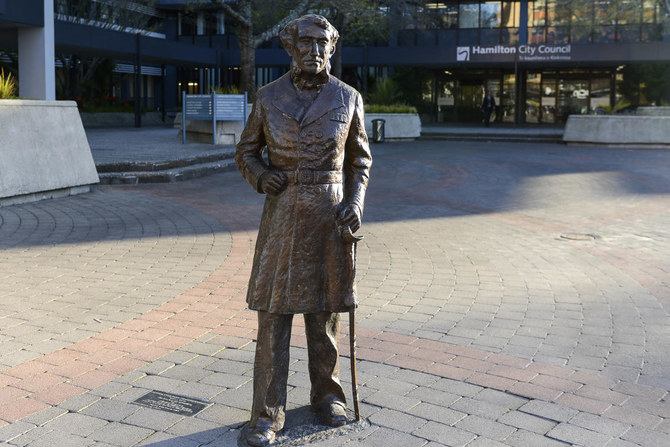
This image provided by Hamilton City Council, shows the bronze statue of British Captain John Fane Charles Hamilton before it was removed from a square in central Hamilton, New Zealand, Friday, June 12, 2020. (AP)
Short Url
Updated 12 June 2020
Follow

New Zealand removes statue of controversial colonist

  • Captain John Fane Charles Hamilton was a naval commander who fought indigenous Maori
  • A crane hoisted the bronze sculpture of Hamilton from the town square

HAMILTON: The New Zealand city of Hamilton on Friday tore down a statue of the colonial military commander after whom it was named, joining a growing list of places worldwide that are reckoning with their past.
A crane hoisted the bronze sculpture of Captain John Fane Charles Hamilton from the town square after requests from local Maori and threats from anti-racism protesters to topple it.
A small group of cheering spectators looked on.
Hamilton City Council acknowledged the statue’s extraction was part of a push to remove memorials “which are seen to represent cultural disharmony and oppression” sparked by global anti-racism protests.
“I know many people — in fact, a growing number of people — find the statue personally and culturally offensive,” mayor Paula Southgate said.
“We can’t ignore what is happening all over the world and nor should we. At a time when we are trying to build tolerance and understanding... I don’t think the statue helps us to bridge those gaps.”
Hamilton was a naval commander who fought indigenous Maori defending their land against British colonial expansion in the 19th century.
He died at the Battle of Pukehinahina, or Gate Pa, in 1864, when — in an early example of trench warfare — a group of Maori in a fortified encampment successfully fended off British troops and artillery, despite being outnumbered.
The statue was donated to the council in 2013 and the council said its removal came after a formal request from the regional iwi, or tribe, Waikato-Tainui.

Anti-racism protesters had vowed to tear it down at a demonstration this weekend, with activist Taitimu Maipi labelling Hamilton a murderer.
“How can we accept that he’s a hero when he’s a monster who led battles,” Maipi told the Waikato Times.
Waikato-Tainui praised the statue’s removal, saying it was discussing other problematic colonial names and symbols with Hamilton council, including the prospect of restoring the city’s original Maori name Kirikiriroa.
“This was a devastating time for our people and these injustices of the past should not be a continual reminder as we look to grow and develop our beautiful city into the future,” iwi chairman Rukumoana Schaafhausen said.
Hamilton council said the fate of the British commander’s statue and what, if anything, should replace it were still under discussion.
Statues and place names honoring figures such as slavers and colonial military figures are being reassessed worldwide in response to anti-racism protests sparked by the police killing of African American man George Floyd.
Deputy Prime Minister Winston Peters said removing depictions of historic figures was part of “a wave of idiocy” that would prevent future generations learning from past mistakes.
“Why do some woke New Zealanders feel the need to mimic mindless actions imported from overseas?” said Peters, who leads the populist New Zealand First Party, a coalition partner in Prime Minister Jacinda Ardern’s government.
“A self-confident country would never succumb to obliterating symbols of their history, whether it be good or bad or simply gone out of fashion.”
Ardern has not yet weighed in on the statue debate but last year ordered that study of the conflict between Maori and British colonialists, known as the New Zealand wars, become compulsory in all schools.


UN’s top court opens Myanmar Rohingya genocide case

Updated 14 min 8 sec ago
Follow

UN’s top court opens Myanmar Rohingya genocide case

  • The Gambia filed a case against Myanmar at the UN’s top court in 2019
  • Verdict expected to impact Israel’s genocide case over war on Gaza

DHAKA: The International Court of Justice on Monday opened a landmark case accusing Myanmar of genocide against its mostly Muslim Rohingya minority.

The Gambia filed a case against Myanmar at the UN’s top court in 2019, two years after a military offensive forced hundreds of thousands of Rohingya from their homes into neighboring Bangladesh.

The hearings will last three weeks and conclude on Jan. 29.

“The ICJ must secure justice for the persecuted Rohingya. This process should not take much longer, as we all know that justice delayed is justice denied,” said Asma Begum, who has been living in the Kutupalong refugee camp in Bangladesh’s Cox’s Bazar district since 2017.

A mostly Muslim ethnic minority, the Rohingya have lived for centuries in Myanmar’s western Rakhine state but were stripped of their citizenship in the 1980s and have faced systemic persecution ever since.

In 2017 alone, some 750,000 of them fled military atrocities and crossed to Bangladesh, in what the UN has called a textbook case of ethnic cleansing by Myanmar.

Today, about 1.3 million Rohingya shelter in 33 camps in Cox’s Bazar, turning the coastal district into the world’s largest refugee settlement.

“We experienced horrific acts such as arson, killings and rape in 2017, and fled to Bangladesh,” Begum told Arab News.

“I believe the ICJ verdict will pave the way for our repatriation to our homeland. The world should not forget us.”

A UN fact-finding mission has concluded that the Myanmar 2017 offensive included “genocidal acts” — an accusation rejected by Myanmar, which said it was a “clearance operation” against militants.

Now, there is hope for justice and a new future for those who have been displaced for years.

“We also have the right to live with dignity. I want to return to my homeland and live the rest of my life in my ancestral land. My children will reconnect with their roots and be able to build their own future,” said Syed Ahmed, who fled Myanmar in 2017 and has since been raising his four children in the Kutupalong camp.

“Despite the delay, I am optimistic that the perpetrators will be held accountable through the ICJ verdict. It will set a strong precedent for the world.”

The Myanmar trial is the first genocide case in more than a decade to be taken up by the ICJ. The outcome will also impact the genocide case that Israel is facing over its war on Gaza.

“The momentum of this case at the ICJ will send a strong message to all those (places) around the world where crimes against humanity have been committed,” Nur Khan, a Bangladeshi lawyer and human rights activist, told Arab News.

“The ICJ will play a significant role in ensuring justice regarding accusations of genocide in other parts of the world, such as the genocide and crimes against humanity committed by Israel against the people of Gaza.”