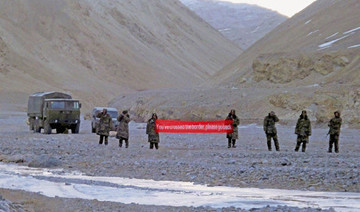
NEW DELHI: Indian and Chinese foreign ministry officials on Friday discussed the flaring of tensions on their disputed Himalayan border, where thousands of soldiers from the two countries have been facing off just a few hundred meters (yards) from each other for a month, an Indian official said.
The video conference came a day before generals in the Ladakh region are scheduled to meet at a border post to intensify efforts for a pullback to their pre-May positions in the region. The army officers have held a series of meetings in the past four weeks to break the impasse.
An External Affairs Ministry statement in New Delhi said both sides agreed that they should handle their differences through peaceful discussion "bearing in mind the importance of respecting each other’s sensitivities, concerns and aspirations and not allow them to become disputes.”
Indian officials say Chinese soldiers entered the Indian-controlled territory of Ladakh in early May at three different points, erecting tents and guard posts.
They said the Chinese soldiers ignored repeated verbal warnings to leave, triggering shouting matches, stone-throwing and fistfights.
China has sought to downplay the confrontation while providing little information. Indian media reports say that the two armies have moved artillery guns in the region.
China has objected to India building a road through a valley connecting the region to an airstrip, possibly sparking its move to assert control over territory along the border that is not clearly defined in places.
India and China fought a border war in 1962 and have been trying since the early 1990’s to settle their dispute without success.
In all, China claims some 90,000 square kilometers (35,000 square miles) of territory in India’s northeast, including the Indian state of Arunachal Pradesh with its traditionally Buddhist population. India says China occupies 38,000 square kilometers (15,000 square miles) of its territory in the Aksai Chin Plateau in the western Himalayas, including part of the Ladakh region.

India, China trying to end army standoff in Himalayas
https://arab.news/zchbp
India, China trying to end army standoff in Himalayas
- Indian officials said Chinese soldiers entered the Indian-controlled territory of Ladakh in early May at three different points, erecting tents and guard posts
- China has objected to India building a road through a valley connecting the region to an airstrip, possibly sparking its move to assert control over territory
Blacklisted naphtha tanker from Russia enters Venezuelan waters while another diverts, ship data shows
- Under U.S. sanctions related to Russia, the ship has a different sanctions profile than Skipper, the tanker that was seized by the U.S. on December 10
HOUSTON: A tanker subject to U.S. sanctions carrying some 300,000 barrels of naphtha from Russia entered Venezuelan waters late on Thursday, while another began redirecting course in the Atlantic Ocean, ship tracking data showed, a reflection of diverging last-minute decisions by ship owners after President Donald Trump ordered a "blockade" of oil tankers under sanctions bound for the OPEC country earlier this week.
The move ramped up pressure on Venezuelan president Nicolas Maduro by targeting the country's main source of income and followed the seizure by the U.S. of an oil tanker off the coast of Venezuela earlier in December.
Vessels that were not subject to sanctions began setting sail on Wednesday from Venezuelan waters after a week's pause, helping drain the country's mounting crude stocks.
Gambia-flagged medium tanker Hyperion docked on Friday at Amuay Bay on Venezuela's western coast, according to LSEG ship tracking data. It loaded near Murmansk in Russia in late November.
Under U.S. sanctions related to Russia, the ship has a different sanctions profile than Skipper, the tanker that was seized by the U.S. on December 10.
The U.S. can only seize vessels outside of its jurisdiction, or vessels that aren't heading to or from the country, if Washington has placed them under sanctions for links to groups it designates as terrorist, said David Tannenbaum, a director at consulting firm Blackstone Compliance Services that specializes in sanctions and anti-money laundering compliance.
Skipper, formerly called the Adisa, was under sanctions for what the U.S. says was involvement in Iranian oil trading that generated revenue for Iranian groups it has designated as foreign terrorist organizations.
With the Hyperion, though, sanctions were imposed to reduce Russian revenues from energy because of its war with Ukraine.
"The Hyperion doesn't have known ties to terrorism, and therefore unless they can prove it's subject to the jurisdiction of the U.S., Washington can't grab it extraterritorially," said Tannenbaum, who previously worked with the U.S. Treasury's Office of Foreign Assets Control that administers and enforces economic and trade sanctions.
REDIRECTS AND U-TURNS
The Angola-flagged Agate, another medium tanker under sanctions that loaded in Russia and had been sailing toward the Caribbean, was seen redirecting on Friday, according to LSEG ship tracking. The vessel was pointing towards Africa, but had not yet signaled a new destination.
Oman-flagged Garnet, also under sanctions and loaded in Russia, continued on its track, signaling the Caribbean as its destination on Friday.
Benin-flagged tanker Boltaris, under sanctions and carrying some 300,000 barrels of Russian naphtha bound for Venezuela, made a U-turn earlier this month and was heading for Europe without having discharged, according to LSEG vessel monitoring data.
Two very large crude carriers not subject to sanctions set sail for China on Thursday from Venezuela, according to sources familiar with Venezuela's oil export operations, marking only the second and third tankers unrelated to Chevron to depart the country since the U.S. seized Skipper.
The American oil major, which has continued to ship Venezuelan crude under a U.S. authorization, exported a crude cargo on Thursday bound for the U.S., LSEG data showed.
Secretary of State Marco Rubio on Friday said the U.S. was not concerned about the four vessels that sailed from Venezuela on Thursday, as those were not ships under sanctions.
"Sanctioned boats, we have the capabilities necessary to enforce our laws. We'll have a judicial order, we'll execute on those orders and there's nothing that will impede us from being able to do that," Rubio said.
Venezuela's government called Trump's blockade a "grotesque threat" in a statement on Tuesday, saying it violates international law, free commerce and the right of free navigation.