

Iran says US talks ‘futile’, denounces black American’s death

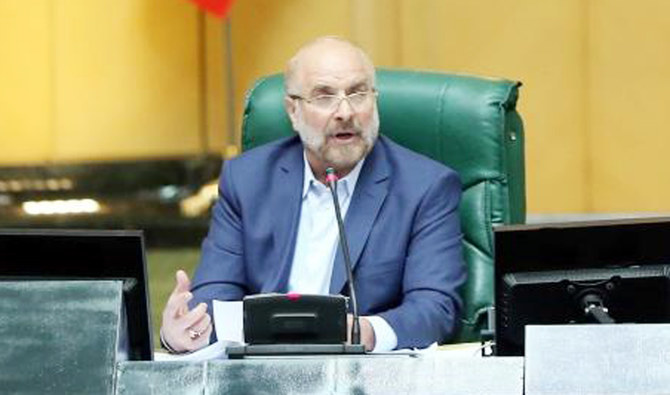
Iranian parliament Speaker Mohammad Bagher Ghalibaf chairing a parliament session in the capital Tehran on Sunday. (AFP)
Short Url
Updated 01 June 2020
Follow

Iran says US talks ‘futile’, denounces black American’s death

  • Ghalibaf called for ties to be improved with neighbors and with “great powers who were friends with us in hard times and share significant strategic relations,” without naming them

TEHRAN: Iran’s new parliament speaker said on Sunday any negotiations with Washington would be “futile” as he denounced the death of a black American that has led to violent protests across the US.
Mohammad-Bagher Ghalibaf, a former commander of the Revolutionary Guards’ air force, was elected speaker on Thursday of a chamber dominated by ultra-conservatives following February elections.
The newly formed parliament “considers negotiations with and appeasement of America, as the axis of global arrogance, to be futile and harmful,” he said in his first major speech to the chamber.
Ghalibaf also vowed revenge for the US drone attack in January that killed Qasem Soleimani, the commander of the Guards’ foreign operations arm.
“Our strategy in confronting the terrorist America is to finish the revenge for martyr Soleimani’s blood,” he told lawmakers, pledging “the total expulsion of America’s terrorist army from the region.”
Ghalibaf has also slammed the US over the death of George Floyd, an unarmed black man, during an arrest in Minneapolis which has led to widespread protests across the country.
Tens of thousands of protesters have taken to the streets from New York to Seattle demanding tougher, first-degree murder charges and more arrests over the death of Floyd, who stopped breathing after Minneapolis police officer Derek Chauvin knelt on his neck for nearly nine minutes.
Decades-old tensions between Tehran and Washington have soared in the past year, with the sworn arch enemies twice appearing to come to the brink of a direct confrontation.
The tensions have been rising since 2018, when President Donald Trump withdrew the US from a landmark nuclear accord and began reimposing crippling sanctions on Iran’s economy.
That was followed by the US drone strike near Baghdad airport in January that killed Soleimani, a hugely popular figure in the Islamic republic.

FASTFACT

Iran’s parliament speaker Mohammad-Bagher Ghalibaf vowed revenge for the US drone attack in January that killed Qasem Soleimani, the commander of the Guards’ foreign operations arm.

Days later, Iran fired a barrage of missiles at US troops stationed in Iraq in retaliation, but Trump opted against taking any military action in response.
Ghalibaf called for ties to be improved with neighbors and with “great powers who were friends with us in hard times and share significant strategic relations,” without naming them.
The 58-year-old Ghalibaf is a three-time presidential candidate who lost out to the incumbent Hassan Rouhani at the last election in 2017.
The newly elected speaker had also served as Tehran mayor and the Islamic republic’s police chief before taking up his latest post.
In a tweet on Saturday, he slammed what he called the US’ “unjust political, judicial, and economic structure.”
This had been “pumping war, coups, poverty, indiscrimination, torture, fratricide and moral corruption to the world, and racism, hunger, humiliation, and ‘choking by knee’ in its own country for hundreds of years,” Ghalibaf said.
Iran’s Foreign Minister Mohammad Javad Zarif echoed his remarks on Twitter.
“Some don’t think #BlackLivesMatter. To those of us who do: It is long overdue for the entire world to wage war against racism. Time for a #WorldAgainstRacism,” he said. The post was accompanied by an image of a 2018 statement by US Secretary of State Mike Pompeo in which the text was changed to be critical of the US States instead of Iran.
The altered text read: “The US government is squandering its citizens’ resources.
“The people of America are tired of the racism, corruption, injustice, and incompetence from their leaders. The world hears their voice.” Pompeo responded to Zarif by tweeting that “you hang homosexuals, stone women and exterminate Jews,” without elaborating further.


Rubio plans to update Netanyahu on US-Iran talks in Israel next week, officials say

Updated 8 sec ago
Follow

Rubio plans to update Netanyahu on US-Iran talks in Israel next week, officials say

WASHINGTON: Secretary of State Marco Rubio plans to travel to Israel next week to update Israeli Prime Minister Benjamin Netanyahu on the US-Iran nuclear talks, two Trump administration officials said.
Rubio is expected to meet with Netanyahu on Feb. 28, according to the officials, who spoke Wednesday on condition of anonymity to detail travel plans that have not yet been announced.
The US and Iran recently have held two rounds of indirect talks over the Islamic Republic’s nuclear program.
Iran has agreed to draw up a written proposal to address US concerns that were raised during this week’s Geneva talks, according to another senior US official who was not authorized to comment publicly and spoke on the condition of anonymity.
That official said top national security officials gathered Wednesday in the White House Situation Room to discuss Iran, and were briefed that the “full forces” needed to carry out potential military action are expected to be in place by mid-March. The official did not provide a timeline for when Iran is expected to deliver its written response.
Officials from both the US and Iran had publicly offered some muted optimism about progress this week, with Iranian Foreign Minister Abbas Araghchi even saying that “a new window has opened” for reaching an agreement.
“In some ways, it went well,” US Vice President JD Vance said about the talks in an interview Tuesday with Fox News Channel. “But in other ways, it was very clear that the president has set some red lines that the Iranians are not yet willing to actually acknowledge and work through.”
Netanyahu visited the White House last week to urge President Donald Trump to ensure that any deal about Iran’s nuclear program also include steps to neutralize Iran’s ballistic missile program and end its funding for proxy groups such as Hamas and Hezbollah.
Trump is weighing whether to take military action against Tehran as the administration surges military resources to the region, raising concerns that any attack could spiral into a larger conflict in the Middle East.
On Friday, Trump told reporters that a change in power in Iran “seems like that would be the best thing that could happen.” He added, “For 47 years, they’ve been talking and talking and talking.”
The Trump administration has dispatched the USS Gerald R. Ford, the world’s largest aircraft carrier, from the Caribbean Sea to the Mideast to join a second carrier as well as other warships and military assets that the US has built up in the region.
Dozens of US fighter jets, including F-35s, F-22s and F-16s, have left bases in the US and Europe in recent days to head to the Middle East, according to the Military Air Tracking Alliance, a team of about 30 open-source analysts that routinely analyzes military and government flight activity.
The team says it’s also tracked more than 85 fuel tankers and over 170 cargo planes heading into the region.
Steffan Watkins, a researcher based in Canada and a member of the MATA, said he also has spotted support aircraft like six of the military’s early-warning E-3 aircraft head to a base in Saudi Arabia.
Those aircraft are key for coordinating operations with a large number of aircraft. He says they were pulled from bases in Japan, Germany and Hawaii.