

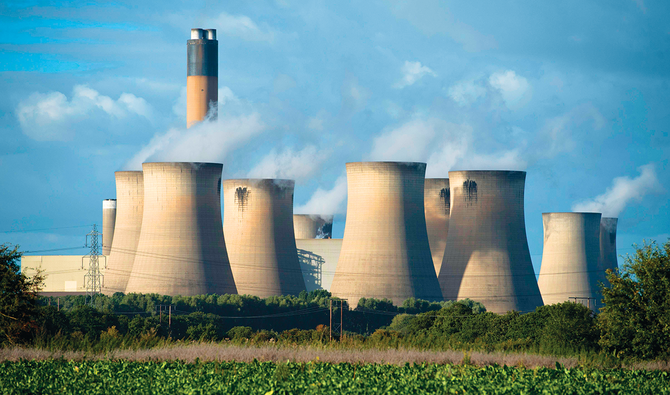

LONDON: As the coronavirus pandemic undermines the production of cleaner renewable fuels, the UK’s biggest electricity plant is close to using only biomass following a bumpy transition away from coal.
Situated in Yorkshire, northern England, the Drax Group power plant will complete its switch next year after embarking on a journey almost a decade ago to use organic matter alongside the fossil fuel to slash carbon emissions.
But the company’s method of capturing CO2 continues to raise concerns even as biomass has become Britain’s second largest renewable energy behind wind power, with only a handful of coal-run plants remaining in the UK. The Drax operation, providing 4 million households with electricity, sees CO2 emitted from burnt wood captured by newly planted trees.
Drax adds that the switch, in line with UK government policy to ban the use of coal by 2025, allows it to keep the plant running and maintain 900 jobs.
“More than 10 years ago, Drax was looking at its future ... and the UK, at the same time, was looking about how it could deliver its climate change objectives,” recalls Drax CEO Will Gardiner.
“And those two things came together in a very auspicious way so that there was a good recognition in the UK that biomass was a very good alternative ... to increase renewable power,” he told AFP in an interview. But the use of biomass to generate electricity is not without controversy.
In 2018, a total of 800 scientists wrote to the European Parliament calling for such biomass to be limited to wood residues, including cut branches, to limit deforestation. But even with such a move, gains to the environment can be trimmed by sourcing wood from afar. “Once you move from local usage ... to extracting trees from distant countries and shipping them to a factory, you are adding quite a significant amount of additional CO2 to the atmosphere,” noted Michael Norton, environment program director at European Academies Science Advisory Council (EASAC).
Norton added that it “takes anything from several decades to centuries to recover through the growth” of new trees.
The Drax plant imports from North America 80 percent of the wood that it burns, although Gardiner stresses that the company uses branches that otherwise would “rot in the fields and emit CO2.”
The International Energy Agency last week said in a joint report that “COVID-19 is intensifying the urgent need to expand sustainable energy solutions worldwide” — a timely boost for companies like Drax amid ongoing criticism regarding their net contribution in helping to tackle climate change.
“The growth of electricity generation from renewables appears to have slowed down as a result of the pandemic, according to the available data,” said the report, written also by the World Health Organization.
“But they so far appear to be holding up much better than other major fuels such as coal and natural gas,” it added.
Gardiner told AFP that he “doesn’t think there will be any coal or natural gas in our system in 2050.”
He added: “In the UK, I think wind power in 2050 probably will be 80 percent of the energy mix.
“At the same time, you always need something else in addition to wind power to provide for flexibility and for system support,” he said, noting that “biomass can do that.”


