Saudi Arabia’s new cases slow down two weeks after reaching peak of 2,840

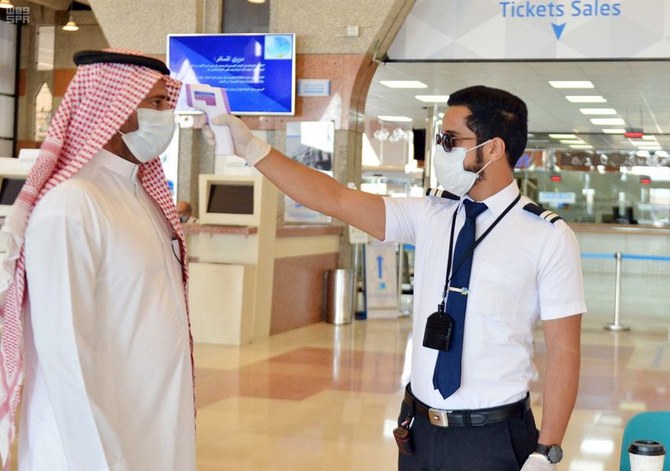
A worker takes the temperature of a passenger at a train station in the Kingdom on May 31, 2020. (SPA)
Short Url
Updated 31 May 2020
Follow

Saudi Arabia’s new cases slow down two weeks after reaching peak of 2,840

  • A total of 503 people have died from COVID-19 in the Kingdom so far
  • The total number of confirmed coronavirus cases in the kingdom has reached 85,261

JEDDAH: For six consecutive days, new recorded cases in Saudi Arabia have been decreasing after a series of strict measures were put in place that lasted more than six weeks.  

Saudi Arabia’s Health Ministry announced 1,877 new cases on Sunday, meaning that 85,261 people have now contracted the disease. There are currently 22,316 active cases, 453 of whom are in a critical condition.

Meanwhile, 3,559 patients have recovered from COVID-19, the highest count since the beginning of the pandemic, bringing the total number of recoveries to 62,442.

The Kingdom’s recovery rate is at its highest at 73 percent and it maintains a low fatality rate at .059 percent.

Saudis made up 43 percent of Sunday’s recorded cases while 57 percent were expatriates; 12 percent of cases were children while 83 percent were adults and 5 percent were adults above the age of 65.

The city of Jeddah recorded the highest number today with 586 cases, with Riyadh at 504 while Makkah recorded 159 cases.
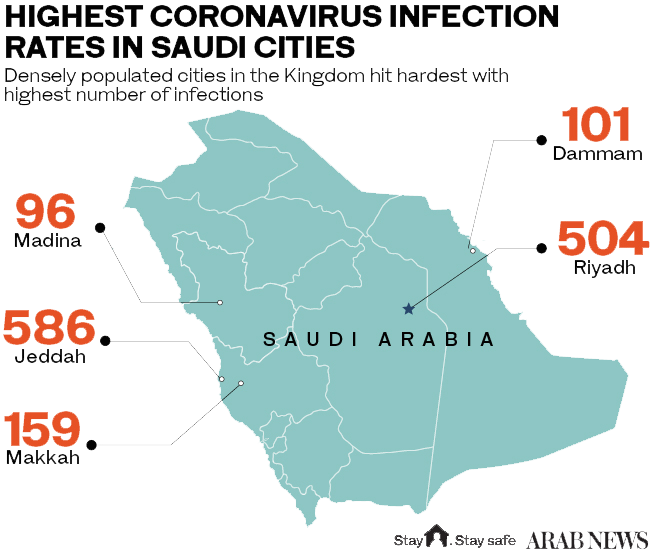
Twenty- three fatalities were recorded in Makkah, Riyadh and Madinah; most had prior chronic conditions.

Meanwhile, 16,200 polymerase chain reaction tests have been conducted, raising the total number of tests conducted in the Kingdom so far to 822,769.

Across the Kingdom, mosques have reopened two months after the pandemic forced them to shut due to fears of the virus spreading. Strict measures are in place and worshipers are told to follow guidelines of keeping a distance of two meters between rows, wearing masks to enter a mosque, and Friday sermons and prayers not lasting more than 15 minutes.

Businesses are gradually returning in many government and private establishments under strict new precautionary guidelines enforced by the authorities.

Public-sector employees have gradually returned to workplaces in all government agencies and offices at 50 percent capacity starting May 31, 75 percent capacity as of June 7 and 100 percent capacity as of June 14.


Economic growth and resilience at heart of 2nd AlUla Emerging Market Economies Conference

Updated 03 February 2026
Follow

Economic growth and resilience at heart of 2nd AlUla Emerging Market Economies Conference

  • Event on Feb. 8 and 9 will bring together ministers, governors of central banks, policymakers, economic experts and international financial institutions
  • Emerging-market economies a ‘pivotal element’ in global economic system due to effect they have on growth and stability, says Saudi Finance Minister Mohammed Al-Jadaan

RIYADH: The second annual AlUla Conference for Emerging Market Economies, which Saudi Arabia will host next week, offers a platform to exchange views on global developments and discuss policies and reforms that support inclusive growth and strengthen economic resilience, the Kingdom’s finance minister said.

The event on Feb. 8 and 9 will bring together finance ministers, governors of central banks and policymakers, alongside economic experts and representatives of international financial institutions.

Organized by the Saudi Ministry of Finance in partnership with the International Monetary Fund, it takes place as emerging-market economies face mounting challenges amid rapid global economic change.

Finance Minister Mohammed Al-Jadaan said the decision to host the conference reflects Saudi Arabia’s ongoing commitment to efforts that support global financial and economic stability, and highlights the growing influence of emerging economies on worldwide growth.

Emerging-market economies represent a “pivotal element” in the global economic system due to the direct impact they have on economic growth and stability, he added.

“The AlUla Conference for Emerging Market Economies provides a unique platform for exchanging views on global economic developments, and discussing policies and reforms that will support inclusive growth and enhance economic resilience, in light of broader international cooperation that contributes to confronting common challenges,” Al-Jadaan said.

Kristalina Georgieva, managing director of the IMF, said the event would help emerging economies deal with growing uncertainty driven by technological change, demographic shifts and geopolitical tensions.

“The AlUla conference provides a vital platform for emerging economies to discuss how they can navigate the risks and embrace the opportunities ahead,” she said.

“In these times of sweeping transformations in the global economy, policymakers face a more challenging and uncertain environment. Countries should work together to strengthen resilience through sound macroeconomic and financial policies.”