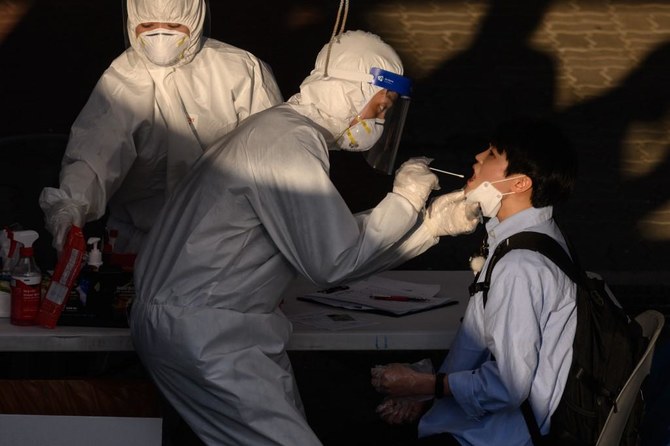
SEOUL: South Korea reported its biggest spike in coronavirus cases in nearly two months on Thursday, as officials scramble to tackle fresh clusters that have raised concerns of a possible second wave of infections.
The country has been held up as a global model in how to curb the virus and has begun to ease restrictions, but is now rushing to contain new infections as life returns to normal.
Officials announced 79 new cases Thursday — taking its total to 11,344 — with most fresh infections from the densely populated Seoul metropolitan area.
It was the largest increase since 81 cases were announced on April 5.
An outbreak at a warehouse of e-commerce firm Coupang in Bucheon, west of Seoul, has seen 69 cases, said the Korea Centers for Disease Control and Prevention.
Around 4,100 workers and visitors to the building were under self-isolation, with more than 80 percent tested so far, vice health minister Kim Gang-lip told reporters.
“We are expecting the number of new cases linked to the warehouse to continue rising until today as we wrap up related tests,” he added.
Social distancing rules have been relaxed in South Korea and facilities such as museums and churches have reopened. Some professional sports — including baseball and soccer — started new seasons earlier this month, albeit behind closed doors.
Students have been returning to classes since last week, although some schools were forced to turn away their pupils over concerns of new virus cases in their neighborhood.
The country endured one of the worst early outbreaks of the disease outside mainland China, and while it never imposed a compulsory lockdown, strict social distancing had been widely observed since March.
But it appears to have brought its outbreak under control thanks to an extensive “trace, test and treat” program.

South Korea sees largest spike in virus cases in nearly two months
https://arab.news/jwpvv
South Korea sees largest spike in virus cases in nearly two months
- Officials announced 79 new cases on Thursday
- It was the largest increase since April 5
‘Doomsday Clock’ moves closer to midnight over threats from nukes, climate change, AI
- At the end of the Cold War, the clock was as close as 17 minutes to midnight. In the past few years, to address rapid global changes, the group has changed from counting down the minutes until midnight to counting down the seconds
WASHINGTON: Earth is closer than it’s ever been to destruction as Russia, China, the US and other countries become “increasingly aggressive, adversarial, and nationalistic,” a science-oriented advocacy group said Tuesday as it advanced its “Doomsday Clock” to 85 seconds till midnight.
The Bulletin of the Atomic Scientist members had an initial demonstration on Friday and then announced their results on Tuesday.
The scientists cited risks of nuclear war, climate change, potential misuse of biotechnology and the increasing use of artificial intelligence without adequate controls as it made the annual announcement, which rates how close humanity is from ending.
Last year the clock advanced to 89 seconds to midnight.
Since then, “hard-won global understandings are collapsing, accelerating a winner-takes-all great power competition and undermining the international cooperation” needed to reduce existential risks, the group said.
They worry about the threat of escalating conflicts involving nuclear-armed countries, citing the Russia-Ukraine war, May’s conflict between India and Pakistan and whether Iran is capable of developing nuclear weapons after strikes last summer by the US and Israel.
International trust and cooperation is essential because, “if the world splinters into an us-versus-them, zero-sum approach, it increases the likelihood that we all lose,” said Daniel Holz, chair of the group’s science and security board.
The group also highlighted droughts, heat waves and floods linked to global warming, as well as the failure of nations to adopt meaningful agreements to fight global warming — singling out US President Donald Trump’s efforts to boost fossil fuels and hobble renewable energy production.
Starting in 1947, the advocacy group used a clock to symbolize the potential and even likelihood of people doing something to end humanity.
At the end of the Cold War, it was as close as 17 minutes to midnight. In the past few years, to address rapid global changes, the group has changed from counting down the minutes until midnight to counting down the seconds.
The group said the clock could be turned back if leaders and nations worked together to address existential risks.


