

Pakistan expects local manufacturing of big cell phone brands after policy change

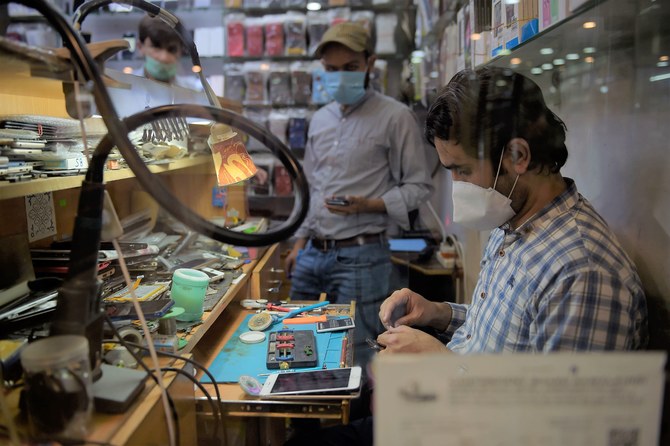
A shopkeeper repairs a mobile phone at his shop after the government eased the nationwide lockdown imposed as a preventive measure against the COVID-19 coronavirus, in Rawalpindi on May 11, 2020. (AFP)
Short Url
Updated 26 May 2020
Follow

Pakistan expects local manufacturing of big cell phone brands after policy change

  • Arrival of high-end brands will give local industry opportunity to become part of global value chain
  • Local manufacturing of handsets will create more employment opportunities, reduce outflow of foreign exchange

KARACHI: Pakistan expects local manufacturing of major cell phone brands following the approval of the first Mobile Device Manufacturing Policy, officials and manufacturers said on Monday.

“Some big brands got in touch with us when they discovered that we were working on the policy. Hopefully, one of them will come to Pakistan within a year,” Pervaiz Iftikhar, who is part of Prime Minister’s Taskforce on IT and Telecom, told Arab News.

“Ultimately big brands will come to Pakistan, though it will not happen immediately since high-profile companies normally take time to make such decisions,” he said while declining to name the brands that have shown interest in manufacturing in Pakistan.

Global brands like Nokia representatives in Pakistan say they are monitoring the industrial situation and government regulations closely.

“We have prepared a proposal in the context of this development. However, global companies do not take decisions very quickly, especially when they involve setting up operations somewhere,” Arif Shafique, HMD Global Country Head for Pakistan and Afghanistan, told Arab News.

Pakistan approved the mobile manufacturing policy to encourage local production of handsets on Thursday, hoping it would also have a positive impact on allied industries.

The new policy is designed to attract high-end brands that will help the local industry become part of the global value chain.

The policy seeks to set up research and development centers and create an elaborate ecosystem for software applications. Various tax incentives have been given to manufacturers for local production.

With a population of 220 million people, Pakistan’s telecom sector offers attractive investment opportunities since it boasts of 165 million mobile phone subscribers with 76 million 3G-4G users, according to the Pakistan Telecommunication Authority (PTA).

The authority has already issued licenses to some 29 mobile manufacturers for the production of handsets.

“Out of 29 licensees, 18 have started manufacturing and are mainly assembling 2G mobile sets,” Aamir Allawala, CEO of Transsion Tecno, a joint venture between Transsion Holdings China and Tecno Pack Pakistan, told Arab News.

The joint venture company is the first to start manufacturing 3G and 4G smartphones in Pakistan. It produces Infinix, Tecno and Itel brands in its Karachi facility and has sold 500,000 units since February 2020.

“The country produces around 12 million handsets annually against the market size of 40 million units. About 28 million sets are also imported annually,” Allawala said.

“Local production figures will more than double in the coming days if the expected investments are made,” Pervaiz Iftikhar said.

The country meets a chunk of its mobile phone demand by importing handsets which adds to its deficit. During the last fiscal year, Pakistan imported mobile phones worth $755.5 million, but the import of these devices increased by 63 percent to $1 billion during July-April period of the current financial year.

“Previously, duties and tariffs did not make local manufacturing a viable option,” Allawala said. “That made the import of handsets more feasible. However, this is likely to change with the introduction of the new policy.”

Manufacturers say this labor-intensive industry has a potential to create 200,000 jobs, and the 49 percent localization of parts within the next three years is likely to help the country export mobile phones.

“It will also reduce the burden on the country’s forex reserves,” Allawala added.

However, some industry players emphasized the importance of keeping the policy consistent.

“It takes high investment to assemble smart phones. When such investments are made, governments take U-turns and implement new policies or impose new duties and taxes,” Imran Ghani, CEO of Tri-Angels Electronics that manufactures Hisense TV in Pakistan and intends to make smartphones, told Arab News.

Local manufacturing was of cellphones was encouraged after Pakistan implemented its Device Identification, Registration and Blocking System (DIRBS) in 2018 to control the smuggling of mobile phone devices through the registration of International Mobile Equipment Identity (IMEI). The move not only resulted in the growth of local manufacturing but also encouraged imports through legal channels.


Pakistan to play India in T20 World Cup, government says

Updated 09 February 2026
Follow

Pakistan to play India in T20 World Cup, government says

  • Islamabad announced boycotting the Feb. 15 match in Colombo to protest the ICC’s exclusion of Bangladesh from the T20 World Cup
  • Pakistan’s government says the decision to play India is taken to protect ‘spirit of cricket and to support the continuity of global sport’

ISLAMABAD: Pakistan Prime Minister Shehbaz Sharif has cleared the country’s cricket team to play India in the T20 World Cup on Feb. 15, the Pakistani government announced late Monday, ending a week-long standoff.

Islamabad announced boycotting the Feb. 15 match in Colombo to protest the International Cricket Council’s (ICC) exclusion of Bangladesh from the T20 World Cup, following Dhaka’s decision to not play matches in India owing to security fears.

On Sunday, ICC Deputy Chairman Imran Khwaja arrived in Lahore for talks with Pakistan Cricket Board (PCB) officials and Bangladesh Cricket Board (BCB) President Aminul Islam as the sport’s governing body strived to save the high-stakes T20 World Cup encounter.

PCB Chairman Mohsin Naqvi met PM Sharif late Monday and briefed him regarding the outcomes of high-level deliberations held between the PCB, Bangladesh board and ICC representatives, the Pakistani government said on X.

“The Government of Pakistan has reviewed the formal requests extended to the PCB by the Bangladesh Cricket Board, as well as the supporting communications from Sri Lanka, the United Arab Emirates, and other member nations. These correspondences sought Pakistan’s leadership in securing a viable solution to recent challenges,” the Pakistani government said.

“In view of the outcomes achieved in multilateral discussions, as well as the request of friendly countries, the Government of Pakistan hereby directs the Pakistan National Cricket Team to take the field on February 15, 2026, for its scheduled fixture in the ICC Men’s T20 World Cup.”

The BCB earlier thanked the PCB, ICC and all others for their positive roles in trying to “overcome recent challenges,” particularly thanking PCB Chairman Naqvi and Pakistani cricket fans for demonstrating “exemplary sportsmanship and solidarity.”

“We are deeply moved by Pakistan’s efforts to go above and beyond in supporting Bangladesh during this period. Long may our brotherhood flourish,” BCB President Islam said in a statement.

“Following my short visit to Pakistan yesterday and given the forthcoming outcomes of our discussions, I request Pakistan to play the ICC T20 World Cup game on 15 February against India for the benefit of the entire cricket ecosystem.”

The dispute stemmed from the ICC’s decision to replace Bangladesh with Scotland last month after Bangladesh refused to play tournament matches in India. Dhaka’s decision followed the removal of Mustafizur Rahman from the Indian Premier League (IPL). He was bought for $1 million by the IPL’s Kolkata Knight Riders, but on Jan. 3 the Board of Control for Cricket in India (BCCI) ordered Kolkata to release Mustafizur without a public explanation but amid regional tensions.

Pakistani cricket authorities subsequently announced boycotting the match against India at R. Premadasa Stadium in Colombo on Feb. 15. An India-Pakistan fixture is the sport’s most lucrative asset, generating a massive share of global broadcasting and sponsorship revenue.

“This decision [to play India in T20 World Cup] has been taken with the aim of protecting the spirit of cricket, and to support the continuity of this global sport in all participating nations,” the Pakistani government said.

“We remain confident that our team will carry the spirit of sportsmanship and national pride onto the field as they compete for global glory.”