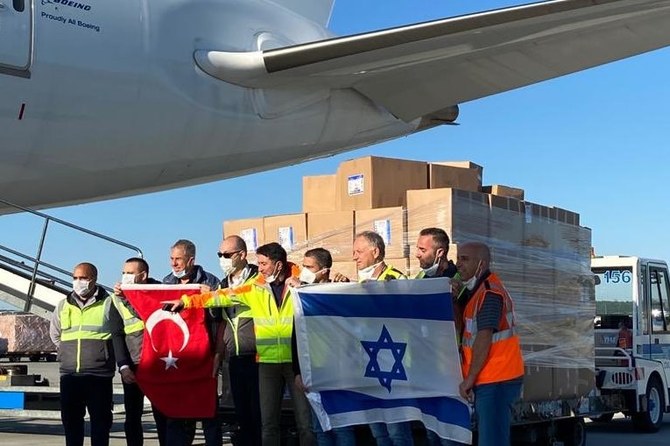
ISTANBUL: Israeli airline El Al has resumed cargo flights twice weekly between Tel Aviv and Istanbul for the first time in 10 years — a sign that decade-long bilateral tensions might be easing.
A cargo flight landed in Istanbul on Sunday morning to pick up humanitarian aid and protective equipment destined for US medical teams fighting COVID-19.
Burhanettin Duran, head of the Ankara-based think tank SETA, wrote that Turkey’s regional empowerment is “obliging Israel to search for normalization steps with Ankara.”
Dr. Nimrod Goren, head of the Israeli Institute for Regional Foreign Policies, said the cargo flight is a positive and visible development in bilateral relations that was probably approved by top government officials on both sides and required diplomatic efforts.
“However, the fact that this step takes place in parallel to a discussion about Israeli annexation in the West Bank, and to criticism of annexation by regional and international actors, might impact how it’s viewed in Turkey,” he told Arab News.
Goren said while the Israeli and Turkish governments continue to have significant policy differences, they should work to restore their relations to ambassadorial level, and to relaunch a strategic dialogue on regional developments of mutual interest.
“The forming of a new Israeli government, and the appointment of Gabi Ashkenazi as a new foreign minister, could be an opportunity to do so, and the cargo flight brings some positive momentum,” he added.
Turkey expelled Israel’s ambassador in May 2018 after the US moved its embassy from Tel Aviv to Jerusalem.
Ankara’s involvement in Syria’s Idlib province against the Tehran-backed Assad regime has recently provided a common denominator for Turkey and Israel to reconcile, as it also serves the latter’s strategic interests in weakening the Iranian presence in Syria.
But Israel’s treatment of the Palestinians remains a major irritant in relations with Ankara. Turkish President Recep Tayyip Erdogan on Sunday reiterated his support for the Palestinians.
In a video message on Twitter, he said the issue of Jerusalem “is a red line for all Muslims worldwide.”
He added that Israel’s “new occupation and annexation project … disrespects Palestine’s sovereignty and international law.”
Ryan Bohl, Middle East analyst at geopolitical-risk firm Stratfor, told Arab News: “Turkey is trying to create economic ties with Israel because … Erdogan is finding the political ground changed, caused in part by demographic changes as young Turks are less incensed by the Palestinian issue, and in part by a general weariness among Turks about putting too much skin in the game to solve the Palestinian question,”
Israel is expected to annex large parts of the occupied West Bank on July 1 under the terms of a coalition government agreement. Ankara has strongly criticized the plan.
Israeli and Turkish officials are rumored to have held talks behind closed doors to reach a deal on maritime borders and exclusive economic zones in the eastern Mediterranean.
Israel’s Foreign Ministry recently said it was “proud of our diplomatic relations with Turkey.”
But Goren said it is currently unlikely that Israel will advance a maritime demarcation deal with Turkey as it would shake several regional balances at the same time.
“It will put in jeopardy, and run in contrast to, the important alliances in the eastern Mediterranean that Israel has fostered in recent years with Greece, Cyprus and Egypt,” he added.


![]()

Resumed cargo flights: Thaw in Israel-Turkey ties?
Short Url
https://arab.news/2fmbj
Resumed cargo flights: Thaw in Israel-Turkey ties?
- Ankara’s involvement in Syria’s Idlib province against the Tehran-backed Assad regime has recently provided a common denominator for Turkey and Israel to reconcile
- Israel’s treatment of the Palestinians remains a major irritant in relations with Ankara – Recep Tayyip Erdogan on Sunday reiterated his support for the Palestinians


Latest updates


© 2026 SAUDI RESEARCH & PUBLISHING COMPANY, All Rights Reserved And subject to Terms of Use Agreement.