

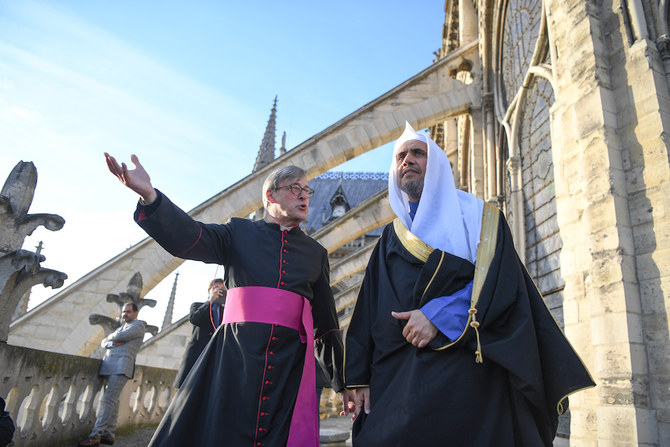

NEW YORK CITY: “The Qur’an instructed Muslims to be righteous and benevolent to non-Muslims as long as they are peaceful and do not attack you or fight you. Muslims treated well the Jews who refused to enter Islam, starting with the Prophet, peace and blessings be upon him, until our time,” said Sheikh Mohammed bin Abdul Karim Al-Issa, secretary-general of the Muslim World League (MWL), a leading religious Muslim nongovernmental organization based in Makkah.
Sheikh Al-Issa has been leading by example since taking up that position in 2016, tirelessly traveling the world, forging relationships — with governments, religious institutions (including the Vatican) and NGOs (including the American Sephardi Federation and the American Jewish Committee) — and announcing historic initiatives to counter extremism, guarantee religious freedom and improve human welfare.
Most recently, Al-Issa called on members of different religions to unite against the COVID-19 pandemic, stating: “We want Muslims and all other citizens to be aiding one another in this time of common challenge, without discrimination for religion or race, for gender or ethnicity.”
MWL today is drastically different than the organization it was even five years ago, when it was still an ally of the Muslim Brotherhood.
Despite Al-Issa’s exemplary humanitarian, educational and outreach efforts all over the world, including with Jewish communities, some remain skeptical about MWL’s agenda and Islam’s doctrinal teachings concerning other religions.
They variously claim that the essence of the religion eschews equal treatment for non-converts and that any attempts to disassociate from controversial interpretations is merely whitewashing, and they have tried to tie MWL’s actions to regional politics. Such criticisms are sorely mistaken.
In an exclusive interview, Al-Issa addressed these issues and other controversial topics forthrightly.
The question of how a religion that proselytizes can be respectful of other religions and their members who do not convert is nothing new. Christian missionaries used to convert Jews under duress.
-------
READ MORE: ‘West not plotting against Islam,’ says MWL’s Sheikh Mohammed Al-Issa in exclusive interview
-------
Today, non-violent groups such as “Jews for Jesus” use persuasion, not torture, but concerns linger about the targeting and manipulation of vulnerable individuals who lack Jewish education.
Does Islam have some unique issues that Christianity does not? Concerns are understandably compounded by the images of Islamist and terrorist organizations indoctrinating their followers and converts through deception or force.
Al-Issa responded that most religions except Judaism practice proselytization. That fact does not inherently signify a lack of respect, nor mean that practitioners of various religions should be locked in an illogical and endless struggle.
“We, as Muslims, respect, love, understand, cooperate, coexist and tolerate everyone. Our historically documented and verified actions demonstrate this, and in the Muslim World League we have played a major role in this aspect, pursuant to our Islamic values,” said Al-Issa.
“With our Jewish brothers, we concluded agreements and mutual cooperation, and we love them and respect them greatly, far from the problems of politics, as our principle is not to interfere in politics.”
Al-Issa emphasized that it is permissible to engage in normal business and friendly relations with members of other faiths, including Jews, as was the case in the Prophet Muhammad’s time.
Political disagreements are separate from religious precepts. Moreover, he added, Islam considers Jews and Christians to be Peoples of the Book who are accorded privileges in jurisprudential proceedings.
At the same time, Islam respects other religions and guarantees the rights of all people to religious choice.
But what about the Qu’ranic quotes, as well as hadiths and alleged accounts, that point to a conflict between Islam’s prophet and the Jews of Arabia?
Most modern-day discussions feature claims of enmity, persecution and even a massacre resulting from the Jews’ refusal to convert to Islam.
Nothing could be farther from the truth, according to Al-Issa.
The Qu’ranic references criticizing Jews that some have taken to mean a generalized attack on all Jews actually admonish specific followers of Judaism who went “off the derech” - strayed from the faithful commitment to the letter and spirit of their own Abrahamic tradition, he said.
To illustrate his point, he presented two seemingly paradoxical quotations: The Qur’an differentiates between the types of people, as the Almighty says: “They are not [all] the same; among the People of the Scripture is a community standing [in obedience], reciting the verses of Allah during periods of the night and prostrating [in prayer].”
The Almighty also said: “And among the People of the Scripture is he who, if you entrust him with a great amount [of wealth], he will return it to you. And among them is he who, if you entrust him with a [single] silver coin, he will not return it to you unless you are constantly standing over him [demanding it].”
God says: “Indeed, those who believed and those who were Jews or Christians or Sabeans [before Prophet Muhammad] - those [among them] who believed in Allah and the Last Day and did righteousness - will have their reward with their Lord, and no fear will there be concerning them, nor will they grieve.”
The Qur’an instructed Muslims to be righteous and benevolent to non-Muslims as long as they are peaceful and do not attack you or fight you.
Sheikh Mohammed bin Abdul Karim Al-Issa, secretary-general of the Muslim World League (MWL)
The Qu’ran speaks to different categories of people, but due to historical misinterpretations, mistranslations and, at times deliberate distortions, there is an appearance of a contradiction.
Those who focus on the allegedly anti-Jews passages ignore how Muslims engaged in wrongdoing are castigated in a similar vein. Additionally, even when critical of specific Jews, the Qu’ran speaks positively of the legacy of Jacob and calls on the Jewish community not to depart from their historic mission.
Al-Issa said: “The Qur’an admonished a group of Jews, not all Jews, and reminded them of the honor of affiliating with the Prophet Jacob, peace be upon him: ‘O Children of Israel! Remember My favor which I bestowed upon you, and that I favored you over all nations.’”
But what to make of the alleged massacres of the Jews that have become so closely associated with the extremist outcries of “Khybar, khybar ya yahood?”
They, too, should be viewed in their proper context. Al-Issa pointed out that there was no mass extermination of Jews qua Jews. On the contrary, the issues that led to tribal violence were purely political, not religious.
Indeed, he continued, affiliation with a religion does not preclude criticism for errors.
Contemporary audiences should look to the example of the prophet himself, Al-Issa said.
“The prophet, peace be upon him, stood out of respect to a passing Jewish funeral, lived next to a Jew, and married Safiya, the daughter of Hayy bin Akhtab from Bani Al-Nadir. He told her: ‘You are the daughter of a prophet, your uncle is a prophet, and you are the wife of a prophet.’” Muhammad was referring to the fact that his wife was descended from Aaron and Moses, peace be upon them.
From this quote it follows that Muhammad not only respected Safiya’s Jewish heritage, but encouraged her to take pride and inspiration in her lineage.
Al-Issa also emphasized Muhammad’s signature achievement, the Madinah Charter, as an example of Islam’s position on religious existence put into practice: “The Prophet, peace be upon him, has signed the most important Islamic constitutional document, which is the Madinah Charter, which preserved religious and civil rights, as well as provided for Jews and others to live within Madinah in dignity as part of the ummah (community).”
What about the idea that Muhammad and his followers slaughtered the Jews who refused to convert?
Due to misinterpretations and politicized stories by later clergy, many now believe there is inherent enmity towards Jews who do not become Muslims, and all outreach efforts by Muslims is, therefore, “fake news.”
Al-Issa firmly rejected this criticism: “Islam gives freedom to everyone in accepting or rejecting Islam, and there is an explicit verse considered one of the most important constitutional texts in Islam that says: ‘There shall be no compulsion in religion.’ And the position of Islam on the Jews who refuse to enter Islam, according to the Qur’an, is respecting their choice while preserving their dignity and their religious and civil rights, and living with them in peace.”
The conflicts that followed in subsequent generations, he affirmed, were entirely political, even though both the contemporaneous parties and future scholars frequently attribute clashes and persecutions to religion.
Religion is an expedient cover for power grabs and there is also “often confusion in terms and translations, or by the misunderstanding of Islamic religious texts. When the Qur’an discusses a topic related to a specific situation or religious group, some people will mistakenly interpret that as an attack on everyone or as a position against the existence of that religion.”
Islam’s original intent concerning the relations between Muslims and Jews is clear from the treatment of non-converts.
As Al-Issa puts it: “Muslims treated the Jews who refused to enter Islam well, starting with the Prophet, peace and blessings be upon him, until our time.
“The neighbor of the prophet was a Jew, whom he visited and accepted his hospitality, and considered all the food of the Jews permissible for Muslims, permitted marriage to them, and built a family from a Jewish mother, and the Jewish community lived with Muslims in Madinah in peace.
Surveying thousands of years of Jewish life in the lands of Islam, it is easy and nevertheless wrong to present a single narrative.
There were periods of incredible coexistence, when Muslims and Jews worked together to make great advances in trade, science, philosophy, and other fields.
At different times, there are instances of conflicts and persecutions. Al-Issa rejects any basis for bigotry in Islam, instead asserting that such instances were caused by motives divorced from religion.
Al-Issa went on to explain how Muslims have been prime targets of Islamist extremists throughout time. “What happened in the past is still being done by some extremists (that are present in all religions) who, by their misunderstanding of the teachings of Islam, do not represent the majority of Muslims or Islam at all. They only represent themselves, and with their extremist ideas they offend us as moderate Muslims and Islam more than they offend other religions.
“Muslims have suffered more violence and terror from extremists than non-Muslims have.”
Indeed, those who believed and those who were Jews or Christians or Sabeans [before Prophet Muhammad] - those [among them] who believed in Allah and the Last Day and did righteousness - will have their reward with their Lord.
Dr. Al-Issa
The source of much falsehood is attributable to the Ottomans, who were behind mistranslations and misapplications of the Qu’ran.
Distribution of questionable hadiths by clerics of different backgrounds likewise led to confusion and divisive views.
Later, political movements, using theology as a cudgel, deliberately came to distribute inaccurate information. And, in non-Arab Muslim communities, understanding was severely skewed by the lack of access to original source material.
Poorly educated or ignorant self-proclaimed imams would use populist rhetoric and sensationalist sounding quotations out of context to fire up the public.
The Muslim Brotherhood came to rely on these combinations of factors to push an intolerant and violent interpretation of Islam that was mainstreamed with the help of media, governments, political organizations, and other allies and fellow travelers.
Al-Issa compared the Muslim Brotherhood to Al-Qaeda and Daesh in a recently launched Ramadan program on Saudi Arabia’s best-known channel, MBC.
The Muslim Brotherhood ideology, which incorporated the religious rhetoric of some Ottoman Sufi sects, and of Bolshevik, Nazi, Jacobin, and later extremist Salafi teachings, has managed to become a source of discord among Muslim communities.
The inflammatory pulpit imams and Brotherhood ideology are the gateway drug leading students to join Al-Qaeda, Daesh, Hamas and other terrorist organizations, who hunt down and punish Muslims deemed insufficiently subservient.
Within the Brotherhood camp, there is remarkable flexibility in making alliances with seemingly divergent schools of thought, such as with the Iranian Khomeinists.
The Brotherhood conveniently claimed to no longer engage in violent direct action but, as the appreciation for Islamism is dying out in the Arab world, thanks in part to reforms instituted by Arab governments, it now appears to acknowledge direct involvement in terrorist activity.
-------
READ MORE: Responsible leadership key to ‘justice, harmony’, Muslim World League chief tells conference at UN
-------
So what effect, if any, has MWL’s activity had on the discourse in the Muslim world? To start with, Al-Issa practices what he preaches in Arabic and uses the substantial soft power of the MWL to advance his campaign to assert the true, inclusive and benevolent nature of Islam.
Anyone in doubt can refer to the Charter of Makkah, a historic statement drafted by Al-Issa, who then convened a meeting of 1,200 pre-eminent Islamic scholars near Islam’s holiest site, the Kaaba, to debate and sign the document.
The Charter of Makkah answers those, who deny or distort the truth, both within Islam and without.
In one episode of his MBC program, Al-Issa discusses how all religious places of worship should be protected — in other words, the attacks on Muslim, Christian, Jewish, and other places of worship by terrorists have no basis in religious teachings or practices, but are the result of politics and distortions.
In another episode, he discusses the empowerment of Muslim women throughout history, which is contrasted with the limited public role and the presumable marital subjugation accorded to them in various communities and contexts based on cultural, rather than religious, traditions or erroneous (perhaps deliberately so) readings of texts.
Al-Issa is working to undo decades of denial about women’s influence in Arab and Muslim societies.
There is no question that this shift in the intellectual discourse is having an effect as more Middle Eastern countries are opening their media to portraying positive roles for the Jewish communities that once lived in their countries.
One Saudi columnist, impressed by MWL’s position and Al-Issa’s visit to Auschwitz, calls for wider recognition of the “Jewish tragedy” (the Holocaust) in the process of bridge-building.
Another example is the MBC Ramadan drama “Um Haroun.” Based loosely on true stories of the Bahraini Jewish community, the series, which had a Kuwaiti director and star, aired in Saudi Arabia.
There is a desire to undo the damage of decades of politicization of Jewish life that led to attacks, expulsions and fear.
Egypt, too, in addition to its recent restoration of synagogues, has just as importantly opened up to a more sympathetic portrayal of Jews in a Ramadan series.
The acceptance of this portrayal by the public is just as much of a breakthrough and an example of “positive soft power” of religious institutions as the political determination that made such moves permissible to the media.
At the end of the day, actions speak louder than words. Religions are a combination of doctrinal teachings and practices.
Al-Issa’s hard work is leading the way in showing that a combination of correct beliefs and righteous actions can withstand even centuries of obscurantism and political hijackings.
It is up to each generation to return to its roots and to use history and knowledge as an inspiration for the building of tolerant, humane, respectful, and intellectually open societies.
----------------
Irina Tsukerman is a New York-based human-rights lawyer and national security analyst @irinatsukerman


