

Lebanon’s dollar crisis hits migrants workers

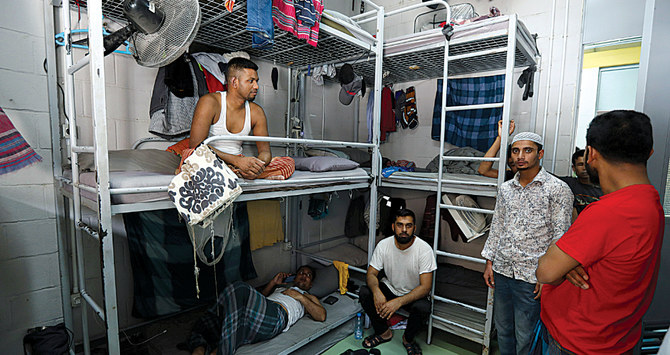
Migrant workers from Bangladesh, working for waste management company RAMCO, inside their dormitory at a company facility in Biakout, near Beirut, Lebanon. The dollar crisis has affected migrant labor especially badly in Lebanon. (Reuters)
Short Url
Updated 23 May 2020
Follow

Lebanon’s dollar crisis hits migrants workers

  • International labor force bears the brunt of Beirut’s economic woes, as the economy reels from currency and virus crises

BEIRUT: Temitope cannot find work in Lebanon since the Nigerian domestic worker escaped her employer’s house last month.

With Lebanon in deep financial crisis and dollars in short supply, people have less money to spend on help. And with Beirut airport shut under a coronavirus lockdown, Temitope can’t go back home even if she tries.

“I’m very afraid. There’s not a day that I don’t cry ... without any money even to eat now,” said Temitope, who climbed down a building after her employer beat her until she bled. She now lives with friends, relying on any cash they can give her.

Like many African and Asian women in Lebanon, Temitope, a mother of two, was recruited for work and came so she could send money home to her family.

But dollar shortages piling pressure on hundreds of thousands of migrant workers in Lebanon have left some stranded in the streets and many begging to go home. Rights groups warn this puts workers at risk of abuse and trauma.

Embassy and NGO shelters are saturated.

Since Lebanon plunged into crisis late last year, the local currency has lost more than half its value. Prices have soared as more Lebanese slide into poverty.

The coronavirus pandemic has also hampered government efforts to repatriate workers via their embassies, and even those flights require payment in dollars.

“There’s more need than ever before for shelters...for those who lost jobs and have no place else to go,” said Zeina Mezher of the International Labour Organization.

Activist groups say they field regular phone calls from unpaid domestic workers who have been kicked out of their accomodation or escaped their employer’s households.

Migrant workers form the backbone of sectors like waste collection and housekeeping in Lebanon, where many barely have any rights, face widespread racism and sometimes commit suicide.

Most women work as maids under a sponsorship system called “kafala” that even the former labor minister likened to slavery. It prevents them from leaving without the employer’s consent, with salaries as low as $150 a month.

Last month, police interrogated a Lebanese man who tried to sell his Nigerian housekeeper for $1,000 on the social media site Facebook.

“The crises, whether it’s coronavirus or the economy, expose the flaws in the kafala system,” Mezher said.

The prime minister’s wife sparked controversy last week when she called on Lebanese people facing rising unemployment to take up jobs usually filled by foreigners like housekeeper or doorman.

Bangladeshi trash collectors went on strike for weeks after the firm managing waste in Beirut, RAMCO, switched to paying them in Lebanese pounds, undermining the value of their wages.

When workers stopped garbage trucks from going out in protest last week, riot police arrived, firing smoke grenades at some and beating up others.

Mohamad Ilahi, one of the workers, has not sent money to his wife and two daughters in Bangladesh for months. “My family cries a lot,” he said. “They can’t pay school fees, and can’t buy enough food.”

He said RAMCO had agreed to a pay raise in local currency.

RAMCO manager Walid BouSaad said the company had no choice because the Lebanese state, its main customer, had stopped paying in dollars late last year, on top of millions the government already owed in arrears. “It is the worker’s right to ask for payment in dollars,” he said. “But some things are out of our hands.”

For Ilahi, the future in Lebanon remains uncertain. “I want to work. But without a solution, there’s no use for me here,” he said. “I will want to leave then. All of us will.” 


Saudi non-oil exports jump 21% as trade balance improves: GASTAT 

Updated 5 sec ago
Follow

Saudi non-oil exports jump 21% as trade balance improves: GASTAT 

RIYADH: Saudi Arabia’s non-oil exports, including re-exports, rose 20.7 percent year on year in November to SR32.69 billion ($8.72 billion), official data showed. 

According to preliminary figures released by the General Authority for Statistics, national non-oil exports, excluding re-exports, increased by 4.7 percent in November compared with the same month in 2024. 

The strong performance highlights progress under the Kingdom’s Vision 2030 strategy, which aims to diversify the economy and reduce its long-standing dependence on crude oil revenues. 

In its latest report, GASTAT stated: “The ratio of non-oil exports, including re-exports, to imports increased in November 2025, reaching 42.2 percent, compared with 34.9 percent in November 2024. This increase was driven by a 20.7 percent rise in non-oil exports, alongside a 0.2 percent decline in imports over the same period.”  

It added: “The value of re-exported goods increased by 53.1 percent during the same period, driven by an 81.9 percent increase in ‘machinery, electrical equipment and parts’, which accounted for 51.5 percent of total re-exports.”  

Machinery, electrical equipment and parts also led the non-oil export basket, making up 24.2 percent of outbound shipments and recording an 81.5 percent annual increase. This was followed by products of the chemical industries, which represented 20.3 percent of total non-oil exports and rose 0.5 percent year on year. 

The data adds to signs of resilience in Saudi Arabia’s non-oil economy, with S&P Global’s Purchasing Managers’ Index at 57.4 in December, well above the 50 threshold that separates expansion from contraction. 

Top non-oil destinations 

The UAE was the leading destination for Saudi non-oil exports in November, with shipments valued at SR10.48 billion. 

India ranked second at SR3.01 billion, followed by China at SR2.32 billion, Singapore at SR1.76 billion and Bahrain at SR900.7 million. 

Exports to Egypt totaled SR815.5 million during the month, while Turkiye and Jordan received goods worth SR799.1 million and SR773.3 million, respectively. 

GASTAT said ports and airports played a central role in facilitating non-oil shipments in November. 

By sea, Jeddah Islamic Seaport handled the largest volume of non-oil exports at SR3.57 billion, followed by King Fahad Industrial Seaport in Jubail at SR3.51 billion. 

Ras Al-Khair Seaport was the exit point for non-oil goods valued at SR2.66 billion, while Jubail Seaport and King Abdulaziz Seaport in Dammam handled outbound shipments worth SR2.32 billion and SR2.14 billion, respectively. 

By air, King Abdulaziz International Airport handled goods worth SR5.60 billion, while King Khalid International Airport in Riyadh processed exports valued at SR3.53 billion. 

Exports and imports 

Saudi Arabia’s total merchandise exports reached SR99.73 billion in November, representing a 10 percent increase compared with the same month in 2024. 

“Merchandise exports in November 2025 increased by 10.0 percent compared to November 2024, and oil exports increased by 5.4 percent. The percentage of oil exports in total exports declined from 70.1 percent in November 2024 to 67.2 percent in November 2025,” GASTAT added.  

China remained the Kingdom’s largest export destination, accounting for 13.5 percent of total exports, followed by the UAE at 11.7 percent and Japan at 9.9 percent. India, South Korea, the US, Egypt, Singapore, Bahrain and Poland were also among the top 10 destinations, which together accounted for 71.4 percent of total exports. 

Imports declined by 0.2 percent year on year in November to SR77.38 billion, while the merchandise trade surplus surged by 70.2 percent, the report showed. 

China was the Kingdom’s largest source of imports, accounting for 26.7 percent of inbound shipments, followed by the US at 10.2 percent and the UAE at 6.2 percent.  

“Germany, Japan, India, Italy, France, Switzerland, and Egypt were also among the top ten import sources, with total imports from these ten countries representing 68.6 percent of Saudi Arabia’s overall imports,” added GASTAT.  

King Abdulaziz Port in Dammam was the leading entry point for goods, handling 22.8 percent of imports in November. Jeddah Islamic Port followed with 22.6 percent, ahead of King Khalid International Airport in Riyadh at 17 percent and King Abdulaziz International Airport in Jeddah at 11.9 percent.