Khyber Pakhtunkhwa faces flour shortage as mills shut down

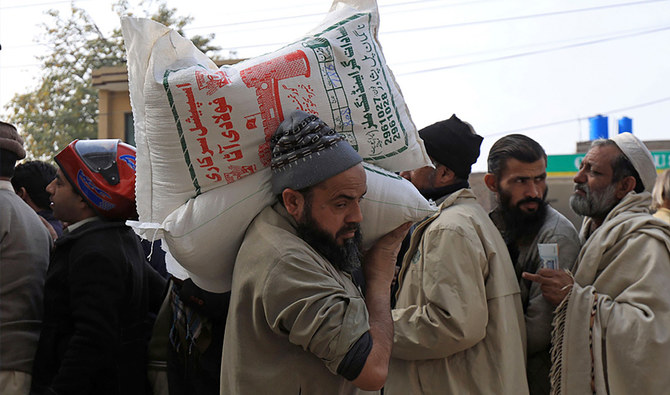
In this file photo, a man carries sacks of flour on his shoulder, while others stand in queue to purchase from a truck along a road in Peshawar on Jan. 20, 2020. (REUTERS)
Short Url
Updated 19 May 2020
Follow

Khyber Pakhtunkhwa faces flour shortage as mills shut down

  • Mills say the situation is already affecting the livelihoods of thousands of their workers
  • Punjab government says grain supplies to KP will resume in coming days

PESHAWAR: Mills in Khyber Pakhtunkhwa (KP) shut operations on Monday and their owners are warning that a flour crisis is looming, as grain supplies from Punjab have stopped.
“Punjab has totally banned wheat supplies to KP. The provincial food department has slashed wheat supply to only 3,000 tons daily ... It will trigger a flour crisis,” Muhammad Iqbal, chairman of the KP chapter of Pakistan Flour Mills Association (PFMA), told Arab News on Monday.
He added that in accordance with earlier interprovincial deals, Punjab should supply 12,000 tons of wheat a day to KP, which means that the province is now facing a daily shortage of 9,000 tons.
According to Punjab authorities, however, the suspension is only temporary as the province is now struggling to meet its target of 4.5 million tons, but will get back on the track in the coming days.
“The Punjab food authority has so far procured 3.8 million tons of wheat and the rest will be procured in a few days. We’ve already directed all flour mills not to keep wheat stock for more than three days. The completion of the procurement process by the government of Punjab will set the process of wheat supply in motion to other provinces, including KP, in the next three or four days,” Punjab government spokeswoman Musarrat Cheema told Arab News on Monday evening.
Meanwhile, KP mills say the situation is already affecting their operations and the livelihoods of thousands of their workers. He alleged that the government is failing to notice the issue.
“At least 120 laborers work in one flour mill and each person has a seven-member family at home. It means that mills closure leaves around 200,000 individuals affected directly,” Iqbal said, adding that 180 out of the province’s 220 mills are now shut.
“We have spent billions of rupees on flour mills and are paying millions in taxes, but in return we are pushed into a blind street,” Iqbal said.
His warnings that a flour crisis is looming have been downplayed by KP Food Secretary Nisar Ahmed, who said that everything will soon get back to normal since the harvest season has already started and Punjab’s wheat procurement is ongoing.
“How can you expect a wheat crisis at a time when wheat harvest season is underway in parts of the country? We will have a surplus stock after crops harvesting,” he said, “It is like creating unsubstantiated rumors about wheat crisis. There is no ban on wheat supply.”


Pakistan, China to sign multiple MoUs at major agriculture investment conference today

Updated 18 January 2026
Follow

Pakistan, China to sign multiple MoUs at major agriculture investment conference today

  • Hundreds of Chinese and Pakistani firms to attend Islamabad event
  • Conference seen as part of expanding CPEC ties into agriculture, trade

KARACHI: Islamabad and Beijing are set to sign multiple memorandums of understanding (MoUs) to boost agricultural investment and cooperation at a major conference taking place in the capital today, Monday, with hundreds of Chinese and Pakistani companies expected to participate.

The conference is being billed by Pakistan’s Ministry of National Food Security and Research as a platform for deepening bilateral agricultural ties and supporting broader economic engagement between the two countries.

“Multiple memorandums of understanding will be signed at the Pakistan–China Agricultural Conference,” the Ministry of National Food Security said in a statement. “115 Chinese and 165 Pakistani companies will participate.”

The conference reflects a growing emphasis on expanding Pakistan-China economic cooperation beyond the transport and energy foundations of the flagship China-Pakistan Economic Corridor (CPEC) into agriculture, industry and technology.

Under its first phase launched in 2015, CPEC, a core component of China’s Belt and Road Initiative, focused primarily on transportation infrastructure, energy generation and connectivity projects linking western China to the Arabian Sea via Pakistan. That phase included motorways, power plants and the development of the Gwadar Port in the country's southwest, aimed at helping Pakistan address chronic power shortages and enhance transport connectivity.

In recent years, both governments have formally moved toward a “CPEC 2.0” phase aimed at diversifying the corridor’s impact into areas such as special economic zones, innovation, digital cooperation and agriculture. Second-phase discussions have highlighted Pakistan’s goal of modernizing its agricultural sector, attracting Chinese technology and investment, and boosting export potential, with high-level talks taking place between planning officials and investors in Beijing.

Agri-sector cooperation has also seen practical collaboration, with joint initiatives examining technology transfer, export protocols and value-chain development, including partnerships in livestock, mechanization and horticulture.

Organizers say the Islamabad conference will bring together government policymakers, private sector investors, industry associations and multinational agribusiness firms from both nations. Discussions will center on investment opportunities, technology adoption, export expansion and building linkages with global buyers within the framework of Pakistan-China economic cooperation.